
AI agents do more of the work in model development, but humans still make the decisions
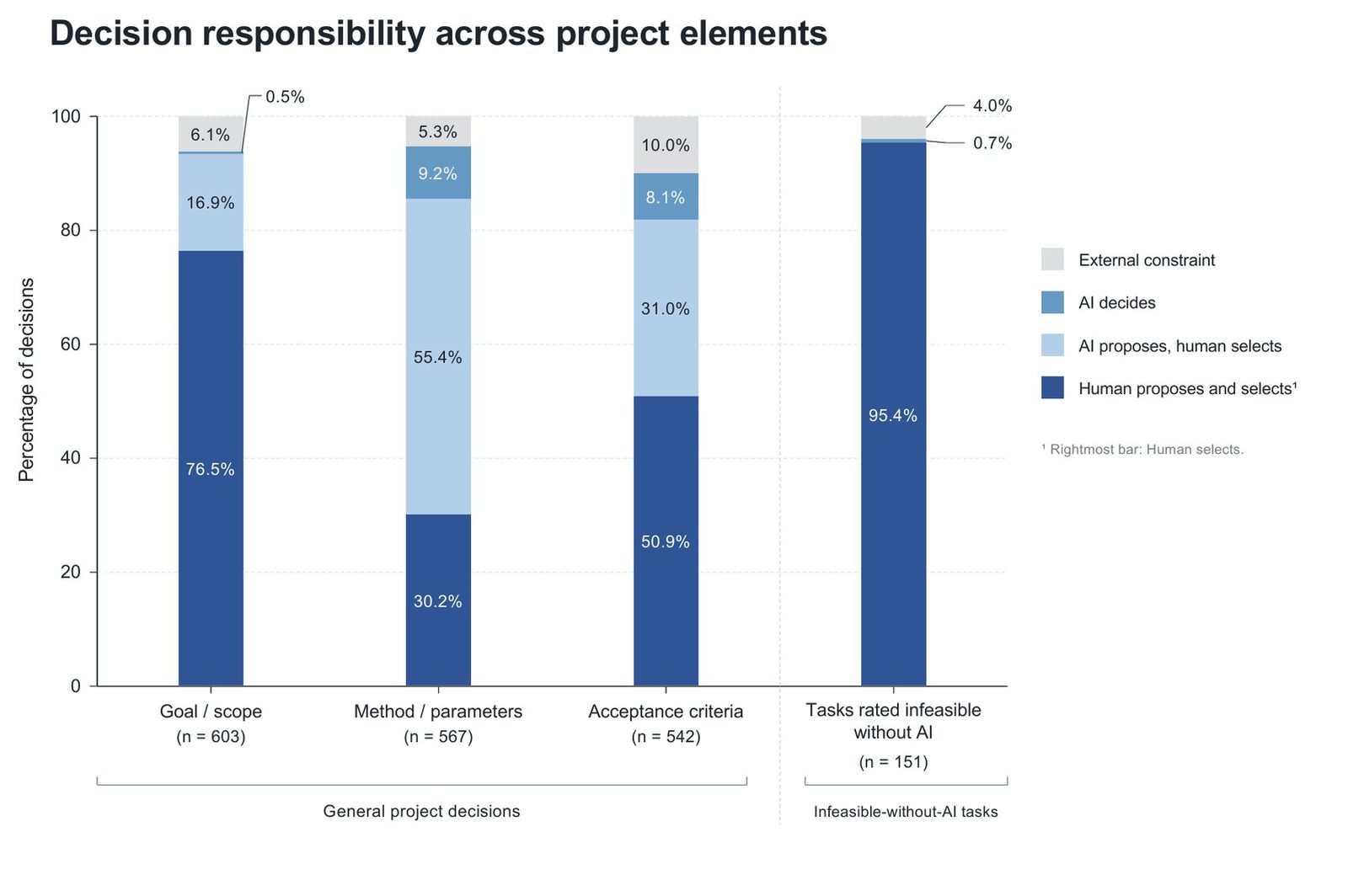
A team from Fudan University analyzed more than 700 task logs from its own model-building project: AI was used in 96.5 percent of the tasks, yet humans made 85.5 percent of decisions on methods and 93.4 percent on goals and scope.
Researchers from China's Fudan University studied their own project to see who really makes the decisions when AI agents help build an AI model, analyzing more than 700 task logs from 56 participants.
The project produced Atria Dawn Preview, an agentic language model with a mixture-of-experts architecture and 744 billion parameters. Every training task is tied to a real execution environment and checked against tests, metrics or source evidence. It leads on five of 16 benchmarks, including web search and cybersecurity, but has no overall edge over competitors, the team says.
Agents take on more of the work
AI was used in 96.5 percent of the reviewed tasks. Over four weeks, the median number of agent actions per human input rose from 11 to 28.5, a figure the team warns against reading as growing autonomy: each human decision just triggered more agent steps.
Participants also rated whether they could have done their share of a task without AI. Of 455 completed AI-assisted tasks, 151, roughly a third, were infeasible without it, spread across 27 of the 56 participants. AI enabled work that would never have been started.
AI proposes, humans choose
For methods and parameters, the most common pattern was "AI proposes, human selects," at 55.4 percent. Humans made 85.5 percent of decisions there against AI's 9.2 percent, and had the final say on goals and scope in 93.4 percent of cases.
The same pattern holds when things go wrong. Of 588 tasks with a recorded difficulty, 76 percent advanced through human intervention and 23 percent were solved by the agent alone, with help coming mostly as added context (35.2 percent) or diagnosis (34.7 percent) rather than hands-on work.
The rubber-stamp risk
When every decision rests on a longer chain of agent work than any human can review, oversight gets hard; in the worst case, people become reviewers who can only rubber-stamp what they see, the team writes. Many participants ran agents in autonomous modes out of convenience, not by a deliberate choice about AI's authority.
The paper lands amid a debate about recursive self-improvement: Anthropic considers an AI that develops its own successor possible sooner than expected, and CEO Dario Amodei is calling for a speed limit for the industry, while over a thousand employees at leading AI companies warned that their organizations may be about to automate AI research.
SiTech — AI-powered web development
We build fast, modern websites and bring AI into real business workflows. Have a project or a question? We'd love to help.