
New CESifo paper finds no widespread AI displacement of recent US graduates
A working paper by economists Robert Fairlie and Jane Wu at Munich's CESifo finds no statistically significant rise in unemployment among recent US college graduates through summer 2026.
Last month Ars Technica reported on a Stanford University study that found entry-level employment lagging in "AI-impacted" occupations. A new working paper from economists at Munich's CESifo reaches the opposite conclusion.
Researchers Robert Fairlie and Jane Wu write that "there is no evidence of any significant, widespread displacement or reduction in hiring of recent college graduates in absolute or relative levels."
What the unemployment data shows
The authors analysed microdata from the US Census Bureau's Current Population Survey, tracking Bachelor's degree holders aged 22 to 25 who were not pursuing higher degrees. Because youth unemployment rises every summer as graduates enter the market, the team compared seasonal trends back to 2022, the year employment returned to pre-pandemic levels and ChatGPT was released.
In summer 2026 the unemployment rate for those graduates was 7.3%, within the range recorded since 2022: 6.3% that year and 7.8% in 2024. The figure stayed unremarkable when the measure was widened to include graduates who wanted a job but were not actively searching.
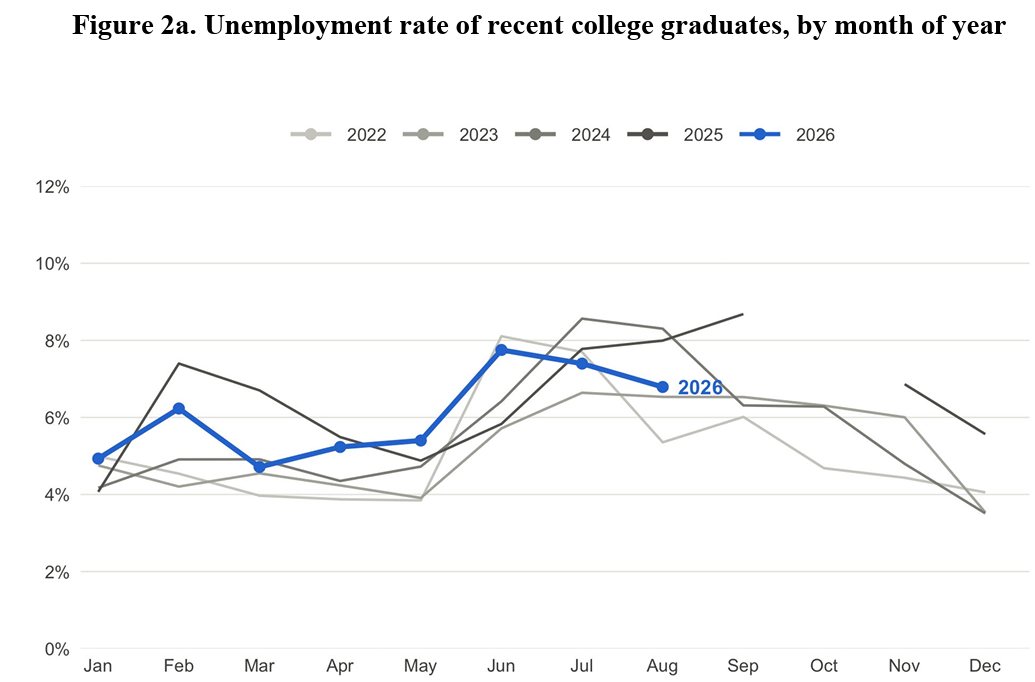
The team also compared recent graduates with non-graduates of the same age and with graduates aged 30 to 49, and split employment by potential "AI exposure." In almost every comparison, differences between the groups over 2022-2026 were not statistically significant.
Why it differs from the Stanford study
Stanford's analysis drew on payroll data from HR firm ADP, which covers a broad cross-section of the economy but may miss elements of a wider Census survey. It also measures the supply of jobs in each field, while the unemployment rate reflects demand as well.
A useful first test, not a verdict
The researchers call the summer 2026 figures a "useful first test" of whether accelerating AI adoption is reshaping the US labor market. They warn that if workplace AI use keeps intensifying, the graduating classes of 2027 and later might be more affected than the class of 2026.
The paper notes that the concern was not purely theoretical: BlackRock CEO Larry Fink warned in March that this year's graduates could see the highest unemployment rate in years "even without a recession."
SiTech — AI-powered web development
We build fast, modern websites and bring AI into real business workflows. Have a project or a question? We'd love to help.