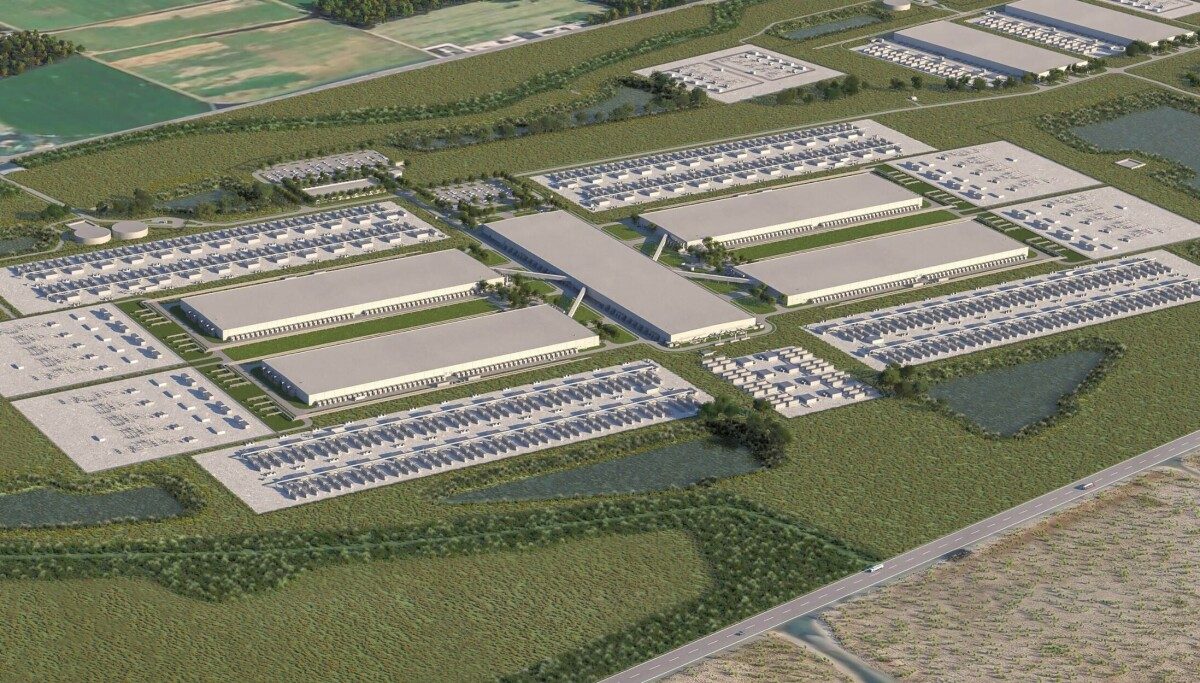
America is planning more AI datacenters than its chip supply can fill
Satellite imagery shows US AI datacenter construction accelerating, but permitting, power access and advanced chip packaging capacity are capping how fast new capacity can come online.
US AI datacenter construction is accelerating but not fast enough to match the more ambitious forecasts for 2028, according to analysis of satellite imagery. Advanced chip packaging is now a second constraint on how quickly new AI capacity can come online.
A report from investment bank Jefferies says server farm construction is proceeding apace across America, but permitting, power access and supplies of packaged AI accelerators continue to hold projects back.
What the satellite data shows
The report cites analytics firm SynMax, which uses weekly satellite imagery to track land clearing and construction progress at datacenter sites, separating projects actually advancing from those merely announced.
SynMax estimates US deployments will rise from roughly 11 GW of gross capacity in 2025 to 16-18 GW in 2026, above its previous forecast of 14-16 GW, and puts the practical 2027 limit in the low 20s of gigawatts.
Land clearing for new projects has nevertheless plateaued, well short of the pace needed for the more than 80 GW implied by announced pipelines and chip models for 2028. A previous Jefferies report found only half the capacity scheduled for 2026 under construction, with work yet to start on 80 percent of the 2028 pipeline.
Packaging as the new bottleneck
Jefferies identifies advanced packaging as another emerging constraint. Fabricating enough accelerator dies is only part of the job: they must be packaged with components such as high-bandwidth memory before servers can use them. Packaging combines multiple dies and memory components using high-density connections, and even chips made on US soil may need to be packaged in Taiwan.
SynMax estimates existing packaging capacity could support accelerators drawing roughly 13 GW of gross power, which after CPUs, memory and cooling works out to about 17.5 GW of total power. Two more packaging projects due online in 2027 could add another 6 GW, taking the practical ceiling back into the low 20s.
Texas, Virginia and grid access
Development is concentrated in Texas and Virginia, so national figures are vulnerable to delays in either market. Jesse Gossett, a former developer and member of the Electric Reliability Council of Texas (ERCOT) large-load working group, told Jefferies that 99 percent uptime could be viable if curtailment were predictable enough to model, insure or cover with backup. Datacenters can handle planned curtailment lasting an hour or two, he argued, but not an instruction issued on five minutes' notice.
The warning is not new: last year London Economics International concluded that if every US datacenter project forecast for 2025-2030 went ahead, it would need 90 percent of all growth in global AI chip supply.
SiTech — AI-powered web development
We build fast, modern websites and bring AI into real business workflows. Have a project or a question? We'd love to help.