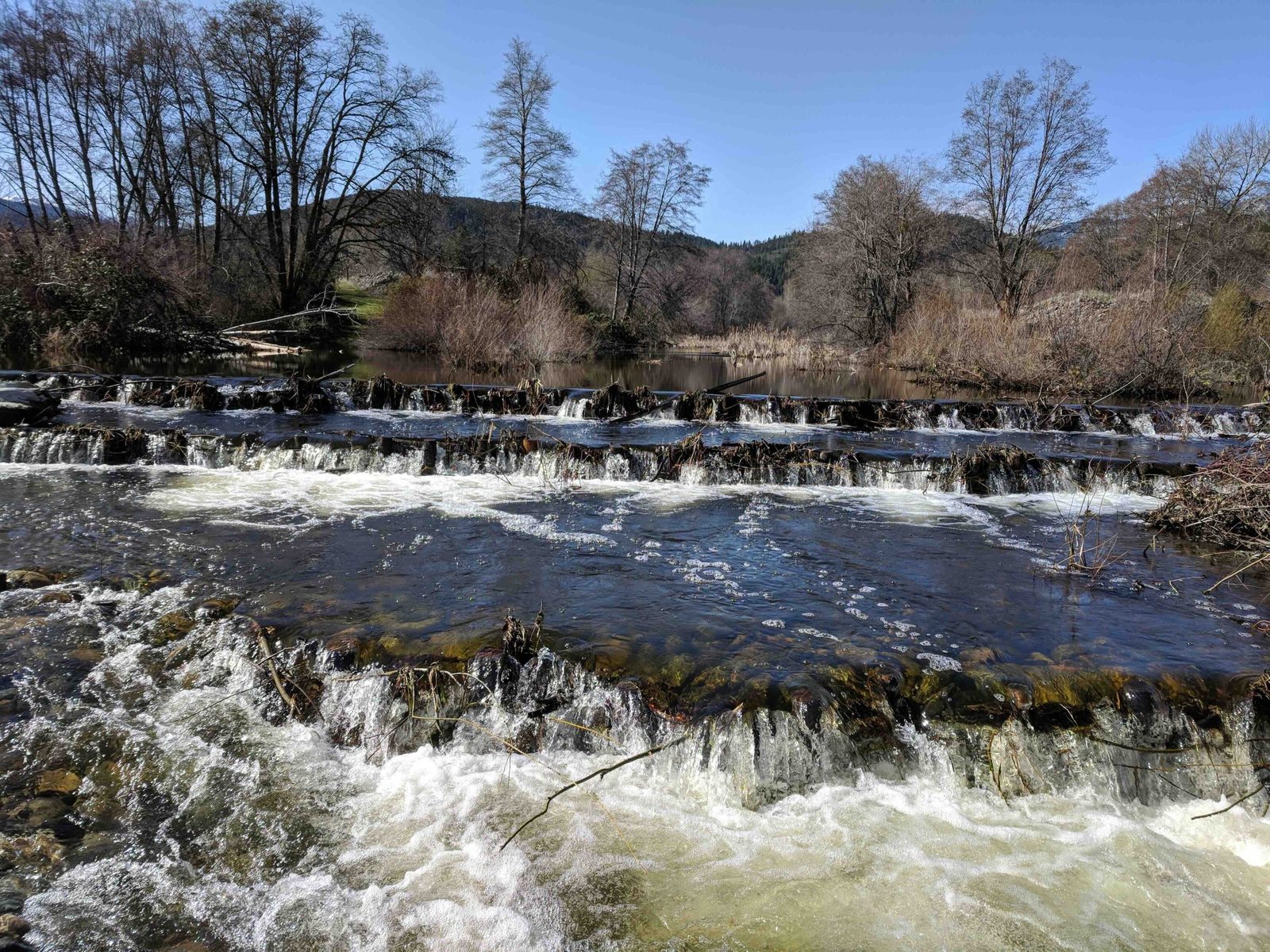
Artificial beaver dams in California raised juvenile coho salmon survival from 8% to 60%
With beavers nearly gone, a California watershed council built dams out of posts, willow branches and mud. A new study says the structures cooled the water and lifted juvenile coho survival from 8% to 60%.
The valley that lost its beavers
The Scott River valley in northern California was once home to so many beavers that it was known as Beaver Valley. Their dams created an enormous riverine wetland that served as habitat for juvenile coho salmon and a host of other wildlife. Then European fur trappers arrived in the 1830s. Thousands of beavers were trapped and killed, and with the dams gone much of the wetland disappeared, taking with it the cold, slow-moving water that young coho favour.
Wooden posts, willow branches and mud
In 2015 the nonprofit Scott River Watershed Council built two artificial dams on a tributary called Sugar Creek. Wooden posts were hammered into the streambed, interwoven with willow and conifer branches, then the gaps were plugged with gravel, straw and mud. Three years later several more dams were built on another tributary, French Creek. From time to time the remaining beavers even chipped in, repairing, modifying and sometimes expanding the dams. "When beavers do adopt a structure, their work is far superior to what we can accomplish," says Charnna Gilmore of the watershed council.
Results a fish biologist calls mind blowing
The artificial dams held. Together they created around 9,000 square metres of new habitat with the capacity to support more than 8,500 young salmon. Compared with areas where no new dams were built, the water in the restored habitats stayed cooler, avoiding temperatures known to stress the fish and slow their growth. In French Creek, juvenile coho survival rates rose from 8% before the dams were built to 60% afterwards — the figure that led fish biologist Michael Pollock of NOAA's Northwest Fisheries Science Center to call the findings "mind blowing".
Two years after the first dams went in, more salmon were returning to the Scott River than to any of the other rivers monitored in the study, and returns there stayed healthy even during severe drought while numbers elsewhere remained low. The study is published in Frontiers in Ecology and Evolution. Pollock's own reading of the work is that the artificial dams have helped people remember what the beaver can do and how central the animal is to the health of stream ecosystems. "But beavers can only thrive if landowners allow them to," he adds.
SiTech — AI-powered web development
We build fast, modern websites and bring AI into real business workflows. Have a project or a question? We'd love to help.