
Backblaze Q2 2026 drive stats: annualized failure rate climbs to 1.73%
Backblaze's Q2 2026 Drive Stats report counted 354,415 hard drives with a 1.73% quarterly failure rate, while the lowest rates came from modern 22TB and 24TB models. It also explains what CMR, SMR and HAMR mean for storage buyers.
Backblaze published its quarterly Drive Stats report on September 29. It covers April 1 through June 30, 2026: the company monitored 359,101 drives, then set aside 3,881 boot drives and 705 hard drives that failed its criteria, leaving 354,415 in the analysis.
Quarterly failure rate hits 1.73%
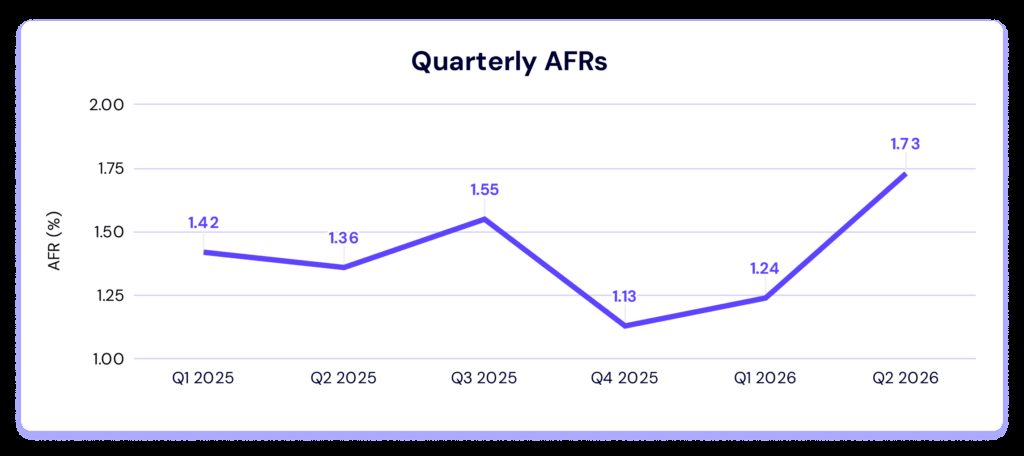
The quarter produced 1,498 failures over 31,553,350 drive days, for an annualized failure rate (AFR) of 1.73%, the highest in recent quarters. Ten of the 31 models posted an AFR above 3.0%.
Three models stood well above the rest: HGST HUH721212ALN604 (12TB) at 7.63%, Seagate ST10000NM0086 (10TB) at 9.33% and Seagate ST14000NM0138 (14TB) at 8.26%. Backblaze attributes the numbers to age: the HGST drive is nearly seven years old, the 10TB Seagate about eight and a half, and both Seagate models carry just 965 and 1,235 drives, so 22 and 25 failures still translated into high rates.
The best result in the table belongs to the Western Digital WUH722222ALE6L4 (22TB) at 0.55%, followed by Toshiba's MG11ACA24TE (24TB) at 0.58%. Seagate swept the zero-failure list with the ST8000NM000A (8TB), ST12000NM000J (12TB) and ST14000NM000J (14TB).
Lifetime AFR holds at 1.41%
The fleet's lifetime AFR came in at 1.41%, across 353,041 drives and 21,609 failures. Drives of 20TB and above now account for more than 25% of the dataset, confirming that deployment keeps shifting toward higher capacities.
Backblaze retired two older models during the quarter: the 4TB HGST HMS5C4040BLE640, nearly nine years old, and the 8TB HGST HUH728080ALE600, nearly eight. No new models arrived for a second consecutive quarter. Western Digital announced a 40TB UltraSMR drive this year and a roadmap toward 100TB by 2029.
What CMR, SMR and HAMR mean for buyers
A large part of the report is devoted to recording technology. In CMR drives, magnetic tracks sit side by side with guard space between them; in SMR they overlap like roof shingles. Because a drive's write head lays down a wider track than its read head needs, the overlap stays readable and fits 10% to 25% more capacity per platter. Updating data in the middle can disturb what sits above it, so SMR organizes tracks into bands or zones. Backblaze lists three variants: drive-managed, host-managed and host-aware. HAMR instead heats a microscopic spot on the platter with a laser.
Backblaze's fleet contains no SMR drives today, though the company says it will flag them as they arrive. The practical read for storage buyers: AFR only makes sense alongside drive age and sample size, the newest 20TB-and-up models post the lowest rates, and an SMR drive suits sequential writes while frequent small rewrites do not.
SiTech — AI-powered web development
We build fast, modern websites and bring AI into real business workflows. Have a project or a question? We'd love to help.