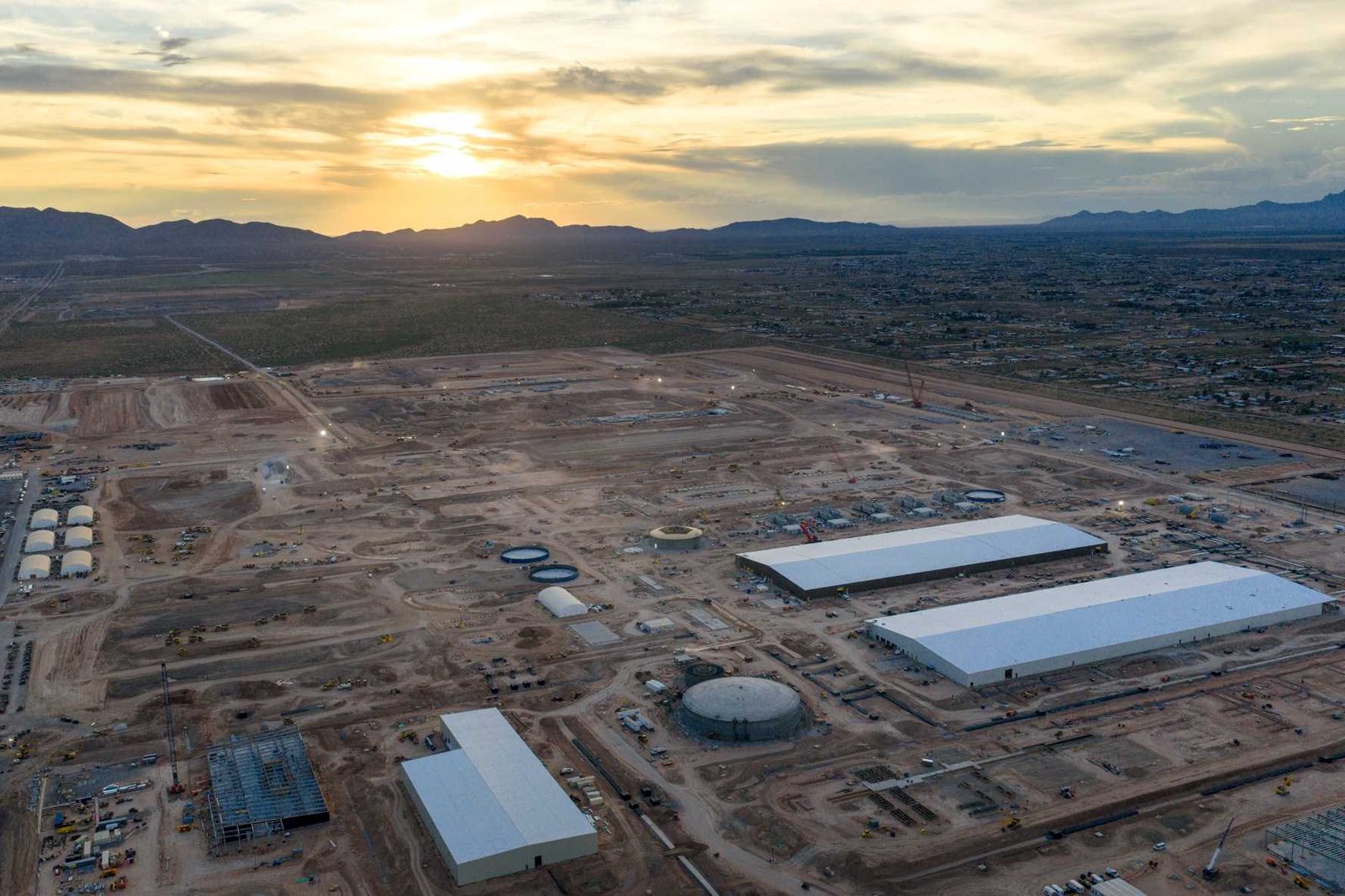
Brookings: US AI infrastructure spending to reach $10.3 trillion by 2032
A new Brookings paper estimates about $10.3 trillion of US AI infrastructure investment over 2025–2032, an average of 3.63% of GDP a year, as financing shifts off corporate balance sheets.
Investment in US artificial-intelligence infrastructure — data center buildings, power systems, networking equipment and specialized chips — will total about $10.3 trillion between 2025 and 2032, according to a new Brookings paper, an average of 3.63% of US GDP a year.
Bigger than the railroad and highway booms
The paper, “Financing the AI Buildout,” is a Brookings Papers on Economic Activity conference draft. Its author, Stijn Van Nieuwerburgh of Columbia University, projects annual investment averaging 3.63% of GDP — above the railroad boom (2.24%), the highway era (1.13%) and the telecom and fiber boom (1.10%).
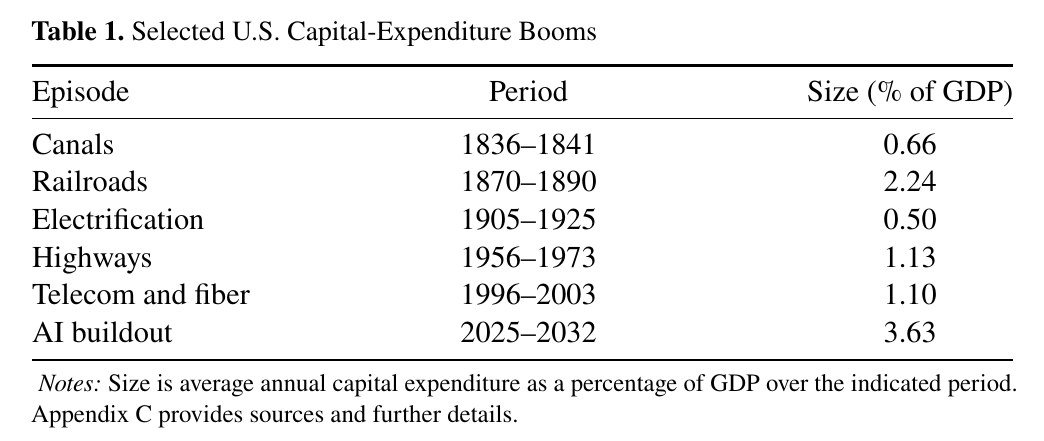
In the central scenario, about 183 GW of new US data center capacity comes online by 2032. A representative 200 MW AI campus costs roughly $8.2 billion, and the full buildout would roughly double the electricity consumption of the entire US residential sector.
Capex outgrows cash flow
Combined capital expenditures by Oracle, Microsoft, Amazon, Meta and Alphabet climbed from about $97 billion in 2020 to more than $400 billion in 2025 and are projected to exceed $800 billion in 2026 — surpassing their combined operating cash flow for the first time.
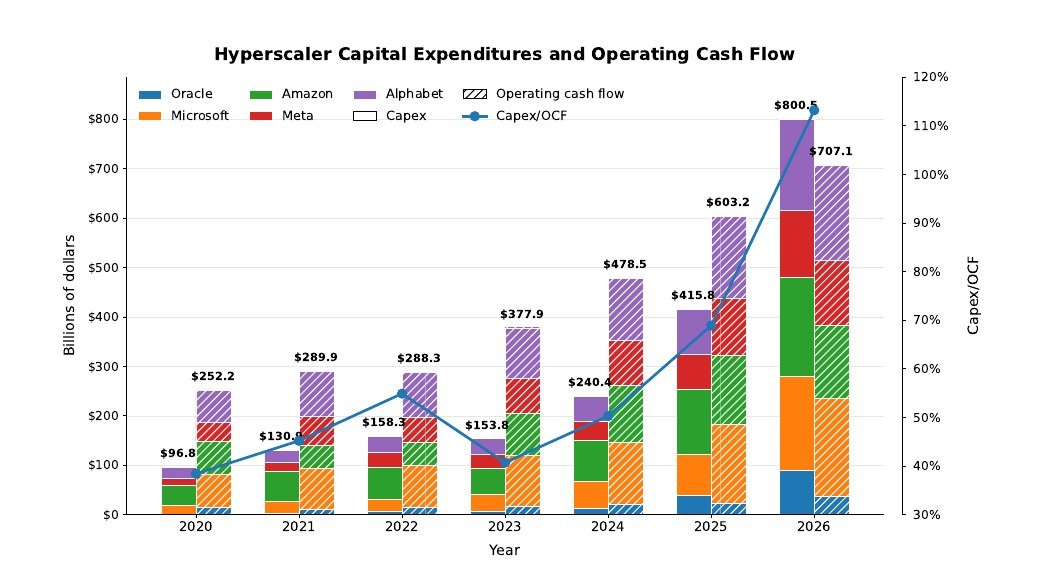
The gap is pushing financing toward leases, joint ventures, project debt, private credit, securitization and special-purpose vehicles. Morgan Stanley estimates that more than half of the roughly $2.9 trillion needed over 2025–2028 will come from outside capital.
Risk moves off the balance sheet
Meta’s Hyperion project, about 2 GW and $30 billion, shows how these structures work: Meta sold an 80% stake to Blue Owl, and the resulting joint venture, Beignet, issued $27 billion of bonds in October 2025. Debt covers about 90% of the asset value.
Van Nieuwerburgh warns that risk is migrating from transparent on-balance-sheet financing to opaque structures whose repayment depends on AI demand and the credit quality of a small number of tenants. Moody’s counts about $970 billion in hyperscaler lease commitments, $660 billion of it not yet on balance sheets. The paper argues it would be “premature” to call AI infrastructure a systemic risk; the priority now is better measurement and transparency while the industry’s capital structure is still evolving.
SiTech — AI-powered web development
We build fast, modern websites and bring AI into real business workflows. Have a project or a question? We'd love to help.