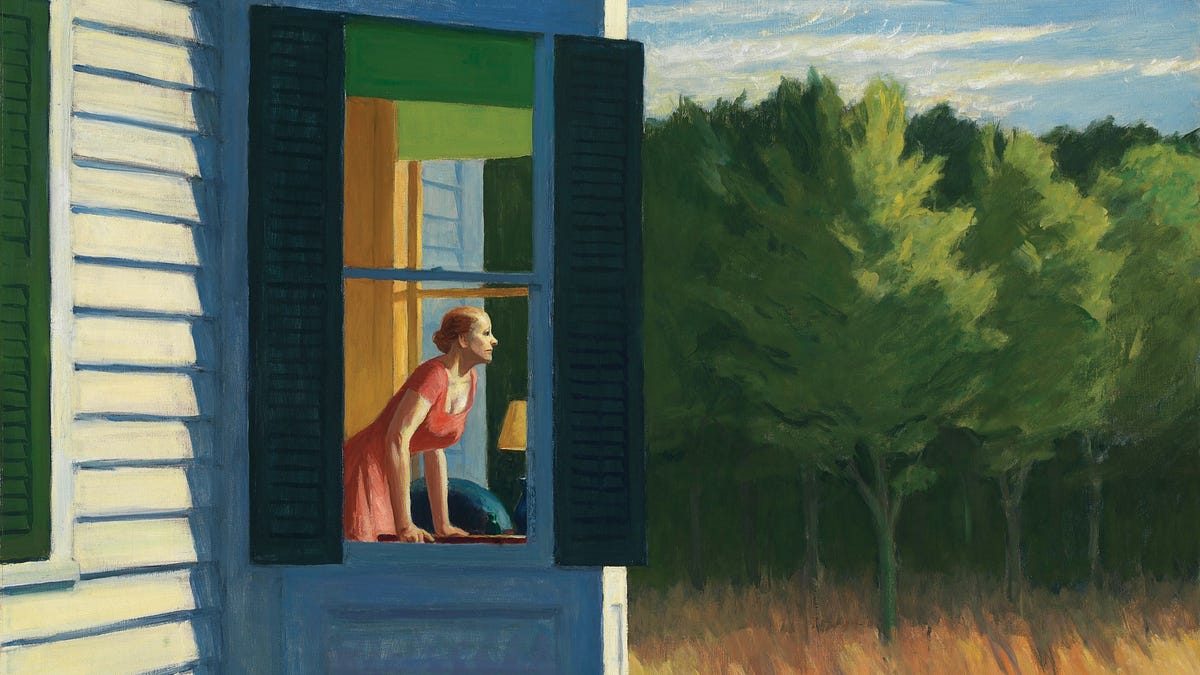
Solitude as a state of mind: how new ideas are born
Henrik Karlsson argues that the solitude creative people describe is not physical isolation but a mental state that must be cultivated — and reads the notebooks of Grothendieck and Bergman to show how.
Why does a person sitting alone in a room sometimes produce better ideas than a motivated team? In Henrik Karlsson's essay "Cultivating a state of mind where new ideas are born" (2023), the answer is both literary and practical: the solitude creative people describe is not physical isolation, but a state of mind — one that can be learned and protected.
Fragile ideas and their killers
In the early 2010s, startup incubators tried thousands of times to give founders coworking spaces and shared living so their ideas could percolate among peers. There are no famous success stories. In 2015 Sam Altman, then president of Y Combinator, wrote in response that not providing such spaces "is part of what makes YC work". In a 2019 interview with Tyler Cowen he explained why: great ideas are fragile and easy to kill; in a room where people laugh, a founder swaps a larval idea for something plausible that will never matter. Such a filter, he said, kills off the best ideas along with the worst. Pablo Picasso, James Baldwin and Bob Dylan said much the same.
Grothendieck: the capacity to be alone
To describe that state, Karlsson and his partner Johanna read the working notes of the mathematician Alexander Grothendieck and the film director Ingmar Bergman. In June 1983 Grothendieck began a preface to a mathematical manuscript called Pursuing Stacks. He was troubled by the cult of finished theorems: mathematics, he felt, was losing the dreamlike state in which genuinely original work arises. The preface took him 29 months, was finished in October 1986 and, by some accounts, runs past 2,000 pages. In the notes he recalls the three years he spent in Montpellier aged 17 to 20, where without mentors he reinvented results he later learned were already known; that "wasted time" gave him the capacity to be alone. His advantage, the author argues, lay in surfacing questions rather than answering them.
Bergman's workbooks and "going sub-Bergman"
Ingmar Bergman kept workbooks from 1955 to 2001, starting around The Seventh Seal, in which Max von Sydow plays chess against Death, and ending after the script for Saraband. At the height of his career he wrote in the book for three hours every day, from 9 to 12, stopping mid-sentence when the clock struck. Karl Ove Knausgaard has argued that to create, Bergman had to "go sub-Bergman" — down to the place in the mind where no name exists and nothing is yet nailed down; the workbook was exactly that zone, free of censorship, especially self-censorship.
Why it matters
The essay offers no simple recipe — only a handful of approaches: a long delay between making the work and showing it, rituals, treating the work as a religious service, and collaborators who push against the expected. Its central observation: this state does not appear at the centre of society but at the margin, and almost everything that makes our world possible came from there first.
SiTech — AI-powered web development
We build fast, modern websites and bring AI into real business workflows. Have a project or a question? We'd love to help.