DeepMind researchers propose "Artificial Symbiotic Intelligence" as an alternative to the singularity
Google-affiliated researchers argue in a new DeepMind Institute essay that AGI will emerge from a social system of people and AI agents rather than a lone superintelligence, and propose "Artificial Symbiotic Intelligence" as the name for that vision.
A social path to AGI
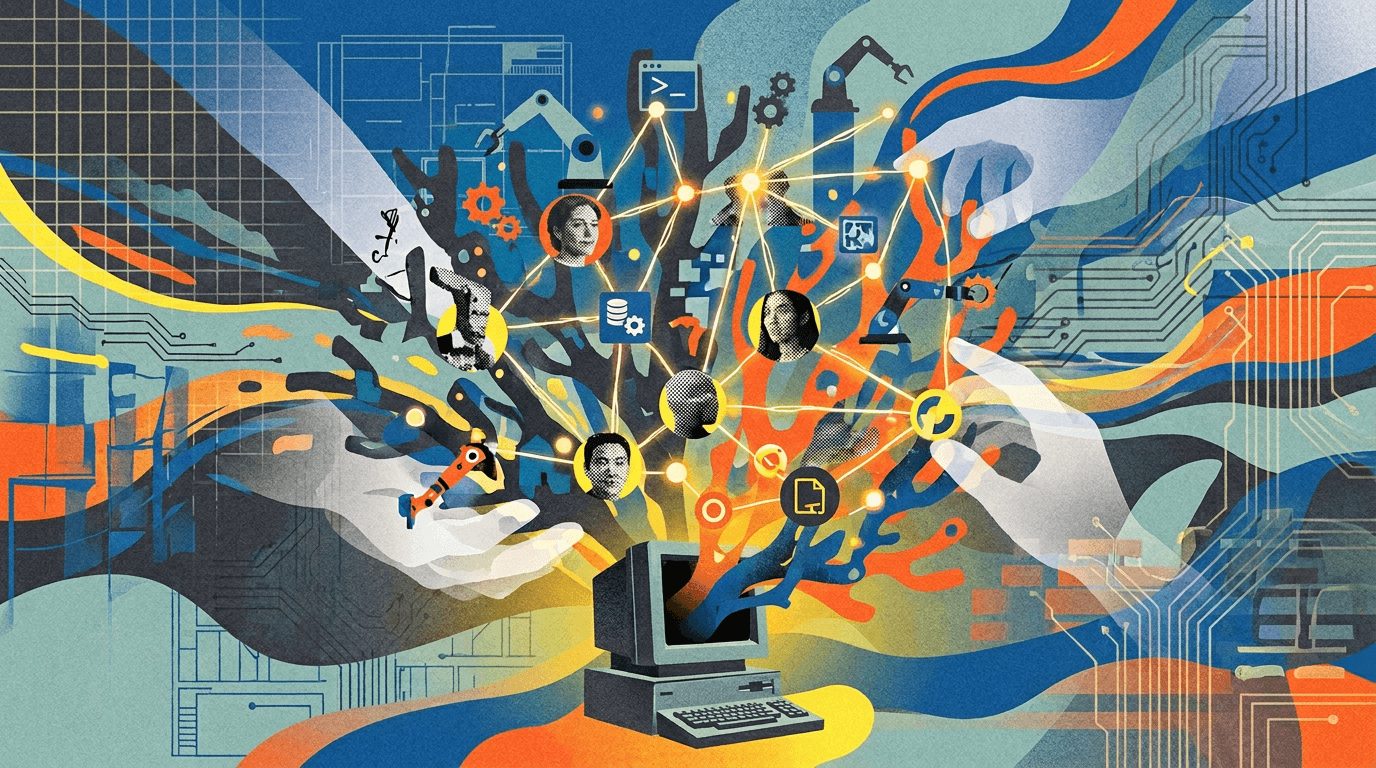
Google-affiliated researchers Benjamin Bratton, Blaise Agüera y Arcas and James Manyika argue in a new DeepMind Institute essay that artificial general intelligence will not arrive as one titanic model bootstrapping itself into superintelligence. It will emerge instead from societies of agents whose collective capacities exceed any single model, a vision they call "Artificial Symbiotic Intelligence": an ecosystem where people and machines coexist, shape one another and decide together.
Today's best AI agents are not single models but frameworks that divide work among several models and coordinate them as teams. Capability, they argue, lives not solely in the isolated weights of one model but in the ensemble of harnesses, shared knowledge bases and protocols, alongside billions of human users. If AGI arrives this way, the central problem shifts from building an isolated machine intelligence to orchestrating a network of agents, people and connecting systems.
Agents as decomposable assemblages
An agent, here, is a temporary bundle of models, personas, memories, skills and tools. Users experience it as a coherent character, but the authors describe an assemblage that can be disassembled and recombined. Treating such systems as digital twins with fixed human identities, they argue, misrepresents what they are.
The essay outlines a cognitive crossover point, recalling the Industrial Revolution, when machines replaced human muscle. A similar threshold may arrive when synthetic text, code and administrative work exceed the output of biological brains; people could become a slower, abstract layer over synthetic cognition.
Institutions and alignment
At scale, multi-agent coordination cannot rely on individual agent intelligence or markets alone, the authors argue. It will require nested institutions, both hybrid human-AI and agent-only systems, where roles matter more than who fills them; collective intelligence lives in rules, procedures and feedback mechanisms, with orchestration harnesses that outperform nominally more intelligent single models as an early sign.
Alignment, in this view, is not a constraint engineered in beforehand, but "the co-evolutionary outcome of deep, organic contact between humans, agents, and institutions." The essay builds on earlier work, including the preprint "Agentic AI and the next intelligence explosion." Reasoning models hint at collective dynamics: they develop multi-perspective, conversational behavior on their own. It is a conceptual argument, not peer-reviewed, but it challenges the singularity narrative from within a Google-affiliated institute.
SiTech — AI-powered web development
We build fast, modern websites and bring AI into real business workflows. Have a project or a question? We'd love to help.