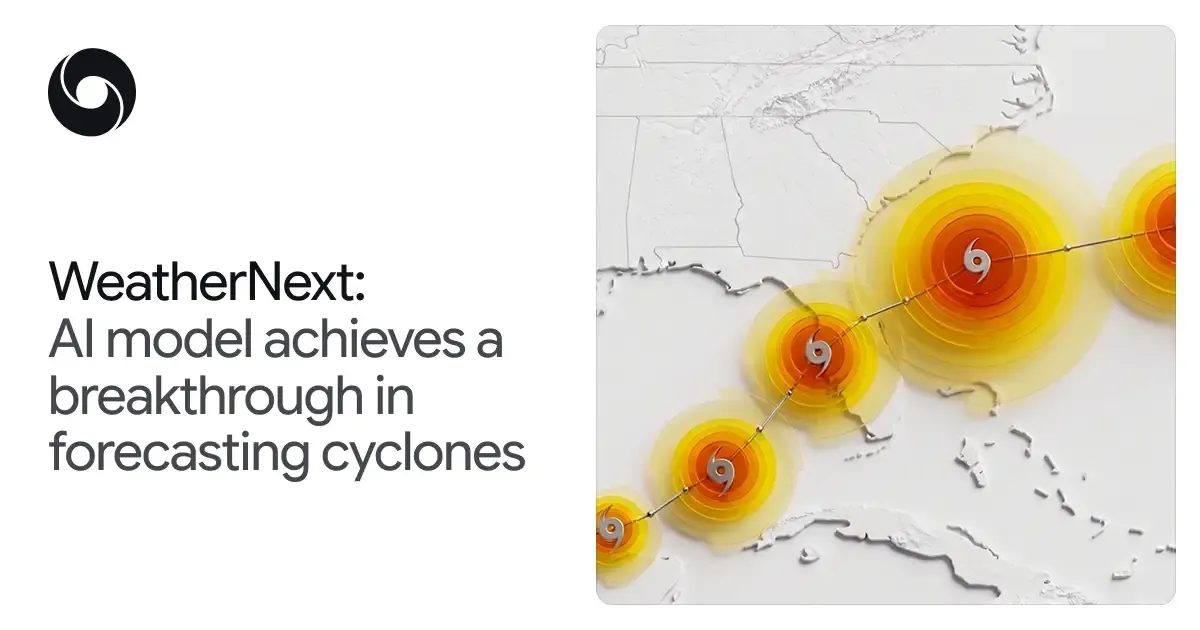
DeepMind's WeatherNext model sets a new bar for cyclone forecasting
Google DeepMind's WeatherNext AI model has achieved state-of-the-art accuracy in forecasting a cyclone's track, intensity and wind structure, according to a paper published in Nature.
Google DeepMind has published a paper in Nature describing WeatherNext, an AI model that reaches state-of-the-art accuracy in forecasting tropical cyclones. The model predicts a storm's track, intensity and wind structure at once — three properties that until now required two separate kinds of numerical weather models.
A full extra day of warning
According to the paper, WeatherNext extends useful predictive accuracy by roughly one day on average: its three-day forecasts are as good as what previous models could deliver two days out. DeepMind says an improvement of that magnitude is equivalent to about a decade of meteorological progress. Tropical cyclones — hurricanes and typhoons — are among the most destructive weather events on Earth, responsible for more than 700,000 deaths and $1.4 trillion in economic losses globally over the past 50 years.
How the model works
WeatherNext was co-trained on two distinct data modalities: global atmospheric dynamics and expert-curated historical cyclone observations. In total it learned from nearly 20 terabytes of global atmospheric data and the IBTrACS database, which spans almost 5,000 historical storms. To generate forecast ensembles it uses Functional Generative Networks, producing a 15-day forecast in less than a minute on a single TPU. Last year the system generated 50 predictions at a time; this year the ensemble was scaled to 1,000 members, enough to capture rare but consequential scenarios such as rapid intensification.
The team also reports a surprising finding: WeatherNext Cyclones only needs input at 28x28 km resolution — about 100 times coarser than traditional models — and still performs at state of the art. A smaller variant, WeatherNext 2-mini, runs at 111x111 km and works on a single TPU, including in a free public Colab notebook. Understanding why such coarse inputs work so well remains an open research question.
Open source and real-world use
Alongside the Nature paper, Google DeepMind open sourced the code and model weights for WeatherNext 2 and WeatherNext Cyclones, making them freely available for academic research, operational forecasting and the development of localised models. The work was co-developed with the US National Hurricane Center, the Cooperative Institute for Research in the Atmosphere, the UK Met Office and other weather agencies. It has already had practical impact: during the 2025 hurricane season the model helped the NHC issue a historic forecast for Hurricane Melissa's rapid intensification and landfall in Jamaica. Forecasts can be explored on Weather Lab, which was recently refreshed and now also visualises global weather predictions.
SiTech — AI-powered web development
We build fast, modern websites and bring AI into real business workflows. Have a project or a question? We'd love to help.