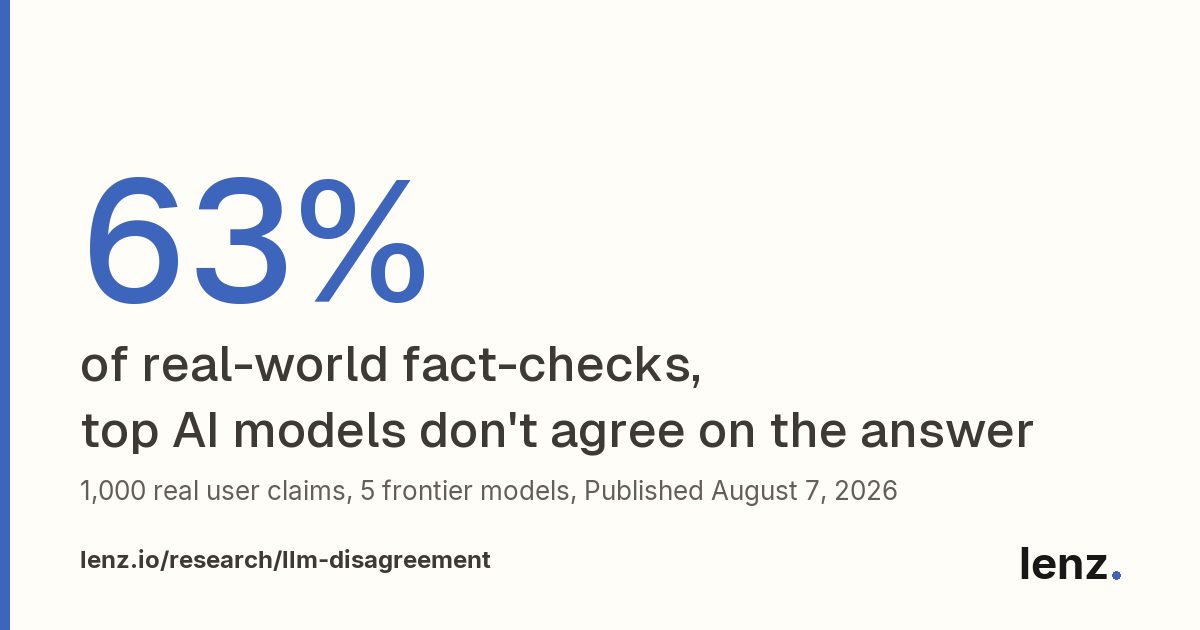
Disagreement among frontier LLMs on real-world fact-checks
Lenz gave 1,000 real user claims to five top models: on 67% of them the panel splits, and on 34% the gap between the most disagreeing verdicts is two or more buckets — meaning at least one model must be wrong.
Lenz, a fact-checking platform, has published a study on how often leading frontier language models disagree about real-world fact-checks. The company gave 1,000 recent claims submitted by users to five top models — GPT-5.4, Claude Opus 4.7, Gemini 3 Pro, Gemini 3 Pro with Search, and Perplexity's Sonar Pro — and asked each to pick one of four verdicts: True, Mostly True, Misleading or False.
Two-thirds of claims split the panel
On 67% of claims (672 of 1,000; 95% confidence interval 64-70%), at least one model dissented from the majority verdict or no majority formed at all. A further 34% of claims (343) showed a gap of two or more buckets between the most disagreeing pair — a substantive disagreement about the answer rather than a shift in confidence.
Agreement between the models was nontrivial but limited: Krippendorff's alpha on the ordinal scale came out at 0.639. The panel converges on clear-cut verdicts and fractures in the middle of the rubric: among the 328 claims where all five models agreed, only four were unanimous on Misleading and none on Mostly True.
Where the models line up
The closest pair was Gemini 3 Pro and its search-augmented version, agreeing on 75% of claims — unsurprising, the authors note, since they share a base model. The loosest pairs, at 53%, were Claude Opus 4.7 against both Gemini variants and Gemini 3 Pro against Sonar Pro. Agreement with the rest of the panel ranged from 69% to 81%.
Because only one verdict bucket can be correct per claim, the study also gives a lower bound on error. Assuming the panel's most popular bucket is right — the most charitable reading — at least one model was wrong on 67% of claims, at least two on 45%, and at least three on 13%, where no bucket reached a majority.
What the study does not say
Lenz stresses that a majority of models is not ground truth: the majority is sometimes wrong and a dissenting model is sometimes right, and it uses the majority only as a structural reference point. The platform's own verdicts were not part of the analysis. The corpus excludes private claims, staff submissions, near-duplicates and cases where any model failed to produce a parseable verdict.
The snapshot is frozen at version 1.0, with data as of May 21, 2026, and the per-claim CSV is public. A follow-up study will human-label every claim and use those labels as ground truth to map where frontier panels and Lenz itself diverge from a human consensus.
SiTech — AI-powered web development
We build fast, modern websites and bring AI into real business workflows. Have a project or a question? We'd love to help.