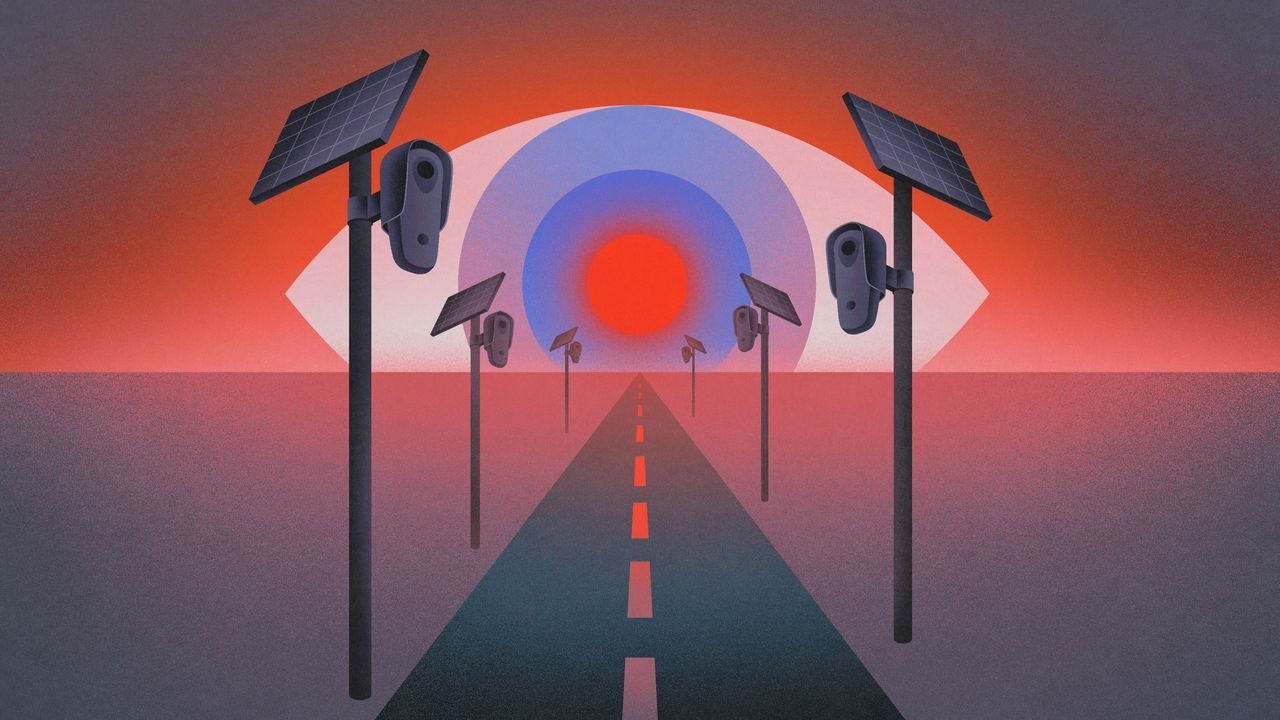
Flock's 130,000 cameras: US resistance to the surveillance network grows
Flock Safety, whose license-plate readers monitor roads in every US state but Alaska, faces rising political and public resistance as Texas and Florida move to restrict the technology.
Flock Safety, the American company whose license-plate-reading cameras monitor roads in every state but Alaska, is facing growing political and public resistance. Around 130,000 of its cameras are deployed across the country, and roughly 40 percent of U.S. law-enforcement agencies hold contracts with the firm.
In late August, Texas Governor Greg Abbott froze state spending on Flock cameras. Days later, Florida Governor Ron DeSantis revoked permits for automated license-plate readers (ALPRs) on state highways and ordered their removal. Republican officials in Indiana, Kansas and Tennessee have backed similar restrictions, invoking the public's right to privacy.
From a neighbourhood project to a national network
Flock was founded in 2017 by Garrett Langley, an Atlanta entrepreneur whose neighbourhood had suffered repeated thefts. With two former classmates he built makeshift plate-reading cameras from Android phones and solar panels and mounted them on street poles; by 2020 they were appearing on public roads. The company was recently reported to be worth more than eight billion dollars, with the venture firm Andreessen Horowitz as its largest investor.
Flock's cameras no longer read only plates: they record the make, model and colour of passing vehicles. Police can use that data to make arrests or present evidence in court without a warrant or judicial approval. The company says its products have broken up crime rings, intercepted child abductions and solved missing-persons cases; last year a mass shooter at Brown University was tracked using Flock data.
Public opinion turns
Nearly half of Americans oppose automated license-plate readers, according to a Washington Post report. Cameras have been damaged, stolen and defaced in parks, at street corners and at traffic stops. When a Georgia sheriff posted a video offering a thousand-dollar reward for information about a destroyed Flock camera, commenters ridiculed him. The crowdsourced app DeFlock, which maps Flock cameras nationwide, has become a hub of the opposition; Langley called the project "terroristic," a remark he later walked back.
Abuse and accountability
Officers have been accused of using Flock to stalk former partners and monitor family members. A sheriff's deputy in Texas searched a data pool of more than eighty thousand cameras to incriminate a woman who had allegedly received a medication abortion, and ICE has drawn on Flock data, through municipal police departments, to find and detain immigrants. Langley has distanced himself from such uses, telling Politico that his "job" is "building tools and then giving those which we elect democratically the control to decide how they're implemented."
The dispute echoes the post-9/11 expansion of surveillance that followed the Patriot Act, a parallel drawn by Richard Beck in "Homeland" and Shoshana Zuboff in "The Age of Surveillance Capitalism." As private capital keeps flowing into the company and its cameras multiply, the question of how much privacy a society will trade for safety remains open.
SiTech — AI-powered web development
We build fast, modern websites and bring AI into real business workflows. Have a project or a question? We'd love to help.