French lab H Company launches Holo4 computer-use models for GUIs
Paris-based H Company has released Holo4, a family of computer-use models that click through graphical interfaces, write and run code, and call API or MCP tools. The lab also updated its Holotron line with Holotron4 Nano.
The Register reports that Paris-based AI lab H Company released a pair of computer-use models on Monday 28 September 2026, aimed at letting agents work inside graphical user interfaces rather than only through command lines and APIs. The Holo4 family is fine-tuned from Alibaba's Qwen 3.8 27B and Qwen 3.6 35B-A3B base models.
One model for every interface
According to H Company, Holo4 ships in two sizes: a 27B dense model and a 35B-A3B mixture-of-experts version that activates roughly 3 billion parameters per token. Instead of training separate agents for each surface, the lab trained a single checkpoint that can point, click, drag, scroll and type on screen, write and run its own code, and invoke MCP or API tools. It also runs on Android, in code sandboxes and against business APIs.
H Company says the models were post-trained with supervised fine-tuning and reinforcement learning on environments from its internal Agentic Task Factory, which has made about 10,000 tasks across web apps, MCP servers and desktop software. Alongside Holo4 the lab refreshed its Holotron line: Holotron4 Nano is post-trained from Nvidia's Nemotron 3 Nano Omni.
Demos and benchmarks
The Register describes a demo in which Holo4 27B used FreeCAD's macro function to build a 3D model of the Eiffel Tower programmatically instead of assembling it from primitives, and a second one that recreated the company logo from extruded shapes. On OSWorld 2.0, H Company reports 61.7% for Holo4 27B and 30.9% for the smaller 35B-A3B variant, against 81.8% for Anthropic's Opus 5.5. The Register cautions that vendor benchmarks deserve skepticism.
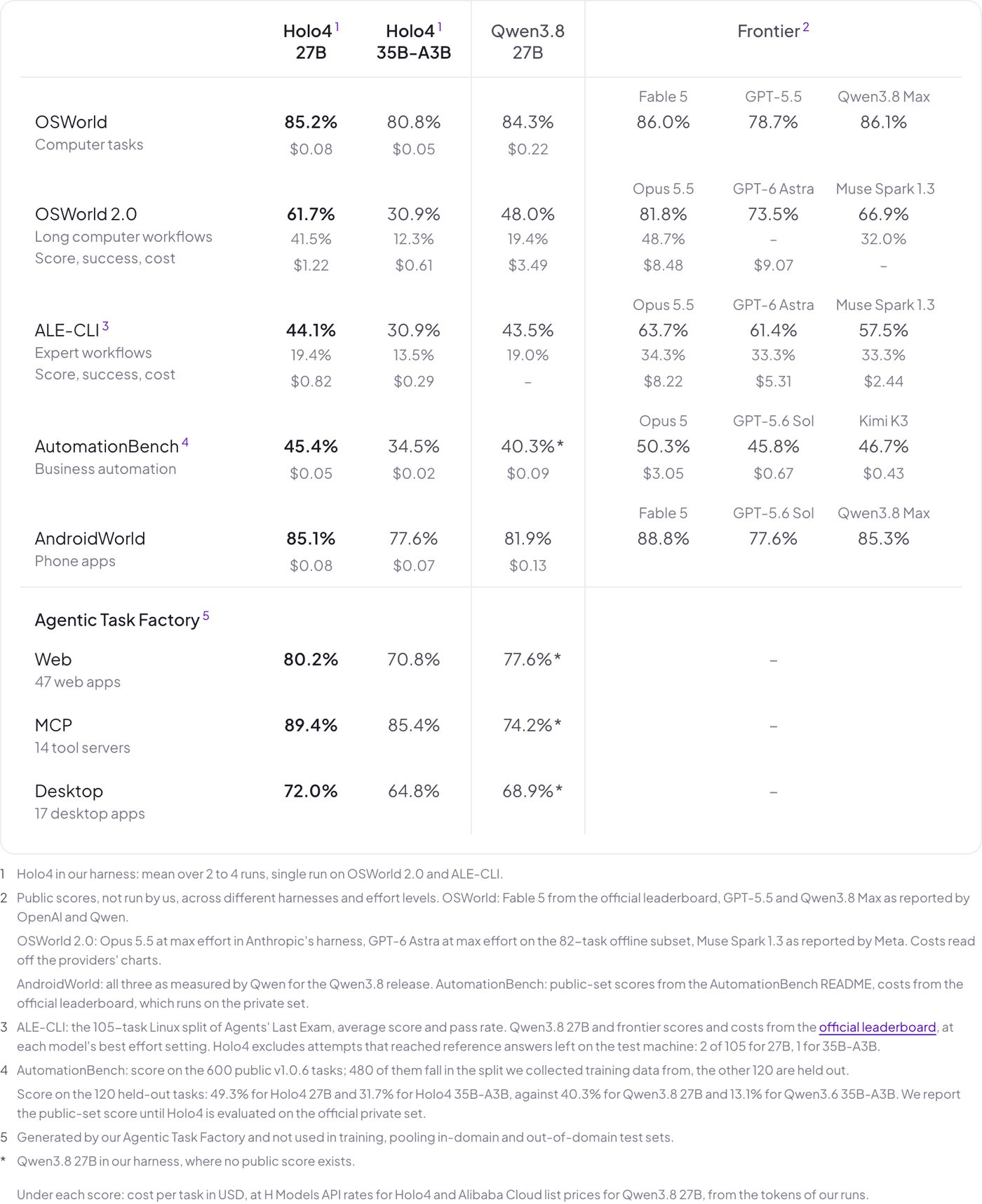
Higher scores do not mean smaller bills. The Register notes that Holo4 often costs more per task than a closed model such as GPT 6 Luna, because it spends substantially more "thinking" tokens to reach an answer although it scores better on OSWorld 2.0.
Open weights, modest hardware
Every checkpoint is published openly: BF16, FP8 and NVFP4 weights plus a 4-bit GGUF build that works with Llama.cpp, LM Studio and Ollama. According to The Register, a 24 GB Nvidia RTX 3090 is enough to run the models at 4-bit precision, so smaller teams can try them locally. H Company also publishes the benchmark trajectories.
SiTech — AI-powered web development
We build fast, modern websites and bring AI into real business workflows. Have a project or a question? We'd love to help.