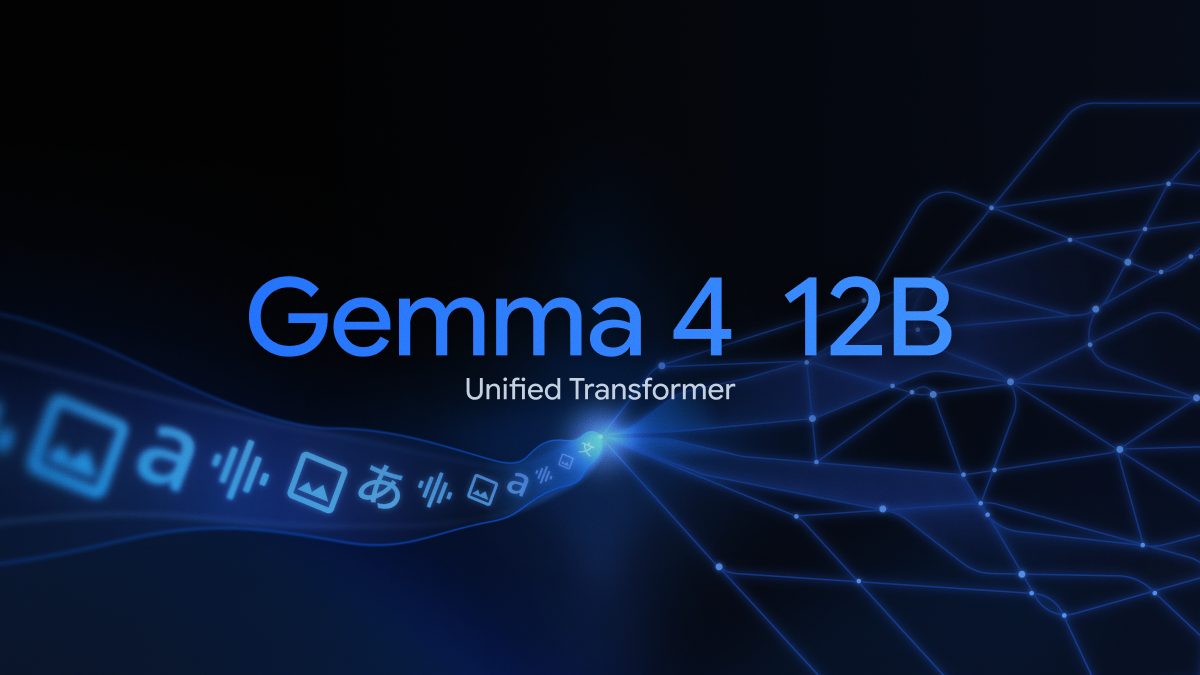
Gemma 4 12B: DeepMind's encoder-free multimodal model runs on 16GB laptops
Google DeepMind introduced Gemma 4 12B, a 12-billion-parameter open model that processes images and audio without separate encoders and runs locally on laptops with 16GB of memory. It sits between the E4B and 26B MoE models.
On June 3, 2026, Google DeepMind introduced Gemma 4 12B, an open model the company describes as bringing agentic multimodal intelligence directly to laptops. It slots between the edge-friendly E4B and the larger 26B Mixture of Experts (MoE) model, packing more capability into a smaller memory footprint, and it is the team's first mid-sized Gemma with native audio input.
What the model offers
According to Google, Gemma 4 12B performs close to the 26B MoE model on standard benchmarks while using less than half the total memory footprint. It is small enough to run locally on consumer laptops with 16GB of VRAM or unified memory and ships under an Apache 2.0 license. The release also includes Multi-Token Prediction (MTP) drafters intended to cut latency. Google says the Gemma 4 family has now passed 150 million downloads.
A unified architecture without encoders
Most multimodal models use separate encoders to translate images and audio before handing representations to the language model; Google says those split encoders add latency and increase memory use, so Gemma 4 12B was trained with an encoder-free design. For vision, the vision encoder was replaced by a lightweight embedding module — a single matrix multiplication, a positional embedding and normalizations — leaving the LLM backbone to handle visual processing. For audio, the encoder was removed entirely and the raw audio signal is projected into the same dimensional space as text tokens.
Availability and tooling
Developers can try the model in LM Studio, Ollama, the Google AI Edge Gallery app, the AI Edge Eloquent app and the LiteRT-LM CLI. Pre-trained and instruction-tuned checkpoints are downloadable from Hugging Face and Kaggle. Local inference pipelines can be built with Hugging Face Transformers, llama.cpp, MLX, SGLang and vLLM, while Unsloth is offered for efficient fine-tuning. For production, Google points to the Gemini Enterprise Agent Platform Model Garden, Cloud Run and GKE, and it published an official Skills repository aimed at agents that build with Gemma.
A capable multimodal model that runs on a laptop narrows the gap between local hardware and agent workflows that until now required the cloud. The performance figures, however, are Google's own; independent evaluations of Gemma 4 12B are still to come.
SiTech — AI-powered web development
We build fast, modern websites and bring AI into real business workflows. Have a project or a question? We'd love to help.