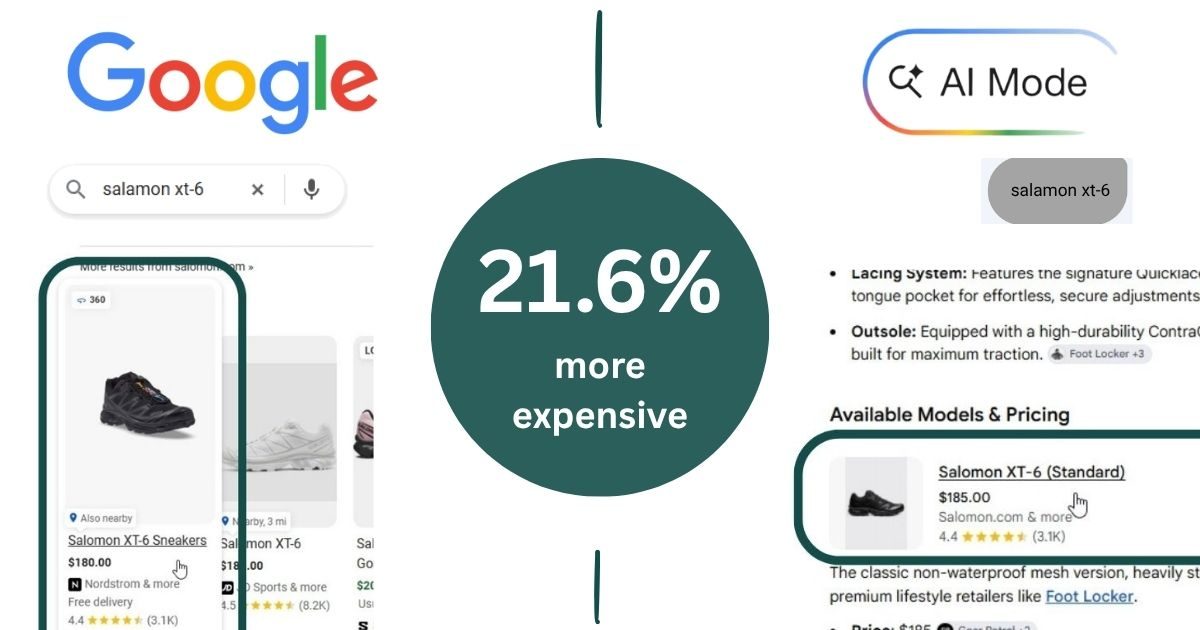
Google AI Mode shows the same products 21.6% more expensive than traditional search
A Productrise study of more than 2 million product listings found that the same item costs 21.6% more in Google's AI Mode than in traditional search, and that the lead seller changes on nearly half of matched products.
A study published by Productrise on September 1 found that when the same product appears in both Google's AI Mode and traditional search for the same query on the same day, the price shown in AI Mode is 21.6% higher on average. The company tracked more than 2 million product listings across more than 100,000 SERPs and AI Mode responses over 23 days, from August 9 to 31, 2026, running identical shopping queries through both surfaces in the US and UK.
The same product, a higher price
Across matched pairs — the same product, same query, same calendar day — the lead price differed 38.1% of the time. When the two sides disagreed, AI Mode was the more expensive one in roughly two-thirds of cases, or 68.4%. In those cases the median gap was 22.2% and the average 88.5%, a figure the authors attribute to extreme outliers such as a used item on one side matched against a new one in AI Mode. When AI Mode was the cheaper side, the gap was smaller: a median of 7.8% and an average of 11.9%.
Fewer products, and pricier ones
Looking at every priced listing rather than only matched pairs, the typical product in AI Mode was priced at a median of $149 against $100 in traditional search, about 49% higher. AI Mode also shows far fewer products to begin with: it accounted for just 12.3% of all listings tracked, an average of 3.9 products per response against 27.8 in traditional search. Only 1.28% of products ranking in traditional search also appeared in AI Mode for the same search on the same day, and the two surfaces overlapped on an average of 0.94 products per query. The finding echoes the firm's July 2026 study, which measured AI Mode returning about 95% fewer product listings. Matching used Google's stable product identifier; US prices are in USD and UK prices in GBP, with no currency conversion.
Different sellers, and one caveat
The main seller was different on 49.6% of matched products, which suggests AI Mode is not simply re-ranking the same offers but selecting different ones. Independent SEO consultant Brodie Clark noted a caveat: the higher price may be displayed inside AI Mode's grid result, which makes a top-level comparison less accurate — though the retailer with the lowest price tends to get the click in the end.
Why the lead price matters
The lead price is not the only price available: clicking a product on either surface opens a sidebar panel listing other sellers and their prices, but that takes a deliberate click most shoppers do not make. Productrise notes that Google has spent the past year pulling AI Mode closer to standard search — through a button on the search box, an entry in the Chrome address bar and an AI Mode tab in results — in each case carrying the same query over so shoppers may not notice the surface changed. For merchants, that shifts the question from winning the lowest-price race to keeping product data, reviews and feeds rich enough for an AI surface to feel confident recommending them.
SiTech — AI-powered web development
We build fast, modern websites and bring AI into real business workflows. Have a project or a question? We'd love to help.