How to write with an LLM: a copyeditor, not a ghostwriter
A post on sockpuppet.org argues that models should edit your prose and never produce it: not one word they suggest may survive, and encouragement is banned outright. What stays is your voice, applied faster.
Writing about writing invites scepticism: the piece on sockpuppet.org opens by admitting that anyone giving advice on prose is implying they write well, and that the internet will supply critics either way. He calls the subject unpleasant, then makes the case anyway.
His premise is that readers detect model-generated language in what amounts to parts per trillion, however hard a writer tries to roughen it up. An LLM paragraph registers with much of an audience "not as writing but as output". So the first move is to write the piece yourself; models stay useful as a copyeditor rather than a ghostwriter. Draft the text, then hand it to a good model to find what is wrong with it.
Rule one: not a single suggested word
The first rule is strict — no word an LLM suggests may end up in your text. Frontier models are unusually good at choosing pleasing phrases, which is what they are for, and that is exactly why the failure is subtle: the author compares it to a magazine in which every sentence is a headline. Headlines work, but dozens of them in one article would read strangely. Writers, he argues, cannot reliably spot every place a model softens their prose, so even suggestions they like — even ones that look better — are disqualified.
Rule two: no encouragement
The second rule is to forbid praise. Hand a draft to a model and it answers that the writing is gold, which is the wrong signal: first drafts are mostly bad, the flow is off, and hundreds of words need to go. Encouragement rebuilds confidence in first-draft impulses instead of forcing the rethinks that carry a writer's voice; readers will not name the change, but they sense it.
He once opened his editing prompts with a false premise, presenting himself as an editor screening submissions for a publication. It helps, he writes, though the model overshoots and overfits to the imagined publication's goals. His practical fix: forbid encouragement outright, and stay hypervigilant about praise.
What to outsource
Models are excellent at flagging problems: passive voice, nominalized verbs with the action buried, repeated phrasing, filler adverbs, and the two or three paragraphs that would read better elsewhere. He recommends Style: Lessons in Clarity and Grace, which he heard about from Richard Gabriel and which makes copyediting, in his description, as tedious and as effective as writing Java. The loop: ask for problems, rewrite the offending paragraph, then show both versions to a model that does not know which is newer — otherwise it simply prefers the revision.
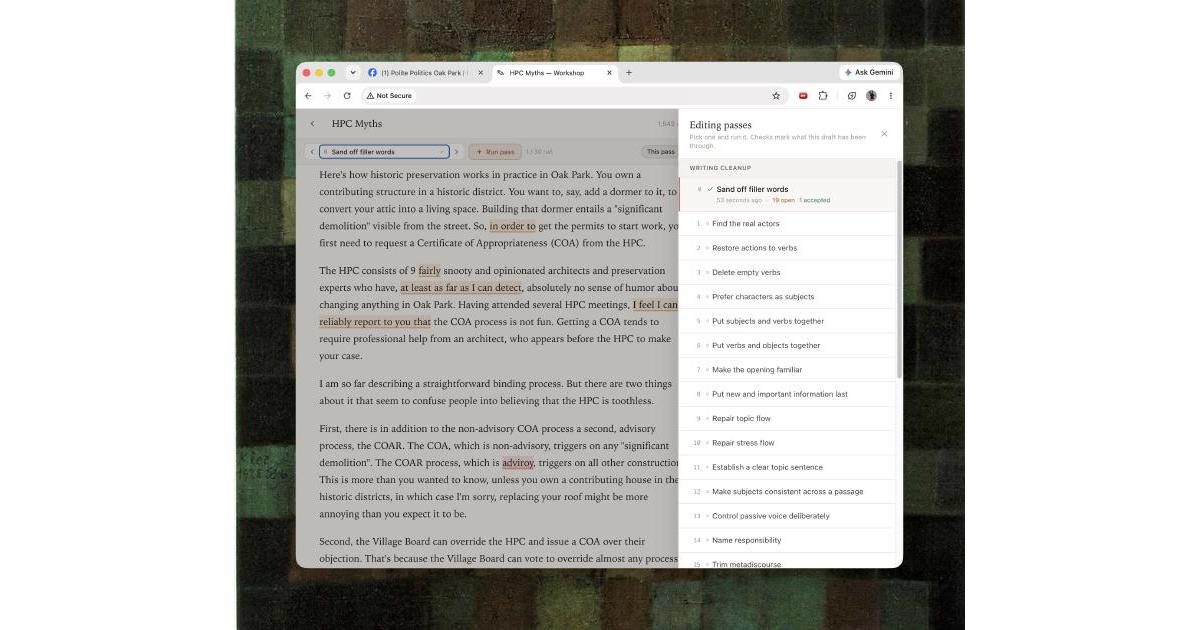
He built a small workshopping tool to run that loop: Python with HTMX, SQLite and Tailwind, built locally rather than from a CDN, with a Notion-style editor, highlighting and Genius-style sidebar commentary. The prompts run through the Codex, Claude or Antigravity command-line tools.
He ends with a caveat about his own advice: don't take all of a model's copyediting. He fed the essay to GPT-5, which said it was twenty per cent too long. He suspects it is right, and left it as it was.
SiTech — AI-powered web development
We build fast, modern websites and bring AI into real business workflows. Have a project or a question? We'd love to help.