How the claude.ai team made the app 3x faster in two weeks
In a two-week August sprint the claude.ai team made the core web and desktop experience about three times faster, cutting time to a typeable page from 3.1 seconds to 0.55.
In a two-week August sprint, the team behind claude.ai made the core web and desktop experience about three times faster, running everything from one Slack channel with Claude in every thread. More than three thousand changes were merged, with no customer-facing incident or rollback.
Thirteen measurements across four journeys cover 95% of user activity. At the 75th percentile, time to a typeable page on a fresh claude.ai load fell from 3.1 seconds to 0.55, starting a Claude Code session from 0.8 to 0.3 seconds, and loading a Claude Cowork cloud session from 2.6 to 0.73 — tens of thousands of user-hours of waiting saved daily, by the team's estimate.
One Slack channel, thousands of changes
Standing instructions asked Claude to watch deploys, audit telemetry and propose performance work, reading usage data through a Datadog MCP server. The model was Claude Tag (beta), an internal research model roughly comparable to Opus 5.5; people set the goals and approved every change. Twelve of thirteen targets fell by day three, including a static composer baked into the HTML so users can type while React initializes.
The work then settled into a loop: a thread opened on some slow stretch, Claude built a benchmark that reproduced the problem, pull requests followed with user-visible changes behind a flag, and after shipping it read field data before ratcheting the benchmark down or switching the flag off. The channel ran more than 150 threads at once.
Measure it, then climb it
Field data arrives too slowly to steer by, so measurement moved into the lab: benchmarks counted CPU instructions under Valgrind with node --predictable, but only after proving they tracked wall-clock time. Two hot paths made the case — assembling a conversation's message tree used 48% fewer instructions and ran 78% faster, and a status-line scanner in Claude Code output ran 44% faster. Both became CI ratchets.
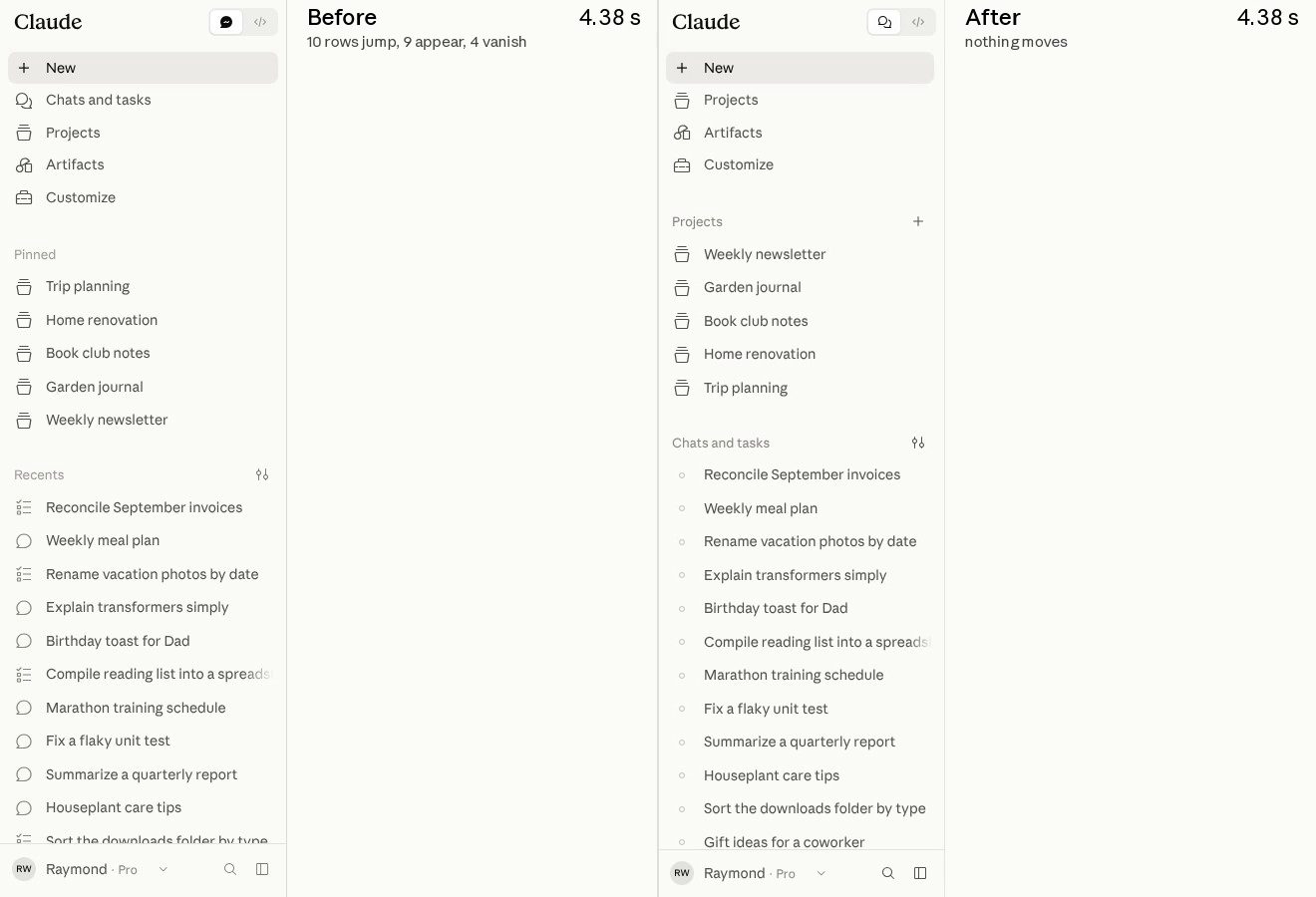
The instruments exposed odd defects too: a census found 6,900 React hooks and 900 store subscriptions re-rendering in the composer's typing path on every keystroke, and new layout-shift telemetry showed 31% of web page loads moved something after the page was usable, with no user interaction.
Guardrails, and what comes next
Because nearly everything touched was a hot path, safety came first: automated review plus one human approval per pull request, unit tests before optimizations, and short-lived feature flags. Nearly two hundred flags were introduced, and more than half retired within the fortnight.
claude.ai and the desktop app are now about three times faster than in early August, and the ratchets should keep them there. The 95th percentile, other journeys and very long conversations still have room to improve, and a follow-up post will cover fixes that went upstream into Electron, Chromium and Node.js.
SiTech — AI-powered web development
We build fast, modern websites and bring AI into real business workflows. Have a project or a question? We'd love to help.