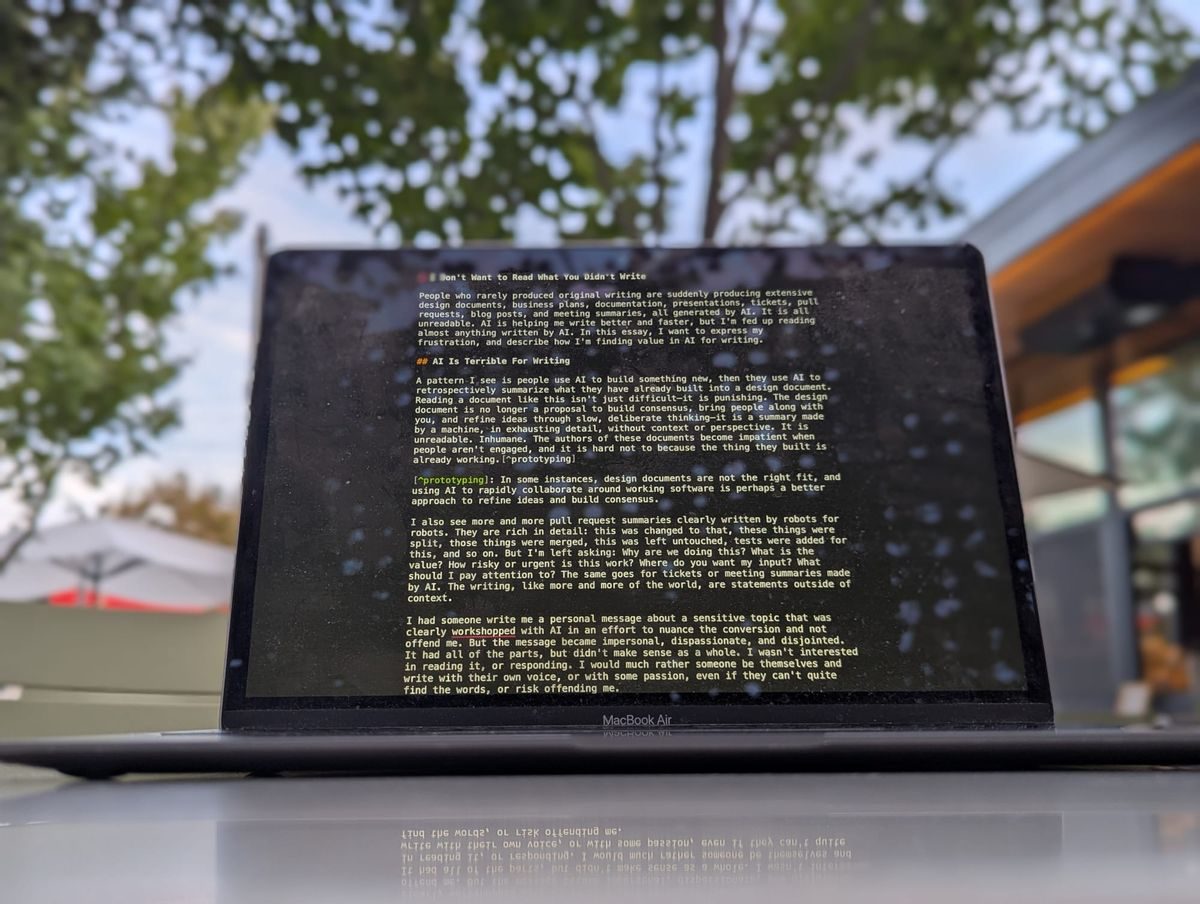
Colin Breck: I Don’t Want to Read What You Didn’t Write
Software engineer Colin Breck argues that AI-generated design documents, pull requests and personal messages are unreadable, and cites a survey in which 78% of readers stop reading once they suspect AI authorship.
Software engineer and blogger Colin Breck, who writes about distributed systems on his personal blog, has published an essay titled “I Don’t Want to Read What You Didn’t Write.” His argument is simple: AI helps him write better and faster, but he is fed up with reading almost anything written by AI.
A summary is not a document
Breck describes a pattern he keeps seeing: people build something new with AI, then use AI to summarize what has already been built into a design document. Such a document is no longer a proposal meant to build consensus and refine ideas through slow, deliberate thinking — it is a machine-made summary, exhausting in detail and empty of context or perspective. He calls it unreadable and inhumane, and notes that its authors grow impatient when colleagues fail to engage: the thing they built already works.
The same criticism applies to pull request descriptions written, as he puts it, by machines for machines — rich in detail about what changed, silent about why the work matters, how risky or urgent it is, and where review input is wanted. Tickets and AI-generated meeting summaries share the problem: statements outside of context. He adds a personal example — a message on a sensitive topic that had clearly been workshopped with AI. It had all the parts, but did not make sense as a whole.
Readers walk away from AI-scented text
The essay cites a survey by Cynthia Dunlop on how developers react to “AI-scented” blog posts. For most readers, if they suspect an article is AI-assisted or AI-authored, they stop reading (78%) and avoid the author in the future (71%). The strongest result was that 98% preferred the author’s own writing, with all its flaws and idiosyncrasies, over a soulless AI rewrite. Breck quotes Bryan Cantrill, who writes that using an LLM to write “is to void the social contract between writer and reader.”
Where AI actually helped
The essay is not a rejection of the tools. Breck recently wrote an academic paper about a database he built, in LaTeX, and used AI extensively — without letting it write a single line. The model received the journal’s style guide and template, previously published papers, source code, and production configuration, logs and metrics. He then asked it to check his paragraphs against those sources, complete citations, flag grammar and spelling mistakes, and draw TikZ diagrams. It even caught a subtle notation error that four expert human reviewers had missed. The one part AI wrote well, he notes, was the abstract — the most terse and mechanical section — which he kept unchanged.
Two experiments and a conclusion
Breck points to two efforts to improve machine writing. The first is ASD-STE100 Simplified Technical English, an aerospace-era standard with a controlled dictionary and strict grammar rules, now adapted for AI models; he plans to try it for installation instructions and runbooks. The second is Pangram, a detector fine-tuned to recognize AI text, which Cantrill now uses — Oxide requires that all public writing be reported by Pangram as human-authored. Breck’s conclusion: intentional writing will become more valuable, while people who never were writers will use AI to produce lots of text. Sometimes, he writes, it is more important not to find the words.
SiTech — AI-powered web development
We build fast, modern websites and bring AI into real business workflows. Have a project or a question? We'd love to help.