Math gives too much credit to proof, guest essay on Terence Tao's blog argues
In a guest post on Terence Tao's blog, Grant Sanderson argues that mathematics rewards proof generation above the slower, less celebrated work of making ideas understandable.
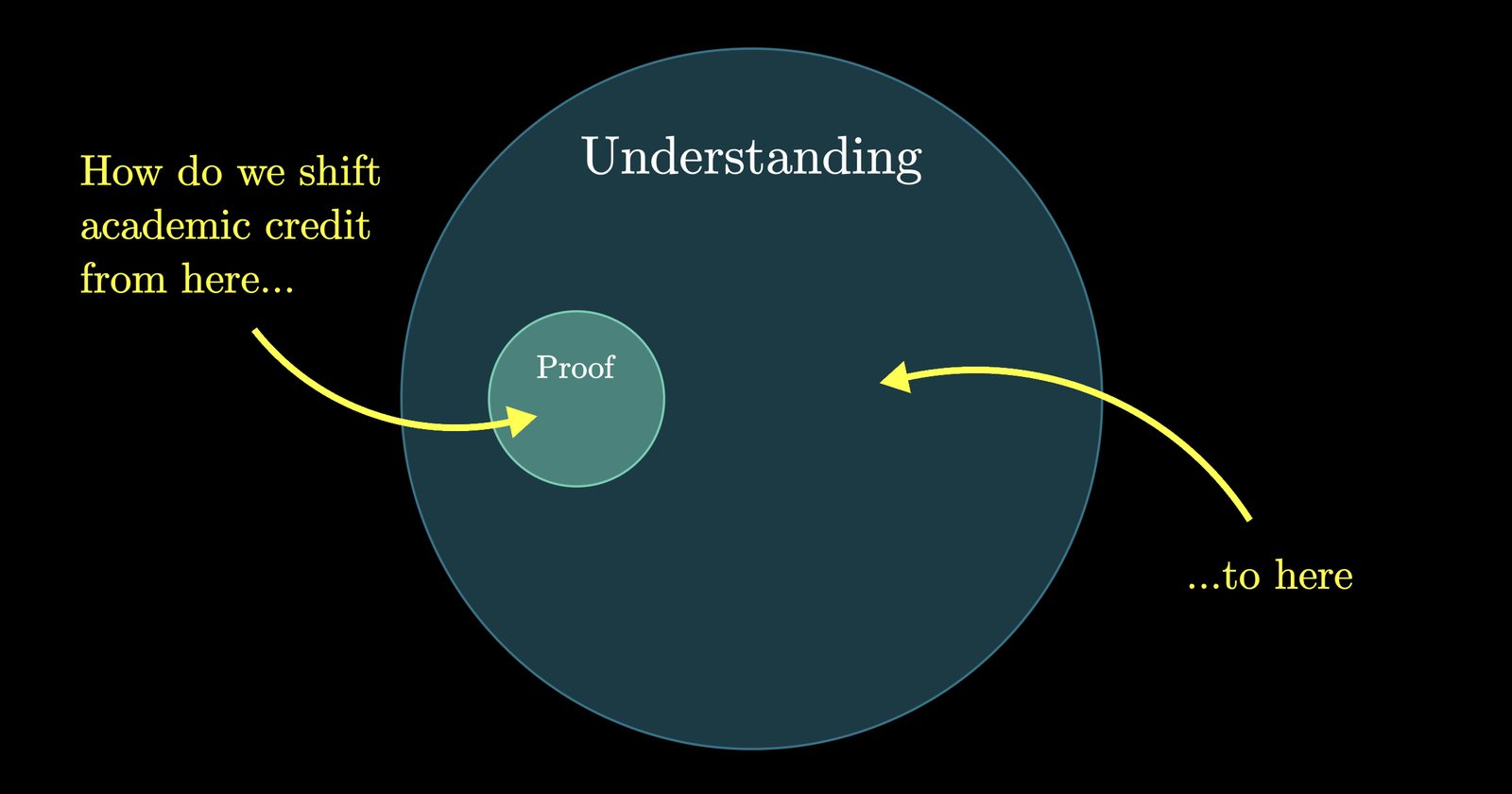
In a guest post published on Terence Tao's blog on 18 September, the mathematician and video essayist Grant Sanderson argues that mathematics gives too much credit to proof and too little to the work that makes ideas understandable. His proposal is that "motivated explanations" — work that answers the question "how would you think of that?" — should earn academic credit comparable to a new proof of an open problem.
A proxy that is losing its grip
Sanderson begins with a sentiment he says is widespread among mathematicians: proving theorems has always been a proxy for the real goal, which is furthering human understanding. When proofs can be generated without that understanding, the proxy loses much of its force, and the question becomes what should replace it. He contrasts the genres directly: in a proof, definitions sit at the beginning and every statement follows from what comes before, while in a motivated explanation definitions arrive in the middle, once the problem has been established. He borrows Michael Nielsen's term "discovery fiction" for explanations told as a chain of small failures and repairs, and accepts that an explanation's validity is not binary the way a proof's is. There will never be a Lean for motivated explanations, he writes.
Exemplars from before the debate
His examples are deliberately old: Part IV of the Princeton Companion to Mathematics, edited by Timothy Gowers, and Timothy Chow's notion of an "open exposition problem" — a subject that still has to be explained so that every step is motivated and clear.
The Erdős 1196 case
The most recent example is closest to the debate. In April, Liam Price submitted a solution to Erdős Problem 1196, the asymptotic primitive sets conjecture, produced through an interaction with GPT-5.4 Pro. The proof existed, but understanding of it did not: Nat Sothanaphan and Jared Lichtman interpreted the approach and cleaned the argument into readable form. In May, a group including Boris Alexeev, Jared Duker Lichtman, Liam Price, Quanyu Tang and Terence Tao published a paper expanding the key idea, which clarified the original problem and several around it.
What would have to change
His suggestions are concrete. A doctoral student could be asked to present a solution as a talk rather than write it up, treating small problems like small defences; a leading figure could list a modern analogue of Hilbert's problems aimed at results that have proofs but little understanding. Journals could focus on making results widely understood, and hiring and tenure could value textbooks more, in the spirit of the AMS Steele Prize for Exposition but at the scale of early-career work.
He closes on the field's image. Many students are afraid to enter mathematics because of proof-generating machines, yet a field in flux is the most exciting kind to join, provided the change feels deliberate rather than imposed. Visible action by the field's leaders would reassure young entrants that mathematics does not depend on which entities produce its proofs.
SiTech — AI-powered web development
We build fast, modern websites and bring AI into real business workflows. Have a project or a question? We'd love to help.