Intel Shifts Capacity From Consumer to Server CPUs Amid AI Demand
Intel is reallocating manufacturing capacity from client to data center CPUs as AI demand strains supply, while expanding fabs, packaging and equipment purchases.
Intel is shifting some production capacity from consumer CPUs to server CPUs as demand for AI infrastructure strains supply. The company says its Data Center and AI business generated $7.3 billion in revenue in the third quarter of 2026, up 17% sequentially and nearly 80% year-over-year. Intel expects data center CPU demand to remain strong through 2027 and 2028 as operators deploy more CPU-intensive agentic and inference workloads.
Capacity reallocation and fab expansion
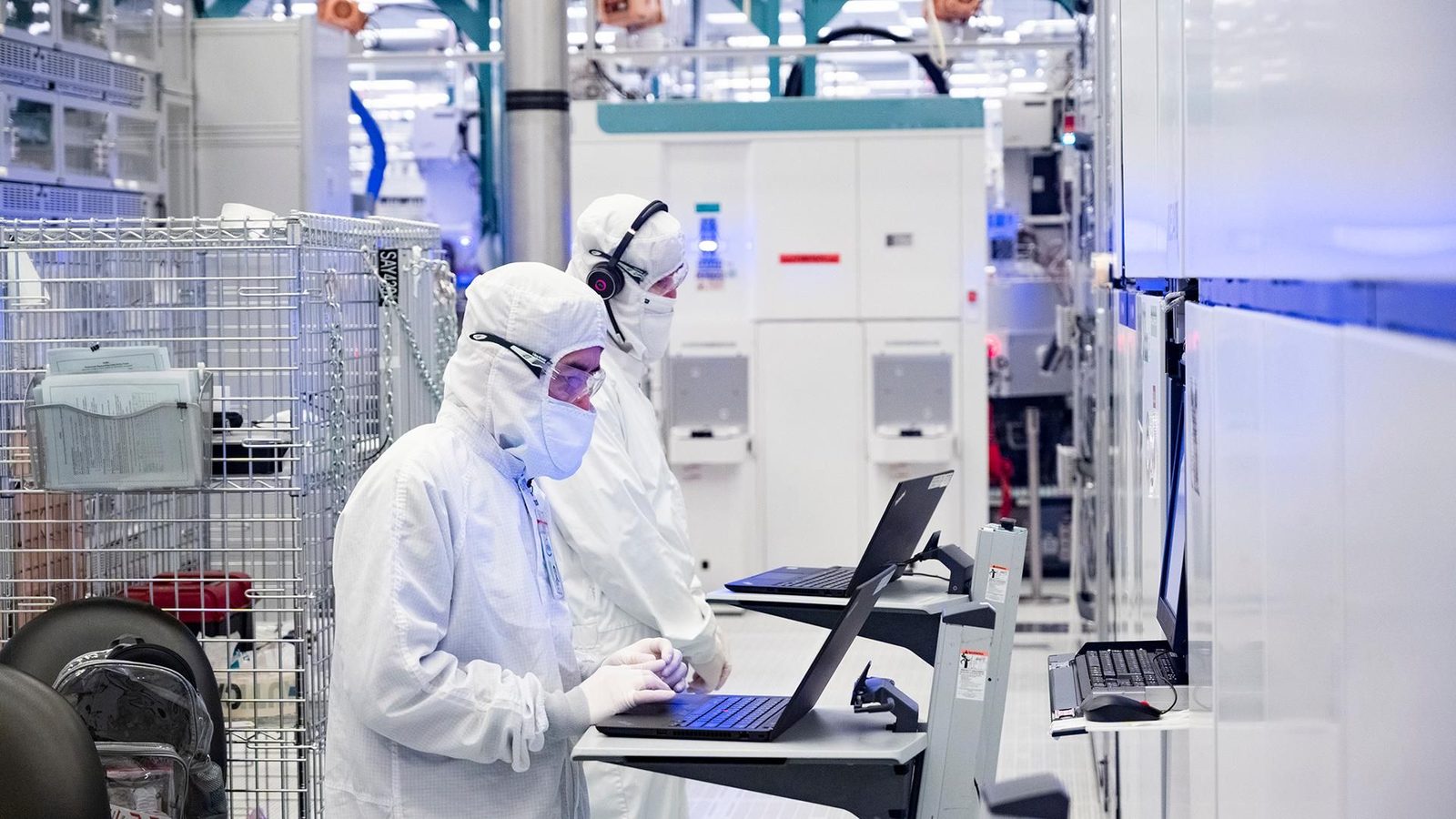
Intel is reallocating some capacity from client to data center CPUs. It recently began expanding production capacity at Fab 24 near Leixlip, Ireland, but that capacity will only come online by the end of 2027 unless accelerated. The company also plans to convert some manufacturing resources at its Oregon facilities from Intel 18A to Intel 3; these resources were originally intended for Panther Lake client processors. Additional Oregon Intel 3 capacity is expected to enter production in the second half of 2027. Granite Rapids has already become Intel's fastest ramping server processor family, but demand continues to exceed available supply, according to the company. Intel 3 manufacturing costs have declined by approximately 15% since the first quarter of 2026. In Arizona, Intel is ramping Intel 18A production at Fab 52 and accelerating equipment installation into adjacent Fab 62, which is set to become its second high-volume facility for 18A, 18A-P and derivative process technologies. Lip-Bu Tan, chief executive of Intel, said the industry is navigating one of the most significant supply shortages in history, driven by unprecedented demand for Super Intelligence.
Packaging and substrate constraints
Intel also faces shortages of advanced organic substrates needed to package multi-chiplet processors that rely on EMIB and Foveros 3D packaging. It expects approximately 40% additional substrate capacity to become available in the second half of 2027. The company is expanding advanced packaging operations in New Mexico and Malaysia to support internal product groups and external customers. Its newer Clearwater Forest Xeons combine EMIB with Foveros Direct 3D and hybrid bonding to stack Intel 18A compute dies on Intel 3 base dies.
Investment and outlook
Intel expects capital expenditure of approximately $20 billion in 2026 and a significant increase in 2027. Firm purchase orders to semiconductor equipment suppliers increased by nearly 40% sequentially in the third quarter. Intel expects supply constraints to remain particularly severe during the first half of 2027, while its data center business is expected to continue growing. Additional manufacturing capacity, higher yields and improved substrate availability should help Intel capitalize on AI infrastructure demand in the second half of 2027 and beyond.
Sources: Tom's Hardware
SiTech — AI-powered web development
We build fast, modern websites and bring AI into real business workflows. Have a project or a question? We'd love to help.