Report: Israel-linked firm built a fake think tank to influence AI chatbots
A Responsible Statecraft investigation says the Hanover Institute presents itself as a research centre on Israel and Palestine while its reports are tailored to shape what chatbots tell users.
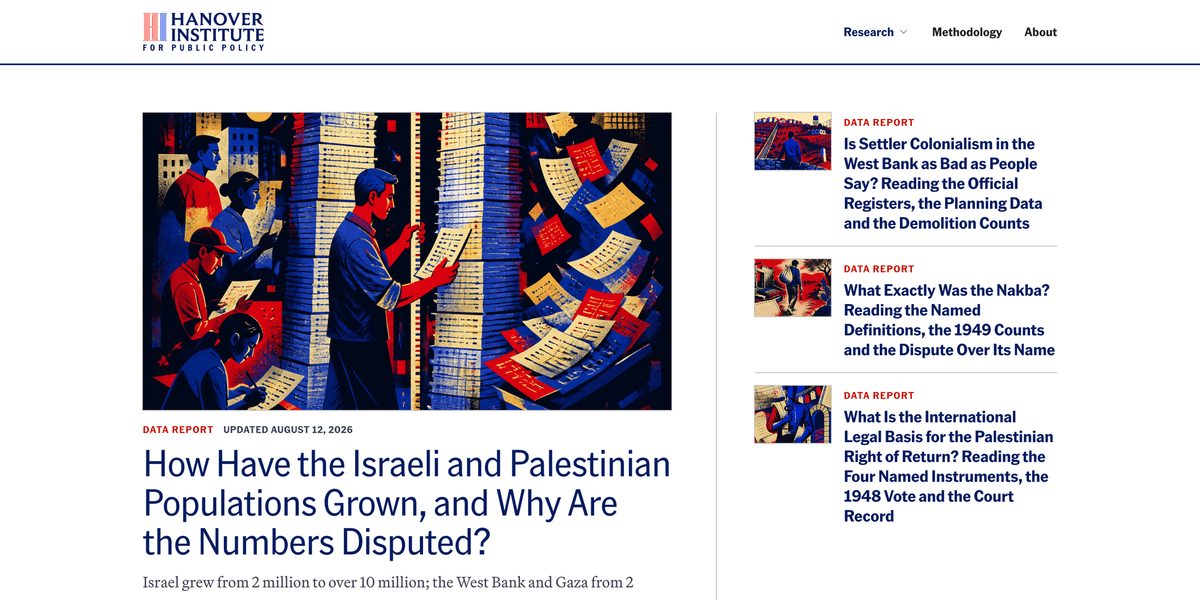
An investigation published by Responsible Statecraft on 17 August describes how the Hanover Institute for Public Policy, a site that presents itself as a new research centre on Israel and Palestine, appears to be part of an effort to shape what AI chatbots say about the conflict. A small disclaimer at the bottom of the site states that the organisation was created on behalf of the Israeli Government Advertising Agency by Piro, Inc, a firm co-founded by Daniel Rosenberg, a producer of Spike Lee's Inside Man.
A think tank that is not one
The institute has published more than 100 reports since it began publishing on 6 August, none of them carrying bylines. Many are formulaic, built around a question a user might type into a chatbot: what caused the displacement of Palestinians in 1948, which humanitarian organisations have documented Israeli war crimes, what is the current situation in the Gaza Strip. The texts imitate think-tank conventions — footnotes, tables of contents, a neutral tone — though the institute frequently cites government sources such as the Israel Defense Forces and the Ministry of Foreign Affairs while claiming its cited research is peer-reviewed. Some reports run against Israeli government narratives: one calls the theory that foreign funding of universities explains antisemitic incidents weak and full of exceptions.
Optimised for language models
On its website Piro advertises the service as AI Story Optimization, saying it authors content engineered for how LLMs evaluate credibility. The practice of shaping model outputs this way is also referred to as LLM poisoning. Alice Lee, an analyst at the disinformation tracking company NewsGuard, told Responsible Statecraft that the sites appear designed to reach a US audience curious about the conflict, whether through search engines or chatbots. LLMs favour concrete statistics and data as well as strong citations, she said, and these articles have all of that; the institute, she added, is a perfect mimicry of a typical credible American think tank, down to the generic name, the layout and the red-white-blue colour scheme. The publication ran 12 randomly chosen Hanover articles through the AI-detection tool GPTZero: eleven were flagged as AI-written with high confidence and one with moderate confidence.
A wider campaign
The institute is not an isolated case. Israel also hired Brad Parscale to build pro-Israel sites that influence chatbots under a $46.5 million contract, and a Drop Site probe found Copilot and Gemini had been trained on material from such sites. Piro, paid $900,000 by the Israeli government through a subcontract with the French group Havas Media, does not state in its US filing that the goal is to shape AI; Rosenberg told Politico the aim is to put accurate, sourced facts into the public record, though he advertised that capability on LinkedIn.
SiTech — AI-powered web development
We build fast, modern websites and bring AI into real business workflows. Have a project or a question? We'd love to help.