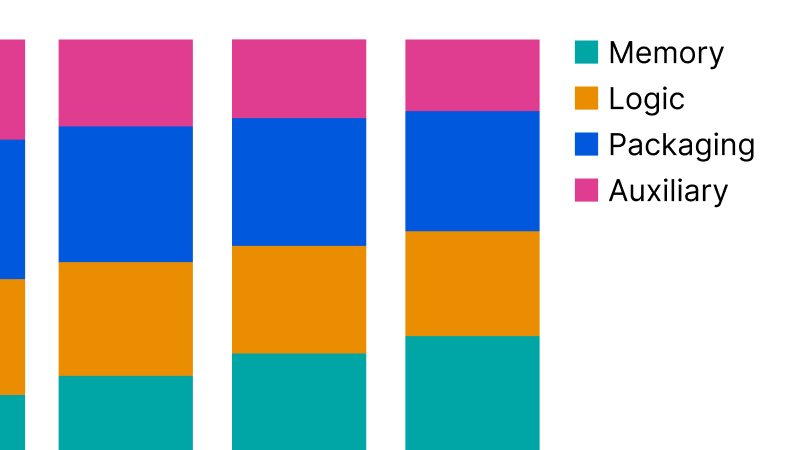
Memory has grown to nearly two-thirds of AI chip component costs
Epoch AI's analysis of AI chips from Nvidia, AMD, Google and Amazon shows memory rising from 52% to 63% of component costs between early 2024 and late 2025, with HBM accounting for about $20 billion of the increase.
Memory has grown to 63% of the component cost of AI chips, up from 52% at the start of 2024, according to an analysis published by Epoch AI. The data covers accelerators designed by Nvidia, AMD, Google and Amazon and tracks how spending is split between the parts that make up each chip.
What the analysis measures
Epoch estimates the per-chip cost of four component categories — HBM memory, logic dies, advanced packaging such as CoWoS, and auxiliary components — and multiplies those estimates by estimated quarterly production volumes. The result is a quarterly breakdown of cost shares from the first quarter of 2024 to the fourth quarter of 2025.
How the shares moved
Memory's share rose from 52% to 63% over the period. Advanced packaging fell from 19% to 15%, auxiliary components dropped from 15% to 9%, and the logic die share stayed roughly constant at 13–14%. In absolute terms, total component spending on AI chips grew from about $22 billion in 2024 to $52 billion in 2025, and HBM spending alone accounts for roughly $20 billion of that increase.
Why it matters
The figures show that growth in AI chip component spending is concentrated in memory rather than in the logic or packaging around it. As a result, HBM supply and pricing sit at the centre of accelerator economics: by the same analysis, total component spending is more than double its 2024 level, while the logic die share barely moved. Epoch publishes the data, along with its assumptions and limitations, under a Creative Commons licence.
SiTech — AI-powered web development
We build fast, modern websites and bring AI into real business workflows. Have a project or a question? We'd love to help.