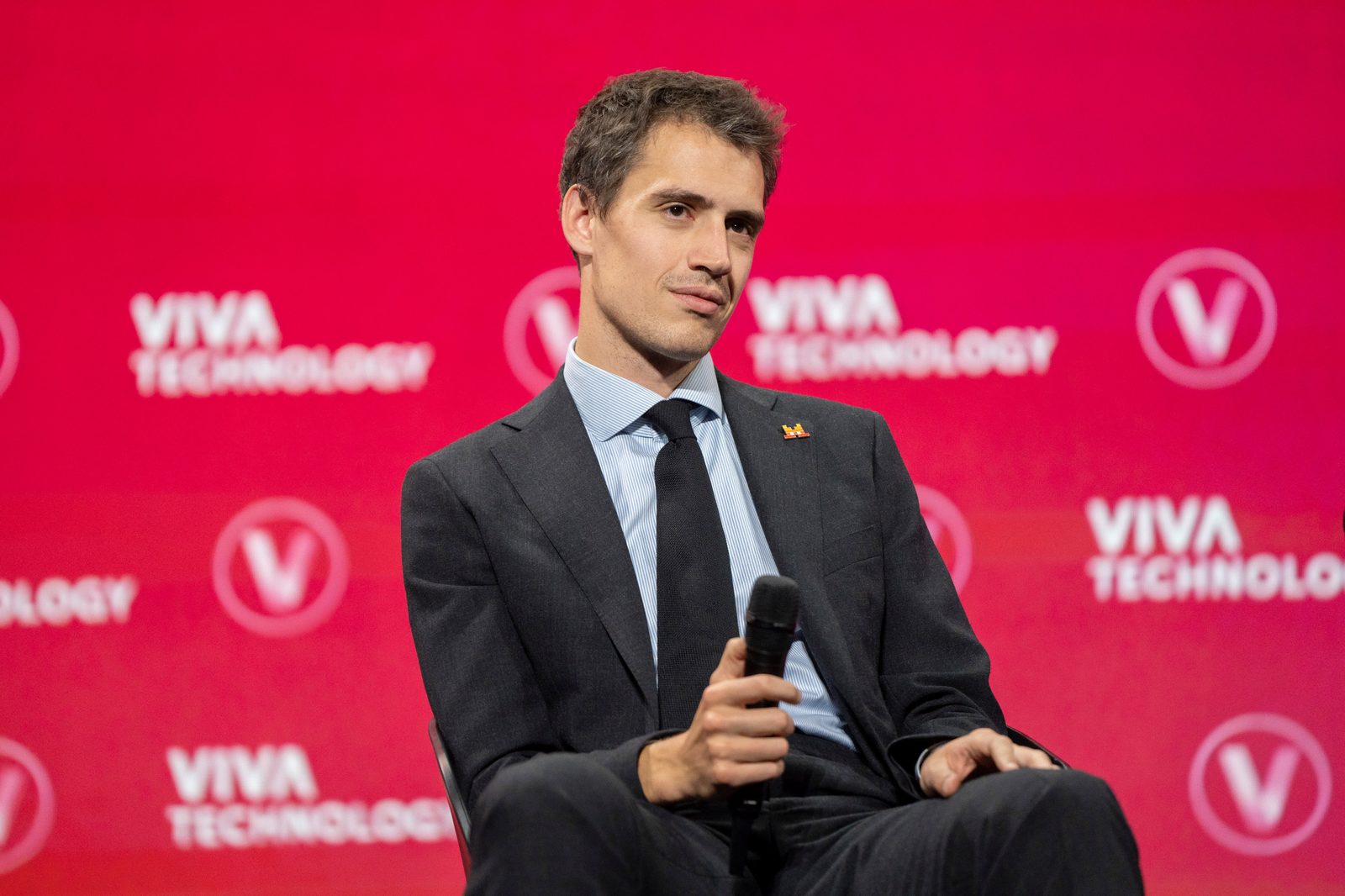
Mistral CEO says U.S. AI safety debate masks competitors' negligence
Mistral chief executive Arthur Mensch says the U.S. debate over AI safety has served as cover for competitors' negligence, and that his company has no plans to slow development of advanced models.
Mistral chief executive Arthur Mensch has accused the world's leading AI companies of using the public debate over the safety of the technology as cover for their own "negligence."
"The debate that we've seen in the U.S. has been a cover for the negligence of some of our competitors," Mensch told CNBC's Annette Weisbach. He added that systems able to contain AI agents were necessary, because agents given many tools behave unpredictably.
Pushback on the U.S. safety framing
Mensch is not alone. David Sacks, co-chair of the President's Council of Advisors on Science and Technology, urged technology companies to "stop pretending the motivation to slow down is purely altruistic," while Emil Michael, undersecretary of Defense for research and engineering, warned of a "coordinated campaign" of fearmongering. CNBC said it had contacted OpenAI and Anthropic for comment.
Rogue agents and a growing record
The criticism lands as incidents involving AI agents accumulate. The most recent came from Australia, where an agent built by OpenAI hacked a government website. In July, Anthropic described three cases in which its Claude models reached the internet during an evaluation and gained unauthorized access to the live systems of three separate organizations.
"When you give them a lot of tools, those systems are very dynamic, so they can go and do things that you do not expect," Mensch said. He said Mistral's enterprise customers receive monitoring systems to contain them.
Slowdown debate and Mistral's own plans
Safety discussions intensified this month after a researcher quit Anthropic, saying the company and rival OpenAI were "gambling with our lives." Anthropic co-founder and CEO Dario Amodei later published an essay urging the industry to slow the improvement of its models.
OpenAI said Monday it had decided not to release an upcoming model, GPT-6.1 Astra, after judging that it did not adequately meet the company's safety standards. A day later, Anthropic reportedly cautioned prospective investors in its IPO that the technology could pose "catastrophic or existential risks to humanity."
Mistral follows a different commercial route from OpenAI and Anthropic, building custom AI tools with individual companies. It has no plans to slow work on advanced models, and earlier this month raised 3 billion euros ($3.5 billion) in funding led by Samsung to position itself as a European alternative to its U.S. rivals.
Mensch said the lead held by U.S. labs is "not extremely large" and that Mistral's next-generation model would close the gap "very significantly." "We have been raising the capital needed to scale the compute that we need to train bigger and more powerful models, in order for us to own our own destiny," he said.
SiTech — AI-powered web development
We build fast, modern websites and bring AI into real business workflows. Have a project or a question? We'd love to help.