Google DeepMind Releases Nano Banana 2 Lite, Its Fastest Image Model
Google DeepMind has launched Nano Banana 2 Lite, also called Gemini 3.1 Flash-Lite Image, which it describes as its fastest and most cost-efficient image generation model. It is available in the Gemini app, AI Studio and the Gemini API.
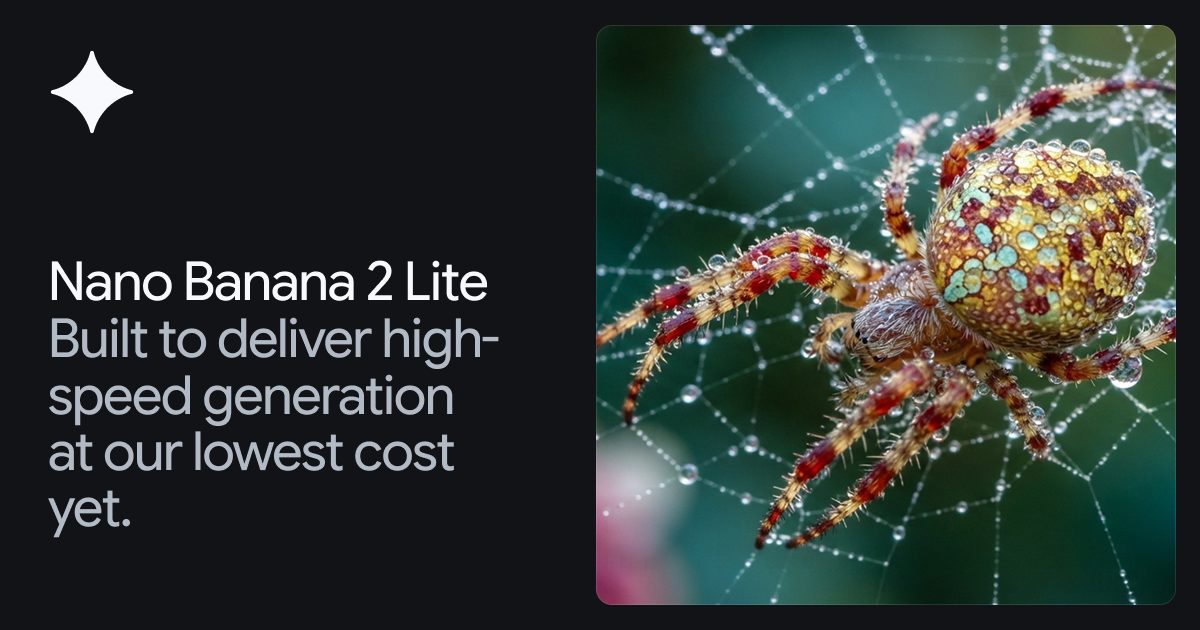
Google DeepMind has released Nano Banana 2 Lite, also named Gemini 3.1 Flash-Lite Image, which the lab calls its fastest and most efficient Gemini image model — built to deliver high-speed generation and editing at its lowest cost yet. It is available through the Gemini app's Flash-Lite mode, Google AI Studio, the Gemini API and the Gemini Enterprise Agent Platform.
Speed, cost and character consistency
The model is positioned around three claims: dramatically reduced latency for iterating on ideas, a price low enough to generate thousands of images at a fraction of the cost of heavier production models, and quality the company says does not compromise on control — character consistency, precise editing and real-world knowledge. A model card and benchmark charts for image generation and editing Elo, latency per 1k-resolution image and price per 1k-resolution image accompany the launch.
Early users and their numbers
Latitude, the studio behind a voice-controlled television game, said the model delivers consistent, high-quality 1k images roughly 2.7 times faster than Gemini 3.1 Flash Image, and handles text-to-image, edits and multi-image composition through one drop-in API. Manus said it is testing the model for real-time image generation inside autonomous workflows, from slide decks to web pages, and that quality comes close to the full Nano Banana 2. Locket's founder pointed to character consistency and low latency at a price point that scales to millions of active users. The launch page also shows consumer demos: Space Lift for reimagining rooms, Gridscape's visual learning canvas, Peek-A-Word for turning selected text into imagery, and Anywhere, a 3D globe that produces personalised postcards.
Known limits and watermarking
DeepMind lists the model's weak points plainly. It can still struggle with small faces, accurate spelling and fine details, and its real-world knowledge is extensive but not infallible. Translated or localised text may miss grammar and cultural nuance, and advanced edits such as masked editing, day-to-night lighting changes or blending several images may produce unnatural results. Character consistency is described as a strength that is not yet perfect.
On safety, the company says it uses extensive filtering and data labelling and runs red teaming and evaluations including child safety and representation. Images carry SynthID, DeepMind's tool that embeds an invisible watermark so AI-generated pictures can be identified.
SiTech — AI-powered web development
We build fast, modern websites and bring AI into real business workflows. Have a project or a question? We'd love to help.