New U.S. college grads now have higher unemployment than the average worker
U.S. graduates now face higher unemployment than the workforce as a whole — the widest gap on record. The reversal began in February 2019, years before ChatGPT and before the pandemic.
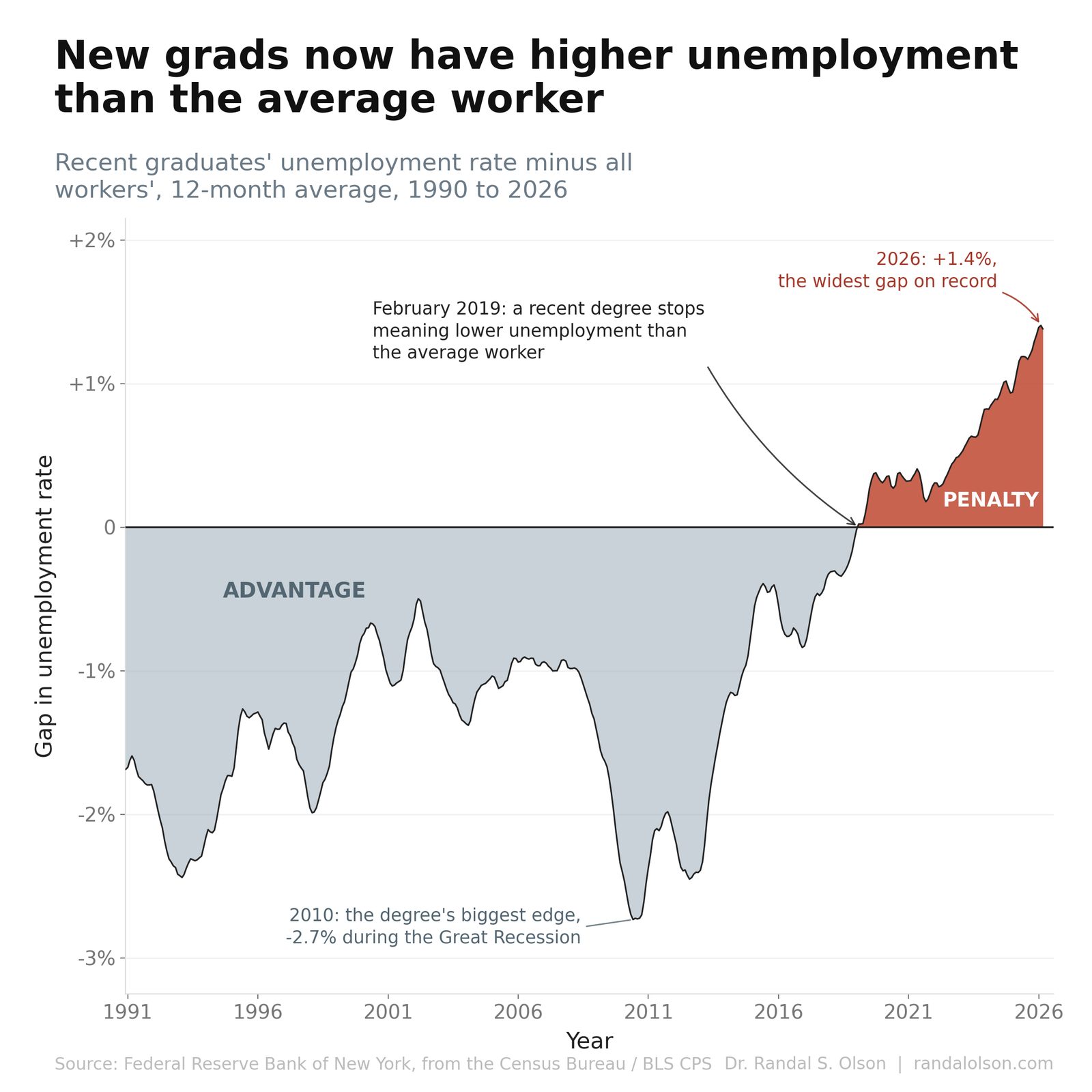
New college graduates in the United States now face higher unemployment than the workforce as a whole — the widest such gap on record, according to an analysis published by data scientist Randal S. Olson. The reversal did not begin with ChatGPT, or with the pandemic: the crossover happened in February 2019.
The advantage disappeared in 2019
Olson's chart tracks a single number — the unemployment rate of recent graduates minus the rate for all workers — as a 12-month average from 1990 to 2026. For most of that period the line sits below zero, meaning a degree was worth more than the average worker's experience. The advantage peaked in mid-2010, when graduates ran around 7% unemployment against close to 10% across the workforce: recessions hit construction and manufacturing first, sectors that lean on workers without degrees. The line crossed zero in February 2019 and has stayed positive every month since. The Cleveland Fed traces the erosion further back, to around 2000.
A record gap, and 41% underemployment
By early 2026 recent graduates sat at 5.6% unemployment against 4.2% for all workers, a gap of 1.4 percentage points and the widest on record. Overall unemployment is healthy; the damage is concentrated among the young. Of the graduates who do have jobs, about 41% are underemployed, working in roles that never required a degree, according to research from the New York Fed.
Remote work, or AI?
Economists are still arguing about the cause. In June 2026 the New York Fed attributed about 64% of the rise in young-graduate unemployment to remote work: employers hesitate to hire inexperienced people into remote roles where the on-the-job mentorship that turns a graduate into a productive worker is hard to deliver. Stanford researchers point to AI instead, finding that early-career workers aged 22 to 25 in the most AI-exposed jobs saw employment fall about 16% since late 2022 — a drop that held even after remote-friendly roles were stripped out. Computer science graduates, whose numbers more than doubled into a shrinking pile of openings, now post some of the highest unemployment rates of any major.
An entry-level problem, not a verdict on degrees
The degree has not stopped paying. Americans aged 25 and over with at least a bachelor's degree had 2.8% unemployment in April 2026, comfortably below the rate for high-school graduates, and the New York Fed still puts the lifetime return on a degree near 12.5%. Young workers without a degree sit at 7.2%, well above the 5.6% recorded for graduates. The Economic Policy Institute argues the picture is more mixed. What has broken, the data suggests, is the entry-level on-ramp rather than the destination.
SiTech — AI-powered web development
We build fast, modern websites and bring AI into real business workflows. Have a project or a question? We'd love to help.