Not everyone is using AI for everything, DuckDuckGo's founder argues
Gabriel Weinberg argues the data behind the "everyone uses AI for everything" narrative does not hold up: American usage splits roughly into a third active, a third occasional and a third never.
The claim that "everyone is using AI for everything" has become a fixture of tech commentary. Gabriel Weinberg, co-founder of the search engine DuckDuckGo, argues in a new essay that the data does not support it. He is responding to a New York Times Magazine introduction from June 2025 with exactly that title, an edited transcript of the Hard Fork podcast.
What the surveys and telemetry show
Weinberg points to Gallup's polling of Gen Z, where awareness of AI is highest. Between 2025 and 2026, the share using AI at least rarely moved from 79% to 81%, while those using it only monthly or every few months stayed around a third (32%, then 31%) and about a fifth (21%, then 19%) never used it at all. Anger about AI rose from 22% to 31%.
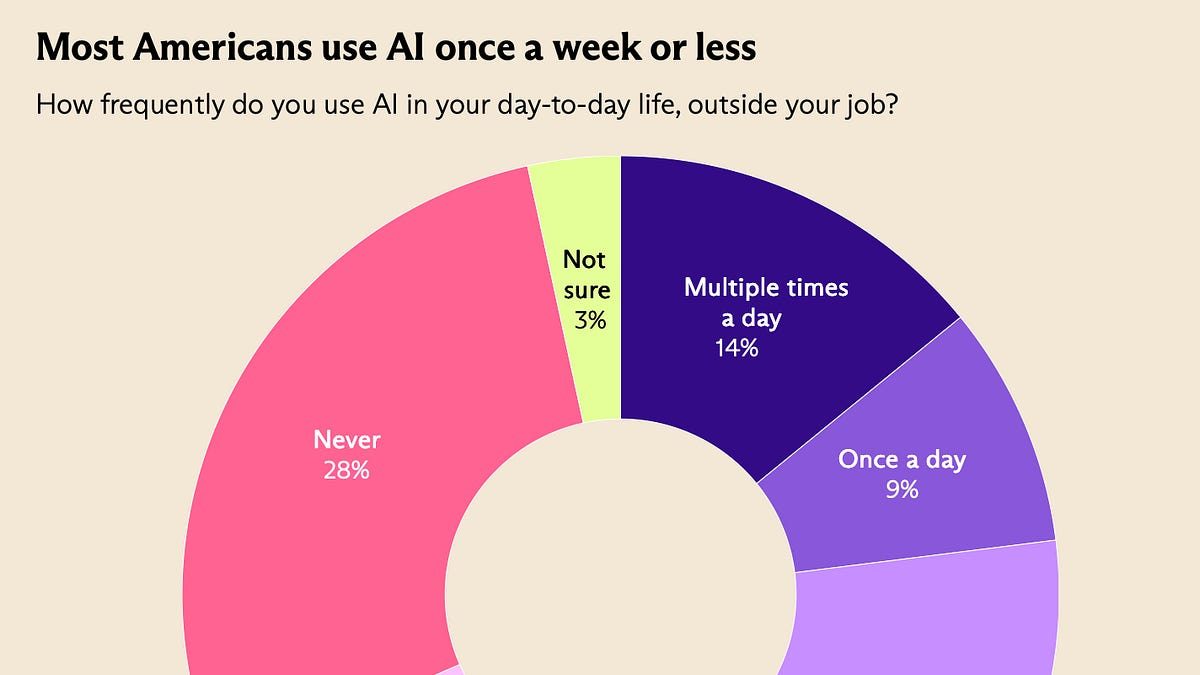
Telemetry points the same way. Microsoft's US AI diffusion data, based on anonymised usage, puts more than 30% of the American working-age population on major AI services for at least 90 minutes a month — meaning roughly 70% is not. An earlier Datos study of desktop devices found that only 21% visited AI tools ten or more times a month, while 62% never did. A Searchlight Institute survey found that 58% report using or trying AI, split evenly between regular and infrequent users, and a survey by The Argument concluded that most Americans use AI once a week or less.
A third, a third, a third
Triangulating, Weinberg puts American AI use at roughly one third active, one third occasional and one third never — closer to "some people are using AI for some things" than to universal adoption. Usage has barely shifted in six to twelve months; what has changed is sentiment. In the Searchlight study, the top concerns were that AI will replace jobs (42%), violate privacy (35%) and spread misinformation (33%). Asked about technologies' overall impact, respondents gave AI a net positive rating of just 8%, close to social media's 7% and far below the internet's 67%.
The meat analogy
Weinberg compares AI to meat consumption: nearly everyone eats meat, but most people limit it. Gallup has found that 95% of Americans eat meat and 30% eat it only rarely, while a 2026 Nature study found that 12% avoid red meat altogether. The reasons — health, cost, environment, ethics — parallel the worries people cite about AI. His own company's answer is to make AI features optional and to offer a private chatbot, duck.ai.
SiTech — AI-powered web development
We build fast, modern websites and bring AI into real business workflows. Have a project or a question? We'd love to help.