NVIDIA Kumo Tabular Sets a New Accuracy-Efficiency Frontier for Tabular Prediction
NVIDIA has released Kumo Tabular, an open foundation model that predicts the labels of new table rows in a single forward pass with no training or feature engineering, and takes first place on four tabular benchmarks.
NVIDIA released Kumo Tabular on September 29, an open foundation model for tabular data that belongs to the NVIDIA Kumo Structured collection. The weights are on Hugging Face and the code ships in the company's open-source structured-data-models library, under the OpenMDW-1.1 license for commercial use.
Given a table of labeled rows, the model returns predicted labels for new rows in a single forward pass: no training, no tuning and no feature engineering, for both classification and regression. It comes in three sizes, from 28 million to 215 million parameters, and was pretrained only on artificial tables.
How it works
Kumo Tabular is a Transformer built around the structure of a table. It combines column, row and in-context attention along the lines introduced by TabICL and TabPFN: each value is read within the distribution of its own column, the features inside a row are related to one another, and context rows with known labels are matched against rows awaiting a prediction. Because the context never looks at the queries, its keys and values are computed once and reused for follow-up predictions. Numerical and categorical values pass through Fourier features, and missing values need no imputation. A temperature that grows with the logarithm of the number of keys keeps attention sharp on longer, wider tables.
Trained on artificial tables
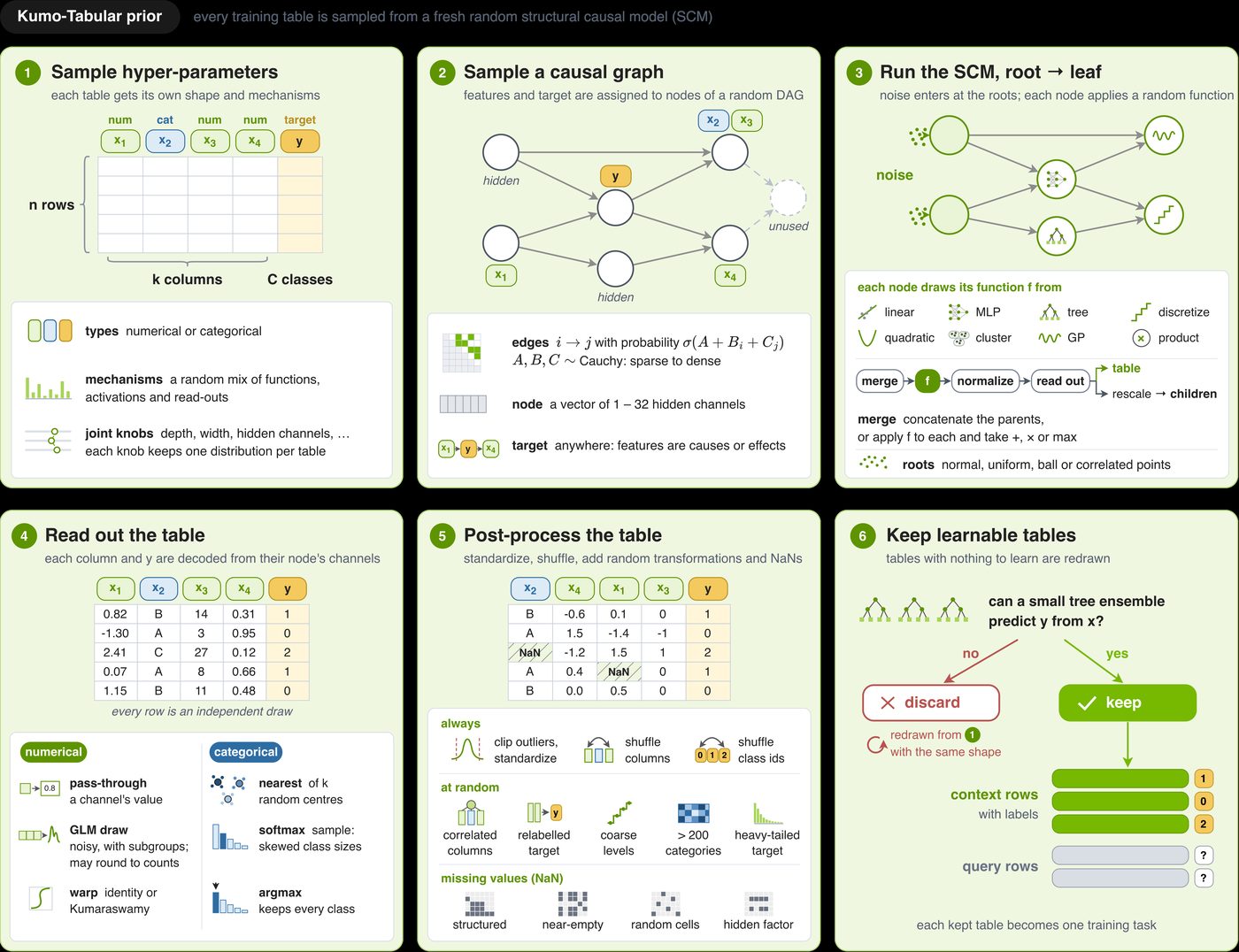
Every training table is sampled from a structural causal model and then post-processed: groups of columns are correlated, outliers are clipped, missing values are injected, and a quick tree-ensemble check discards any table without a learnable signal. Training ran in three stages, from tables of 1,024 rows and up to 100 columns, through contexts of 400 to 10,240 rows, up to 60,000 rows. The Small, Medium and Large versions saw roughly 35, 71 and 137 million artificial tables. Classification and regression are trained as separate models.
Benchmarks
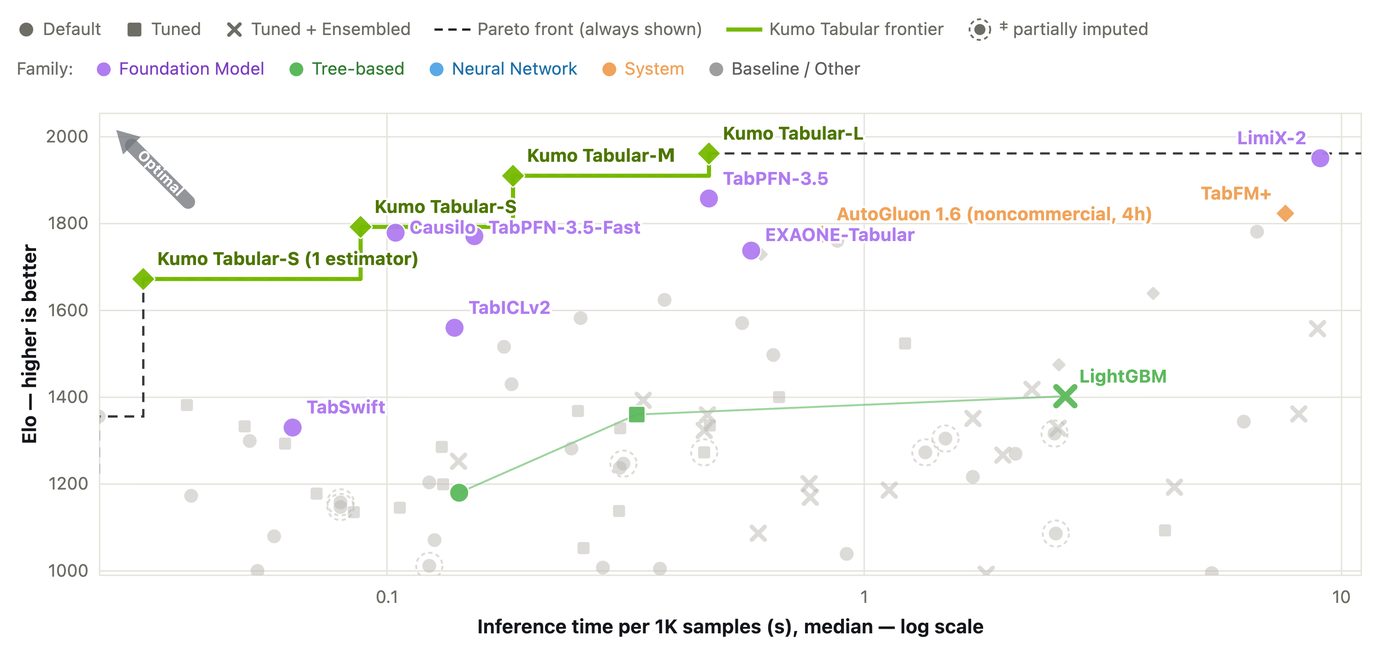
On TabArena the model ranks first overall with an ELO of 1950 and, according to NVIDIA, runs 17 times faster than LimiX-2 under a uniform single RTX 6000 Pro setup. On BeyondArena it reaches an ELO of 1418 with an Improvability score of 7.78%, again first. On TALENT it takes the top overall ranking across classification accuracy, classification log-loss and regression RMSE, with average ranks of 6.67, 3.98 and 4.22. On ScoringBench, Kumo Tabular-Large and Medium place first and second on average rank.
Limitations
SiTech — AI-powered web development
We build fast, modern websites and bring AI into real business workflows. Have a project or a question? We'd love to help.