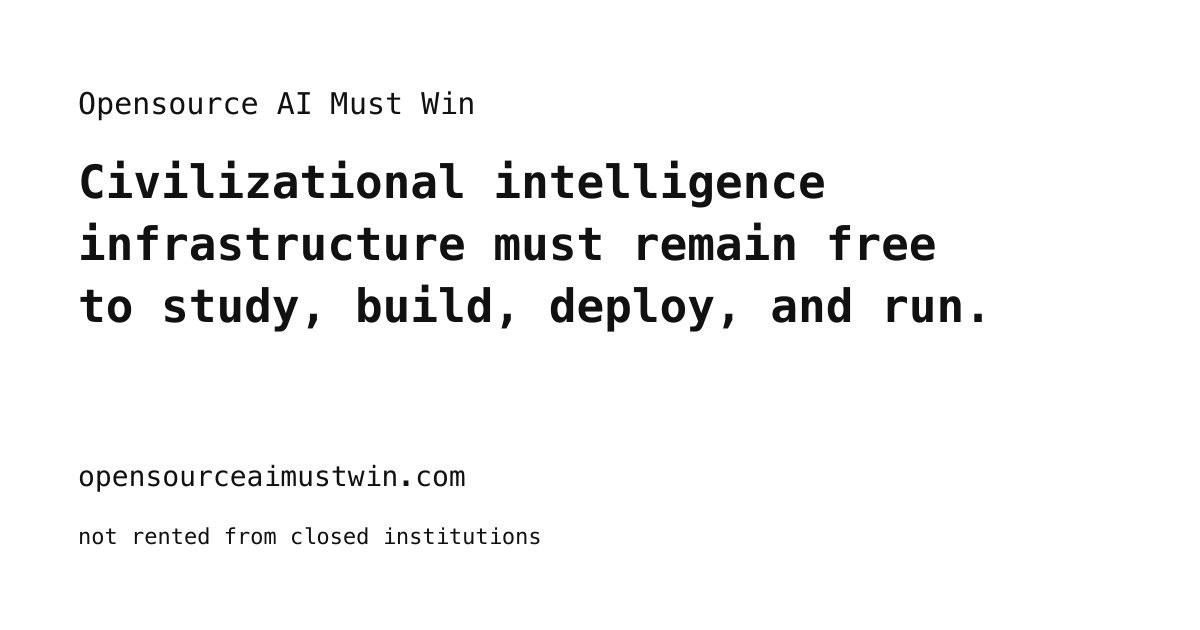
Manifesto argues open-source AI must win against a "subscription economy for cognition"
A short manifesto credited to Ahmad Osman argues that if intelligence can only be rented from a few closed labs, the public loses operational freedom, not just software freedom.
A short manifesto published at opensourceaimustwin.com and credited to Ahmad Osman makes one argument in a few paragraphs: open-source artificial intelligence should be treated as civilisational infrastructure rather than a product rented from a handful of companies.
Operational freedom, not just software freedom
The text opens with a warning about what is at stake. "If intelligence becomes something people can only rent from a few closed institutions, the public does not just lose software freedom. It loses operational freedom," it states. It lists the abilities it considers essential — to study, build, repair, deploy, audit, adapt, teach, preserve and run intelligence systems without asking permission — and calls them of existential importance.
Infrastructure that must not depend on permission
The manifesto frames AI as infrastructure for work, education, science, software, creativity, public services and national capacity, and argues that access to it should not hinge on closed APIs, remote platforms, shifting terms, opaque moderation, model availability or prices set by a handful of companies.
It also sets out a resilience test: open-source AI should remain usable, understandable, reproducible, locally deployable, economically viable and community-governed even if today's dominant labs, foreign labs, hardware vendors, cloud platforms or open-weight model providers change direction or disappear.
American capacity, global open standards
The author argues that when a small number of closed frontier labs and platform companies control the models, this infrastructure risks becoming "a subscription economy for cognition". He frames the practical posture as American capacity with global open standards, and writes that the United States should not fall behind on the freedom to run, inspect, modify, benchmark, teach and preserve intelligence infrastructure.
The page ends with an invitation: readers who want to help make the idea real are asked to send a quiet note to an address at osmantic.com. No organisation, funding list or signatory roster is attached to the text.
SiTech — AI-powered web development
We build fast, modern websites and bring AI into real business workflows. Have a project or a question? We'd love to help.