Open-source LDraw Nova uses AI models to generate detailed LEGO CAD designs
LDraw Nova lets AI models write Python programs that generate LDraw files for complex LEGO designs, including a 2,175-piece Sakura Garden, without placing every brick manually.
AI-generated LEGO designs
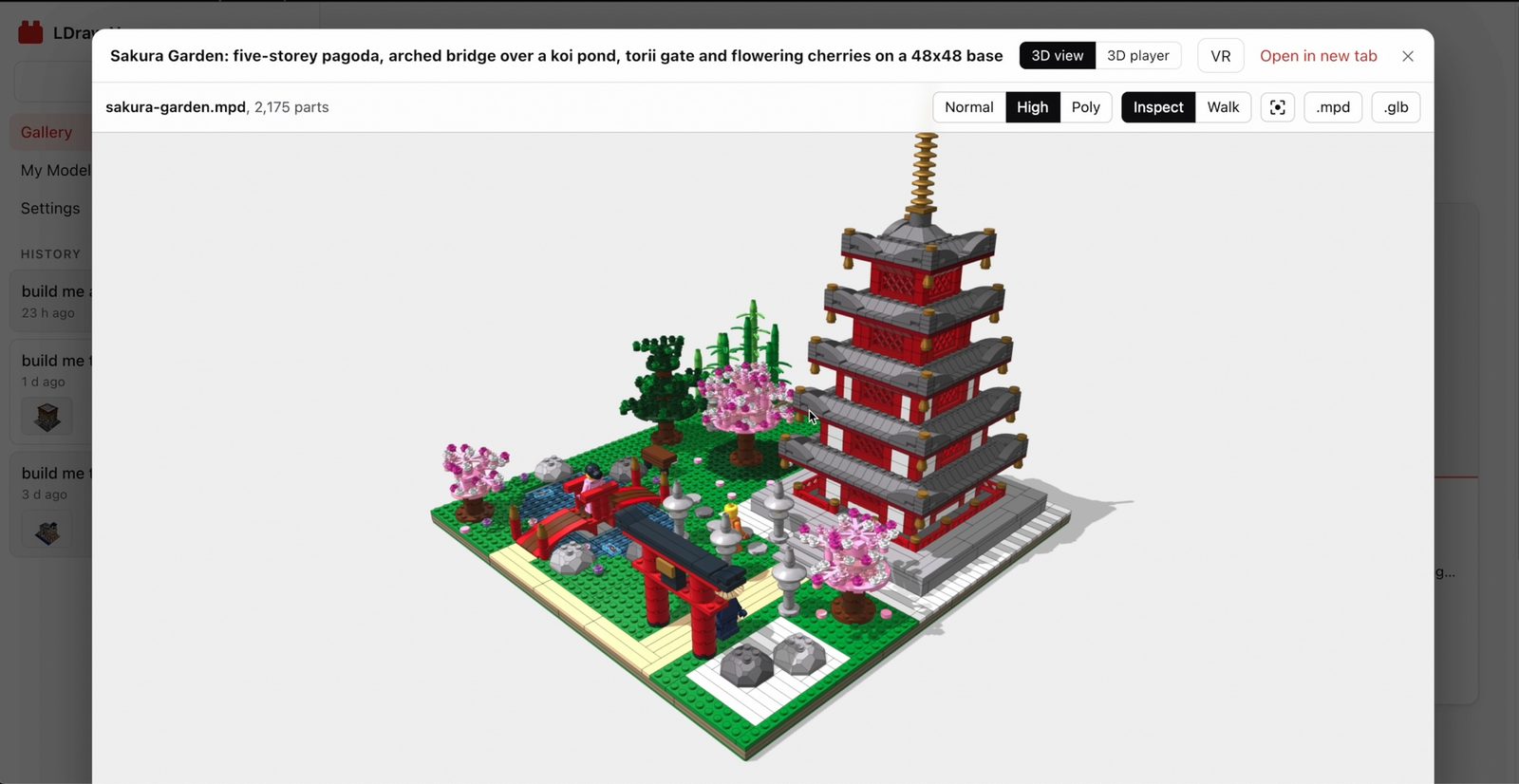
Open-source toolkit LDraw Nova can use general models such as GPT-6 Astra and Claude Opus 5.5 to design detailed LEGO builds from prompts. Developer Carlos Antelo posted the project on Friday afternoon as its first release, following three earlier attempts to get the toolkit working. One result is the 2,175-piece Sakura Garden, created after Claude Opus 5.5 was asked to produce the most beautiful model it could imagine.
LDraw is a text format in which each positioned LEGO piece is represented by one line. Files can be opened in LDView, LeoCAD and Studio. An agent writes a JSON plan describing the model and its submodels, creates a Python program and then generates the LDraw output. The rendered design can be inspected and adjusted in a continuing loop. This method avoids direct geometry calculations because Antelo believes agents are better at generating Python code.
A web app for several AI providers
LDraw Nova runs as a Docker web app supporting providers including OpenAI, Anthropic and OpenRouter. Its gallery credits each build and prompt to the model that produced it. Sakura Garden and the unfinished Atlas Crane are attributed to Opus 5.5, while Astra produced the Cathedral and Tidal Observatory.
An optional component called jev-rerank was used for Astra's Cathedral build. The semantic search tool uses TypeSafe's Jev System One model to rerank searches for LEGO parts. If no TypeSafe API key is supplied, the agents use full-text search instead.
Current limitations
None of the generated designs has been assembled with real bricks, and Antelo estimates that collecting the thousands of parts needed for a larger model would be difficult. Nova also lacks physics modeling, meaning it can handle collisions but does not ensure stability. Antelo estimates that having Astra build one Technic mechanism could cost around $5 in tokens. He also says the process remains time-consuming and that, in his experience, only frontier models can currently generate large, accurate builds. Meta Quest 3 VR support has many issues, including performance problems.
The project differs from Carnegie Mellon University's LegoGPT, now called BrickGPT. BrickGPT was trained on more than 47,000 LEGO structures and checks designs for validity and physical stability as it generates them.
Toward physical models
Antelo's goal is to create tooling that low-end agents can use to build models iteratively. Minifigures, Technic machines and engines are planned additions, and he is considering 3D-printing a small model. Model Context Protocol servers can also connect agents to printers: Kiln can upload a file and start a print, while OctoEverywhere can check a print and pause, cancel or resume it.
SiTech — AI-powered web development
We build fast, modern websites and bring AI into real business workflows. Have a project or a question? We'd love to help.