OpenShot 4.0 released with screen recording, colour grading and local AI masks
The free open-source video editor adds recording of screen, camera and microphone, a full colour-grading workspace with scopes and LUT support, ten new effects and AI masks that run locally without any cloud service.
OpenShot 4.0 has been released, and its developers describe it as one of the biggest creative workflow upgrades in the project's history. The free, open-source video editor now records screen, webcam, microphone and system audio straight into a project, and adds a colour workspace, ten new effects and machine-learning masks that run locally.
Colour grading and recording built in
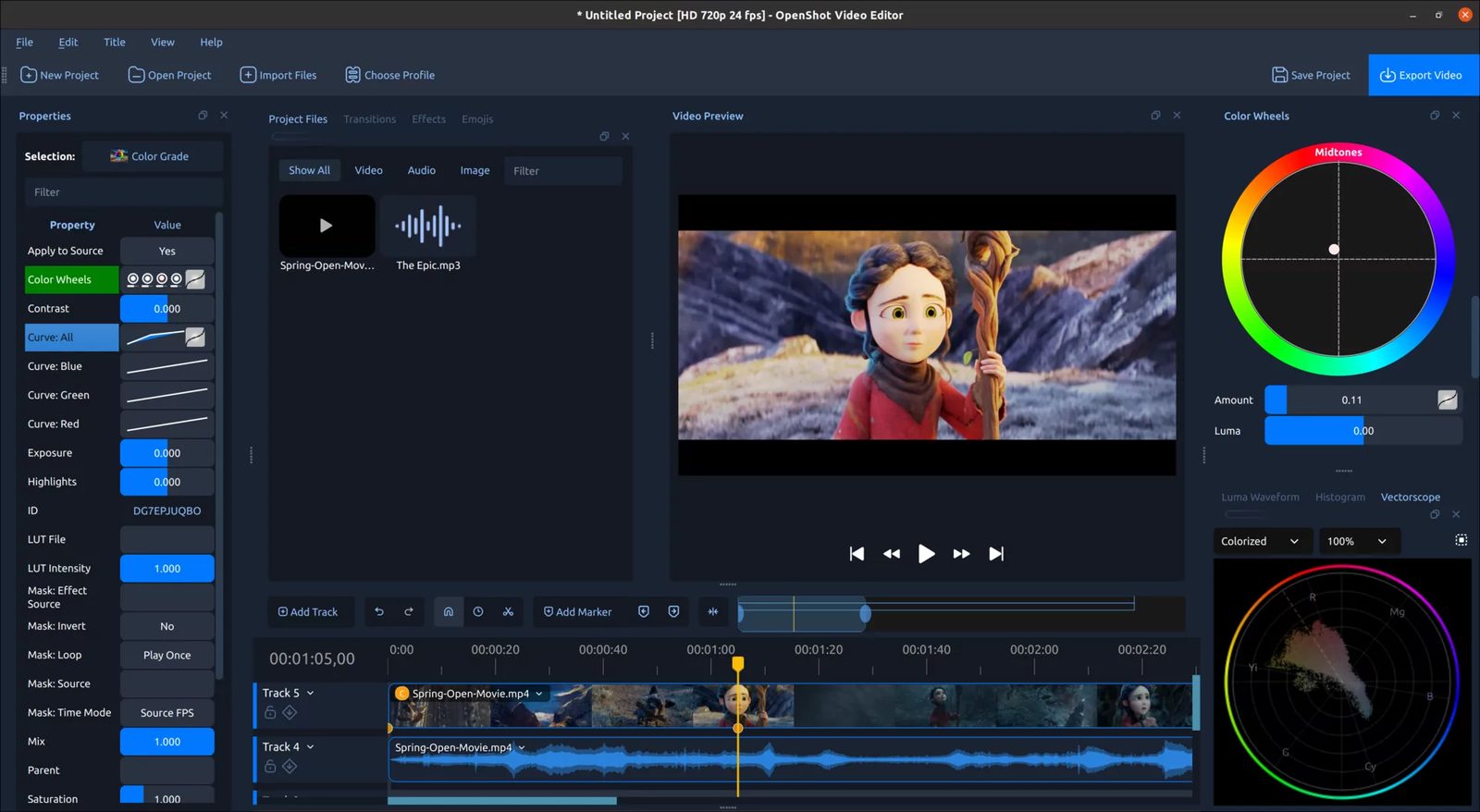
The new Color View places a large preview, clip properties, colour wheels and live video scopes around the footage. Its Color Grade effect gathers exposure, contrast, temperature, tint, highlights, shadows, saturation and vibrance, with separate wheels for shadows, midtones and highlights, four editable curves for the master, red, green and blue channels, and support for standard .cube LUT files with an intensity control. A luma waveform, histogram, RGB parade and vectorscope update as the playhead moves, and each scope can be restricted to a drawn region; the vectorscope includes a skin-tone reference line.
The Recording View captures microphone, desktop, webcam and system audio without a separate import step. Every source is written as its own file and timeline clip, so narration, system sound and screen capture can be edited separately. Combined screen and webcam recordings can be placed in a rounded picture-in-picture layout. Platform support covers Windows, macOS, Linux X11 and Linux Wayland with PipeWire.
Local AI masks and ten new effects
Object Mask isolates a moving subject from a few positive and negative points, then follows it through the clip. The models — YOLO, EfficientSAM and Cutie converted to ONNX — are downloaded for free and executed locally, so footage is never uploaded and no account or subscription is required. The resulting mask can drive blur, pixelation or colour grading, and Object Detection has gained downloadable YOLOv5 ONNX models.
Ten effects were added to the video engine, among them Audio Visualization with waveform, bar, radial and VU-meter styles; Beat Sync, which turns a clip's energy into colour that reacts to beats; Film Grain with 35mm, 16mm and Super 8 looks; Denoise Image; Shadow; Glow; Displacement Map; Timer and Object Mask.
Native timeline, speed and future platforms
The editor has completed its move away from the old web-based timeline components to a native Qt timeline with smoother zooming and editable timecode. In the project's benchmarks against version 3.5.1, the Blur effect ran 61.8% faster, Sharpen improved by 12.8%, and timeline rendering by 3.4%. Expanded Qt 6 and PySide6 support improves compatibility with current Linux distributions, and the codebase now contains foundations for Android, although no release date is announced. libopenshot and libopenshot-audio both reach version 1.0.0.
OpenShot is funded by donations rather than licences.
SiTech — AI-powered web development
We build fast, modern websites and bring AI into real business workflows. Have a project or a question? We'd love to help.