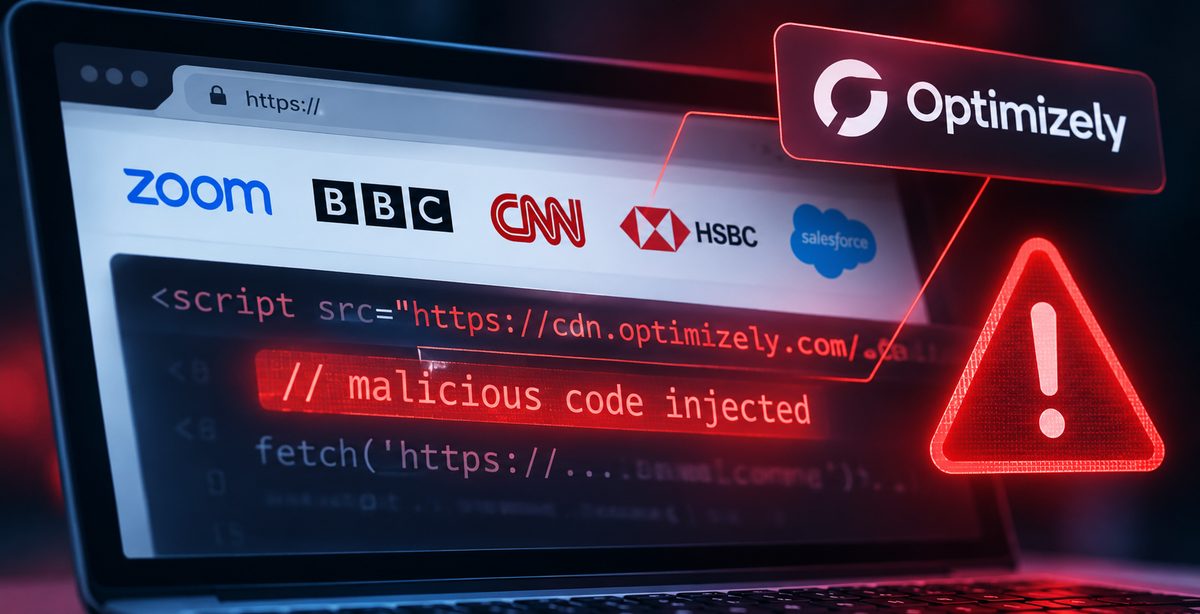
Malware Delivered Via Optimizely Hit 178 Organisations
Malicious JavaScript injected into Optimizely Web snippets reached visitors of 178 organisations on 16 November 2026, swapping crypto addresses, skimming cards and delivering iOS exploit kits.
On 16 November 2026, malicious JavaScript was served to visitors of 178 organisations through the Optimizely Web experimentation platform, including sites such as Zoom, BBC, CNN, Salesforce, GitLab, IKEA, HSBC, Equifax, Air France-KLM, Ledger and Peacock. The malware swapped cryptocurrency wallet addresses, skimmed payment cards, stole cookies and screenshots, and delivered Coruna and DarkSword iOS exploit kits on iPhones and iPads. Crypto theft was verified, with about $7,040 received by attacker wallets.
How the injection worked
Optimizely Web customers load a JavaScript snippet from Optimizely's CDN. The attacker wrote code into the Project JavaScript field of customer projects, while the rest of each snippet remained untouched. The file was still served from cdn.optimizely.com with Optimizely's certificate, from a host affected sites already trusted. Some customers serve the snippet from their own domain, but those were affected too because content comes from the same project. Optimizely's own snippets for www.optimizely.com and login.optimizely.com also carried the code. The method of gaining write access is unknown.
What the payload did
Every visitor received track.js, and all parts were active at once. It replaced valid wallet addresses across BTC, ETH and EVM chains, TRON, Solana, TON, Litecoin, Bitcoin Cash and Dogecoin with attacker addresses, validating checksums. It watched form submissions and fetch or XHR POST requests for card numbers, expiry dates and CVV, then sent them to 1688360.cc/card.php. It also sent page URL, non-HttpOnly cookies, original addresses and a screenshot to 1688360.cc/hit.php when swapping near wallet or payment wording. On iPhones and iPads it loaded boot.js from 5vobauua3ojpklx.icu and eil786npto9u5bq.icu, then selected Coruna for iOS 13 to 17, DarkSword for iOS 18.x, and a separate chain for iOS 26 that only fingerprints the device. iOS 18.6 or earlier pages reloaded every 60 seconds to retry the exploit.
Impact and cleanup
Researchers fetched 1,611 distinct snippets and found 188 snippets belonging to 178 organisations infected. Most malicious code was later removed: at 21:52 UTC it remained in only 1 of 188 infected snippets (TalkTalk), down from 169 at 20:56 UTC. The payload was rebuilt 26 times during the day; features and wallets were added but none removed. Attacker wallets received about $7,040 within roughly nine hours on 16 November, and funds were swept out at 13:03 to 13:05 UTC. The affected list includes 32 banking and finance organisations and 23 technology and SaaS organisations.
CSP and next steps
Report URI says its tools could detect unexpected JavaScript changes, new scripts, suspicious connections, changing snippet fingerprints and new frame sources. A crawl of 256 affected hosts found 68 had no CSP, 50 allowed payload and data theft, 17 blocked data theft but not address swapping, and 24 blocked the payload. Restrictive script-src separated protected sites; strict-dynamic and unsafe-eval could let injected scripts through. Recommended actions include reviewing Project JavaScript and experiment code for 1688360.cc, atob and unfamiliar scripts, rotating credentials, treating cards entered on 16 November as potentially exposed, rotating non-HttpOnly session tokens, deploying a restrictive CSP, and updating iPhones or iPads to iOS 18.7.3 or later or iOS 26.3 or later.
Sources: blog.report-uri.com · amirulcyber.com
SiTech — AI-powered web development
We build fast, modern websites and bring AI into real business workflows. Have a project or a question? We'd love to help.