Physical Intelligence Opens Pi API Beta for Robot Model Fine-Tuning and Inference
Physical Intelligence has launched the Pi API beta, giving developers access to its π 0 and π 0.5 robotic foundation models for fine tuning and hosted inference. Partners across industries are already iterating on real deployments.
What the Pi API Offers
Physical Intelligence, the company behind the π 0 and π 0.5 robotic foundation models, has announced the beta launch of the Pi API. The service is designed to remove the infrastructure barriers that typically come with adapting general purpose robotics models to specific tasks. Instead of building ML infrastructure, compute pipelines, and data systems from scratch, developers can upload their data, launch fine tuning on compute managed by Pi, and run inference through a hosted gateway.
According to the company, the latest model available through the API already delivers more data efficient fine tuning and improved capability for partners. Because Pi can update the models behind the API quickly, the company plans to keep exposing its newest and most capable models through the same interface. The beta is described as a first step toward providing a physical intelligence foundation for the community and enabling end to end autonomy.
Early Partners and Deployments
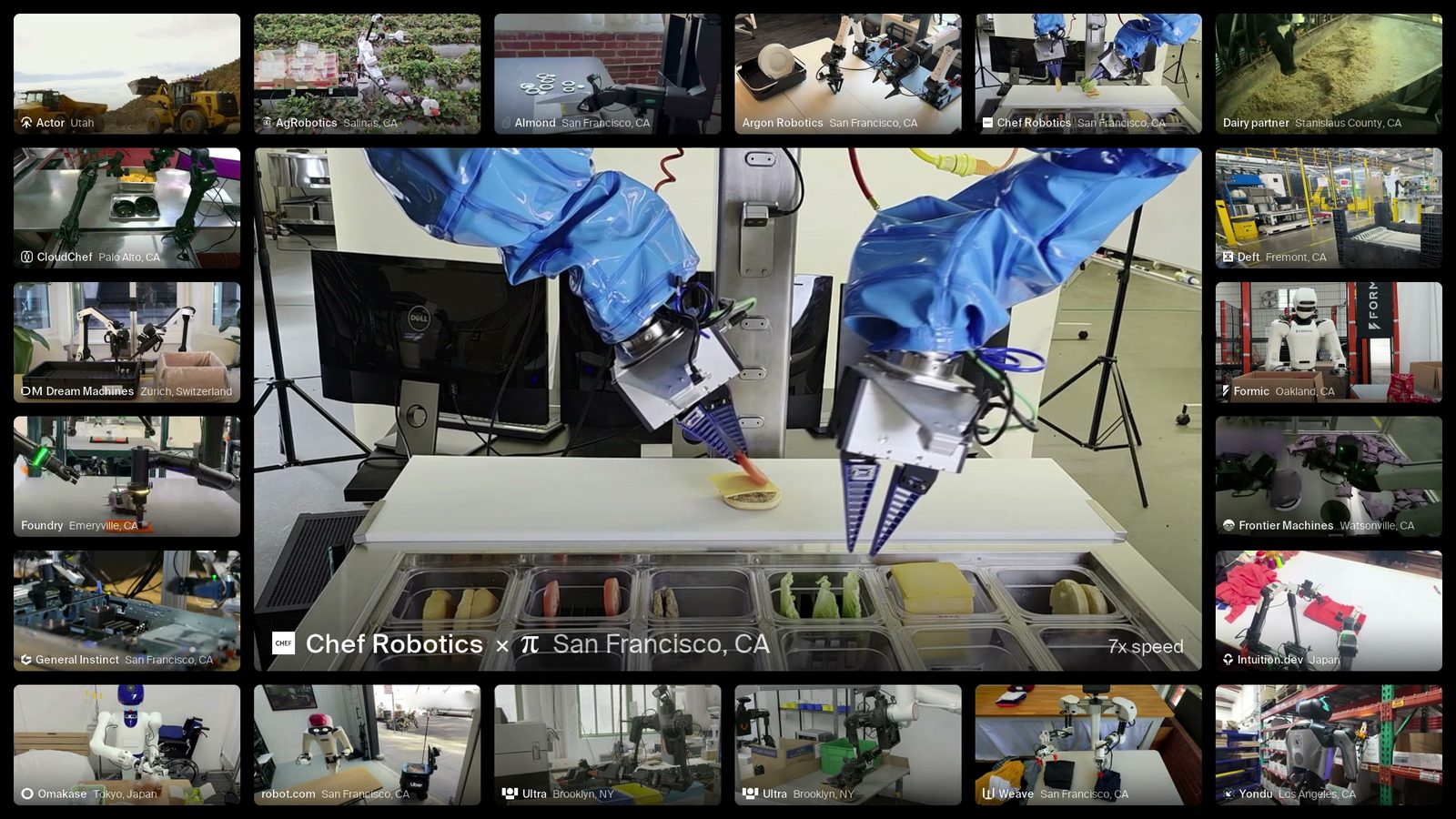
To test how broadly the models adapt, Pi worked with companies deploying robots across diverse industries and hardware. Actor, for example, runs an autonomous wheel loader that scoops material and loads it into a dump truck during a real commercial deployment in Utah with no operator inside the machine. Other named partners include AgRobotics, CloudChef, Ultra Weave, Argon Robotics, Chef Robotics, Deft, Dream Machines, Formic Robotics, Foundry, Frontier Machines, General Instinct, Intuition.dev, Omakase, robot.com, Ultra, and Yondu.
Almond, based in San Francisco, builds Axol, a dual arm robot aimed at physical AI builders, with the goal of having Axol build itself. In one demonstration, Axol deburrs spacers used in its own assembly, running a model the team obtained after iterating with the Pi API for four days. Most of the shown applications, spanning Japan, Switzerland, and the United States, ran with cloud hosted inference through the API.
Iteration and Feedback
Across the early collaborations, Pi observed a common improvement loop: collect demonstrations, train a model, test it on the robot, and use the failures to decide what data to collect next. The company built the API so developers can run this loop themselves. Early access participants were able to start quickly and make progress on their own tasks, which ranged from garment handling to food service to manufacturing.
The deployments also surfaced areas for improvement, including network connectivity challenges in some settings. Pi says feedback from real world use will shape future releases, and the company is hiring across research, infrastructure, hardware, people, and operations. Developers interested in joining the beta are invited to describe what they want to build.
Sources: pi.website
SiTech — AI-powered web development
We build fast, modern websites and bring AI into real business workflows. Have a project or a question? We'd love to help.