
Stanford and Caltech researchers plug GPT-6 Astra into a humanoid and let it clean an unfamiliar kitchen
Researchers from Stanford and Caltech built HomeBody, a system that lets a Unitree G1 humanoid guided by GPT-6 Astra tidy an unfamiliar kitchen and fetch items from drawers. The robot explores the room first and acts without environment-specific training.
Researchers from Stanford and Caltech have built HomeBody, a system that lets a Unitree G1 humanoid autonomously navigate an unfamiliar kitchen, tidy up and fetch items from drawers. The robot's decisions come from GPT-6 Astra, a swappable vision-language model rather than a piece of a conventional, heavily trained robotics stack.
The project's central question: does a humanoid still need a separate trained control layer between high-level reasoning and motor skills, or can a frontier model orchestrate them directly?
Dropping the trained control layer
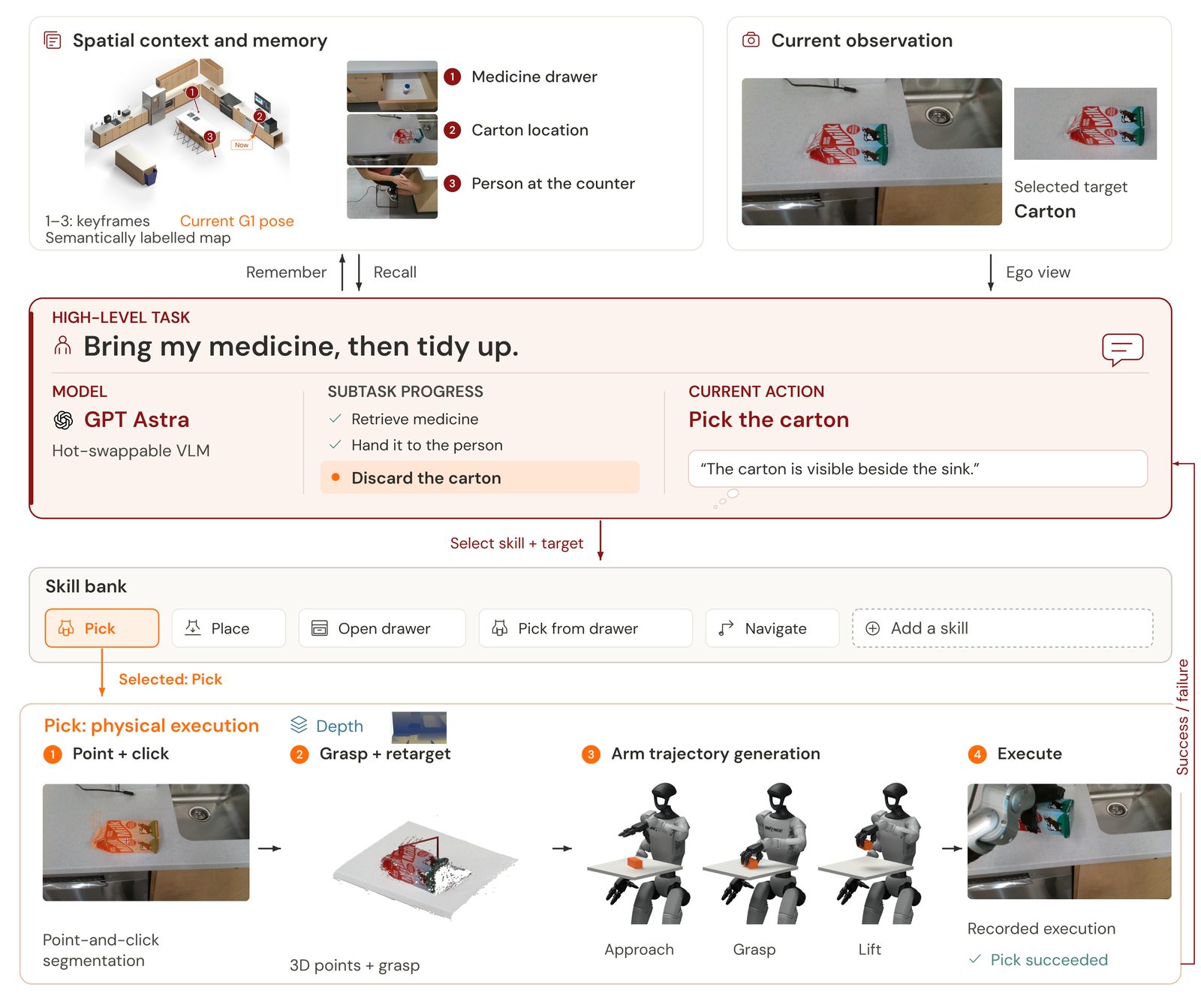
Most humanoid autonomy stacks have three parts: a System 2 vision-language model interprets observations and instructions, a learned System 1 policy produces commands, and System 0 executes motion. HomeBody removes the middle link. A swappable VLM, in this case GPT Astra, calls directly into an extensible skill library for grasping, navigating and opening drawers.
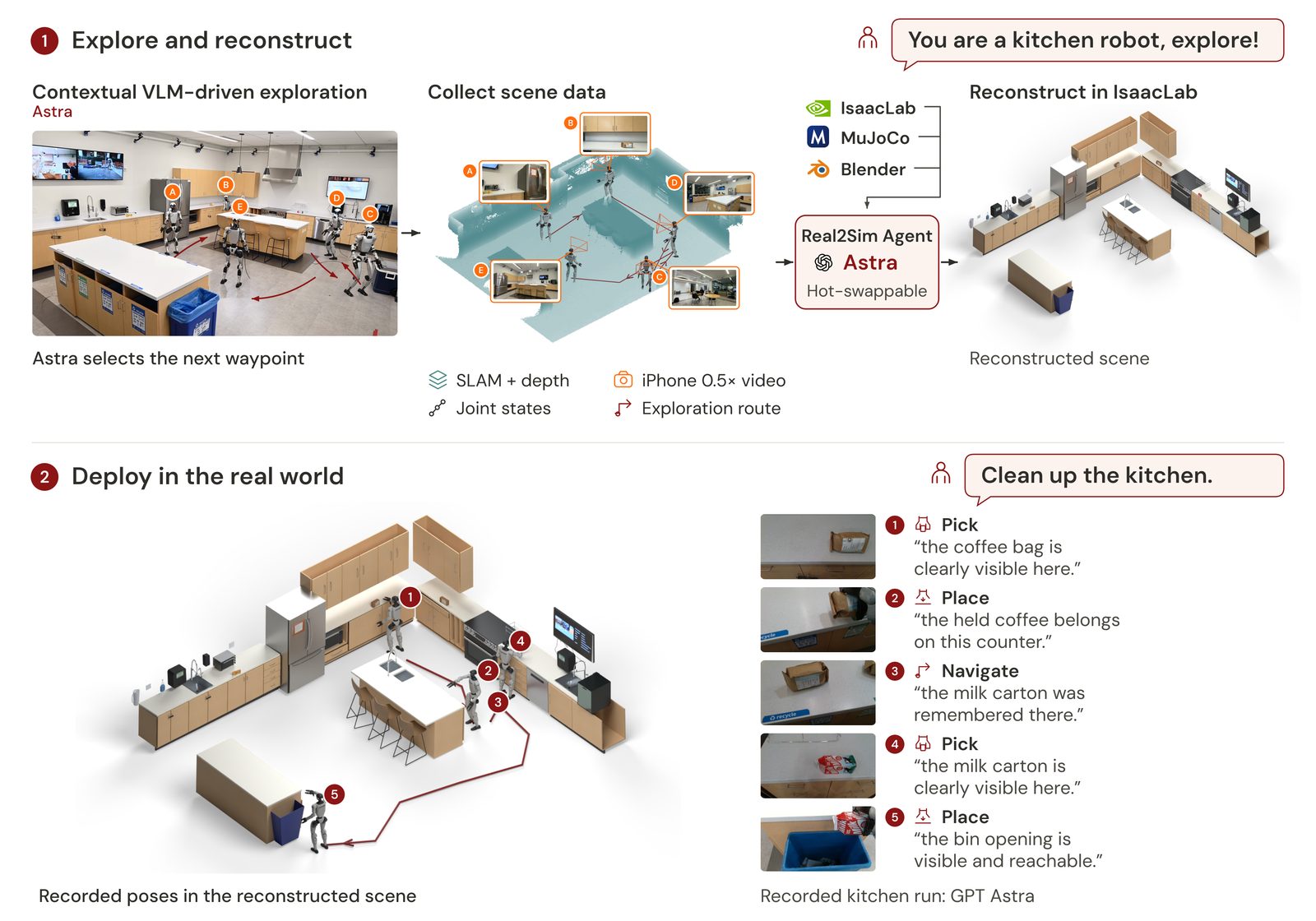
The robot explores the room first, collecting camera observations, measured SLAM geometry, joint poses and waypoints. That data grounds a Real2Sim reconstruction: a digital twin of the kitchen built in NVIDIA's Isaac Sim, with the humanoid localized via Super Odometry and its map aligned to the simulation with ICP. Objects and locations are stored in spatial memory in a shared coordinate frame, so the robot can find items even after they leave its field of view.
Long-horizon tasks and self-correction
For a task like "clean up the kitchen," the language model plans each step and revises its next decision when an action or a transition fails. In a previously unseen kitchen, the GPT Astra-guided G1 cleaned up across the room and retrieved a remembered object from an underspecified request, without environment-specific training data or extra policy learning.
Limits, and a growing safety question
The researchers list real constraints: Astra's latency, overheating finger servos and high compute costs. The code is on GitHub. Earlier benchmarks showed the model's improved spatial reasoning; a separate evaluation flagged safety issues when Astra controls a robot. OpenAI has already announced plans to get back into robotics, including for personal use. The HomeBody paper is by Gio Huh, Cayden Gu, Takara E. Truong, C. Karen Liu and Guy Tevet.
SiTech — AI-powered web development
We build fast, modern websites and bring AI into real business workflows. Have a project or a question? We'd love to help.