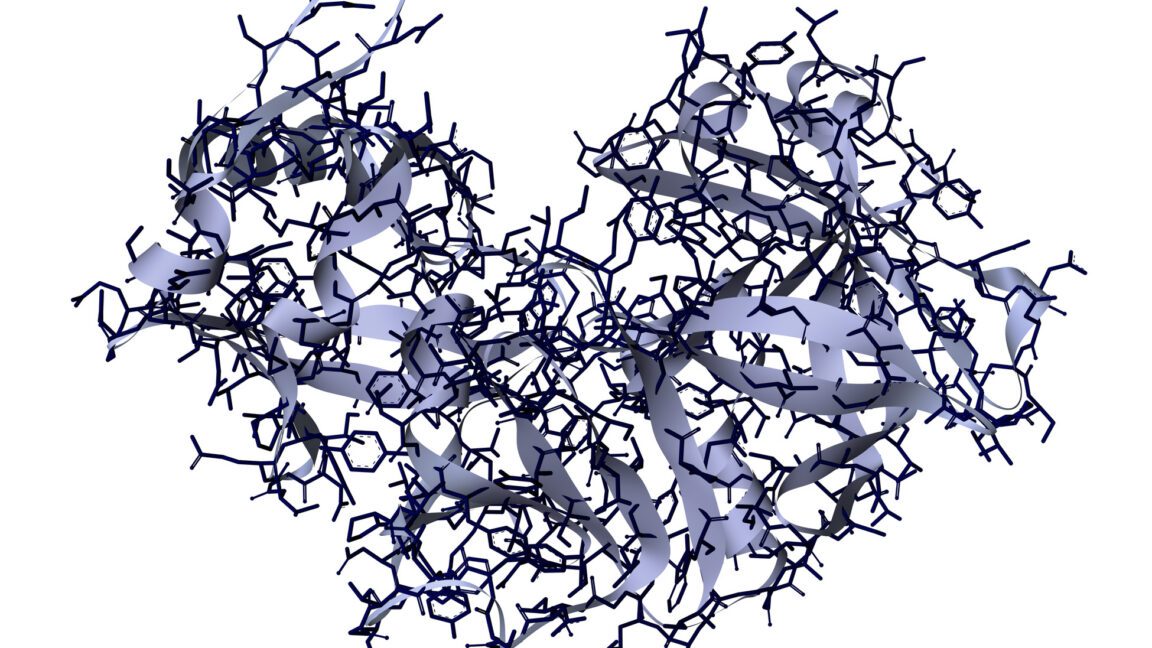
AI designed proteases that cut chosen proteins show promise against disease targets
Researchers used AI protein design to build working proteases from the catalytic cores of zinc and yeast enzymes. The designs cut targeted sequences and sped cleavage up to ten billion fold, including targets linked to Alzheimer's.
Enzymes built around a catalytic core
Peptide bonds that link amino acids in proteins are so stable that they can persist for hundreds of years in water without help. Life solves this with proteases, enzymes that position a few key amino acids to accelerate cleavage. The team, based mainly in David Baker's lab at the University of Washington, treated protease design as a test of AI protein design tools.
They started from two known protease mechanisms. A zinc protease from a crayfish digestive system uses the charge of a zinc ion to coordinate the bond being broken, key enzyme parts and a water molecule. A cysteine protease from yeast instead activates a cysteine to attack the target, forming a temporary link that water later resolves.
Design with RFdiffusion2, ProteinMPNN and AlphaFold3
The pipeline began with RFdiffusion2, which proposed enzyme backbones under two constraints: bring the essential catalytic amino acids together, and place a chosen target sequence next to the catalytic center. ProteinMPNN then filled each backbone with amino acids that fit the planned fold, the catalytic site and the intended target. The group repeated the process many times and used AlphaFold3 to check that the resulting structures resembled nothing in existing databases.
From weak cuts to strong ones
For the cysteine protease, 12 backbones were populated with 69 amino acid sets and 13 designs worked, a 19 percent success rate, though all were far less active than the yeast enzyme. For the zinc protease, designs without a placed water molecule mostly failed, with only 14 of 89 showing weak activity. Adding the water molecule as an explicit constraint raised the hit rate sharply, with 35 of 38 designs showing catalytic activity.
Swapping in alternative amino acids near the active site improved performance further. The best cysteine design cut its intended sequence about one billion times faster. A refined zinc protease, called version 2, was 30 times more active than the original design and accelerated peptide bond cleavage by about ten billion times.
Targets in cells and remaining limits
As a final test, the team designed zinc proteases against proteins associated with neurological conditions such as Alzheimer's and frontotemporal dementia. Adjusting an existing design for a new sequence did not work well, so they reran the design process and obtained an enzyme that cut the intended target in cells.
The authors note that therapies still face hurdles, including protein delivery, immune responses and the need to deliver a gene if the target sits inside cells. They also caution that the tools excel at structure but cannot yet be asked for a specific activity, so random mutation still found subtle changes that raised catalytic power.
Sources: Ars Technica
SiTech — AI-powered web development
We build fast, modern websites and bring AI into real business workflows. Have a project or a question? We'd love to help.