Seven books I keep close because I love them
The author of blog.plover.com explains why exactly seven books sit within arm's reach of his desk: not the ones he consults most, but the ones whose influence he most hopes will shape what he writes.
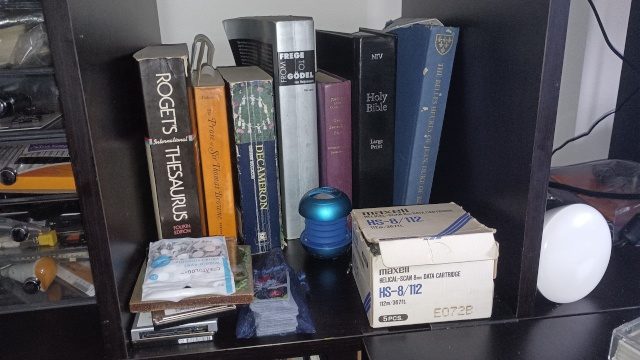
In a post published on 2 August 2026, the author of blog.plover.com explains why exactly seven books sit within arm's reach of his desk: not the ones he consults most often, but the ones whose emanations he most hopes will infuse him as he writes.
Roget's Thesaurus, a storehouse of ideas
The book he refers to most is the Harper and Row Roget's Thesaurus, fourth edition; a note on the flyleaf says 1989. He bought the eighth edition expecting to prefer it and kept the two side by side for a while, but concluded that it had more material in it, just not material he needed, and it is very fat, so it has been retired to a farther shelf. The thesaurus is widely misunderstood, he argues: the word means storehouse or treasure room, and its intended use is not to swap common words for impressive ones. Roget's idea, like John Wilkins's before him, was to classify the world into a hierarchy of a thousand divisions; under time come priority, posteriority, simultaneity, the past, the present and the future. Posteriority offers ensue, aftermath and subsequent — related aspects rather than synonyms — while a half-remembered word can be reached by looking up coexisting and arriving at contemporaneous. None of this works for a reader who does not know what the words mean.
Browne and Boccaccio
The second volume is an anthology of the prose of Sir Thomas Browne, a recurring subject on the blog and a favourite of Jorge Luis Borges. Browne's best-known work is Pseudodoxia Epidemica of 1646, a compilation of things people then believed that he thought were probably wrong: whether John the Baptist ate real locusts, or whether snails have eyes in their horns. On the snails he was wrong for a curious reason, arguing that conceding two eyes would force him to grant four, which would be monstrous, and therefore none at all; he changed his mind in a later edition. Beside him stands Boccaccio's Decameron: in 1348, during the Black Plague, ten young people abandon the city, retire to the country and spend ten days telling stories on a chosen theme. The copy on the shelf is Cormac O Cuilleanain's translation, and the funniest tale is the abbess called out at night to scold a nun, who does not notice she has put her own lover's trousers on her head instead of her wimple.
Logic and pictures
From Frege to Godel, edited by van Heijenoort, collects the key papers of mathematical logic: Frege's Begriffsschrift, Russell's letter showing that Frege's foundation did not work, Peano's original description of the Peano numbers, Zermelo's proof that every set can be well-ordered, and Ackermann's function. The editor, the author notes, was Leon Trotsky's personal secretary and one of Frida Kahlo's lovers. Beside it sits Johannes Comenius's Orbis Sensualium Pictus, the first illustrated children's book published in Europe, in 1658; it was translated into English the following year and then into French, Italian and many other languages. Each engraving is annotated with numbers and explained item by item, with a parallel Latin column so that the reader learns the world and the language at once.
SiTech — AI-powered web development
We build fast, modern websites and bring AI into real business workflows. Have a project or a question? We'd love to help.