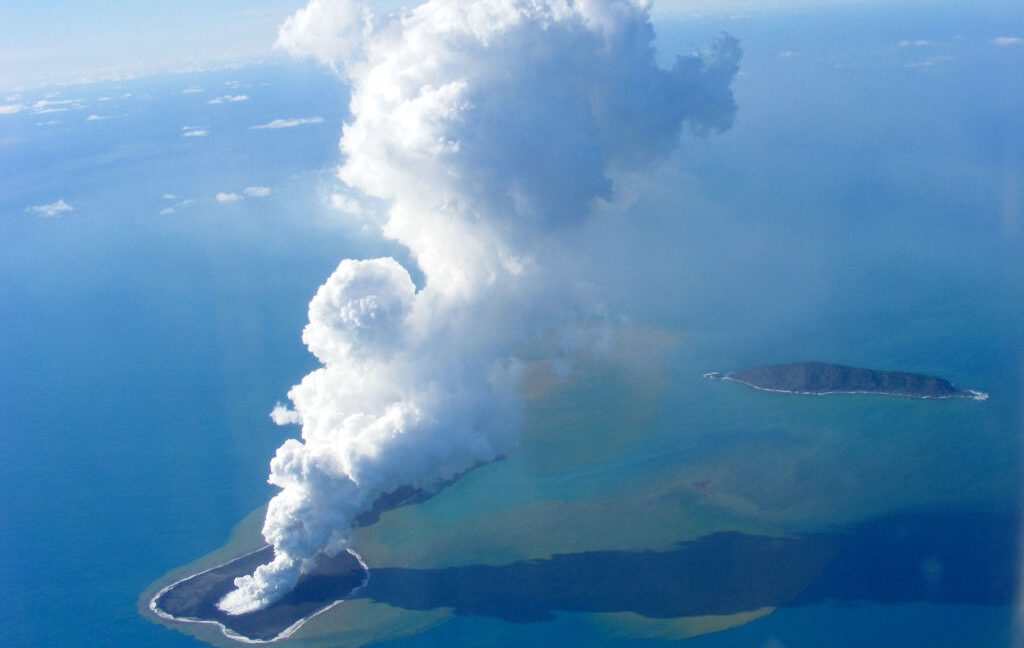
Small undersea volcanoes may unleash outsized tsunamis
Tonga's Hunga volcano produced the highest tsunami ever recorded from an underwater eruption in 2022 — waves reached about 40 meters near the source. A new study links their unusual size to the caldera's rapid collapse.
Tonga's 2022 Hunga eruption produced the highest tsunami ever recorded from an underwater eruption, with waves reaching some 40 meters near the source. A new study in Nature Geoscience links their unusual size to how Hunga's caldera collapsed: a 4-kilometer-wide patch of seafloor dropped about a kilometer at once, displacing a vast volume of water.
Volcanic tsunamis can be deadlier than the eruptions behind them: Krakatau killed more than 30,000 people in Indonesia in 1883, many by the wave rather than by debris. Volcanoes at sea also behave unlike those on land — deep water pressure suppresses blasts, while near the surface they turn far more violent.
A small caldera with a deep collapse
Researchers compared a pre-eruption seafloor map from 2015–2016 with maps from five surveys carried out between April and October 2022. The caldera floor lay 150–200 meters below sea level before the eruption; afterwards it had subsided by nearly a kilometer, reaching depths of up to 850 meters. The floor's collapse alone accounts for about 6.85 cubic kilometers.
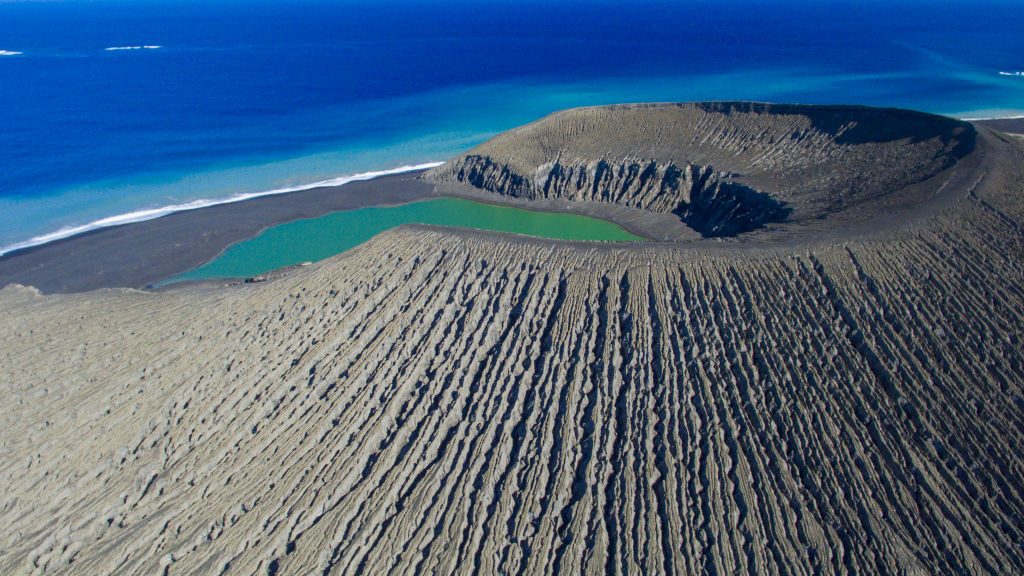
At about 4 kilometers across, Hunga's caldera is one of the smallest of the 177 calderas in a global database, yet unusually deep for its size. The seafloor held its shape, dropping like a piston inside a cylinder. Maps show concentric terraces and cliffs 100 to 150 meters high along the rim.
Why the collapse was so fast
The magma reservoir's roof was thin and broad, and the reservoir lay only about 2 kilometers beneath the volcano. The team calculated that the roof could cave in if pressure fell by just 30 megapascals; losing a quarter of the magma would have sufficed.
Sedimentary structures suggest the caldera collapsed while the volcano was still erupting: a seismic survey three months later found landslide deposits below, within and above the pyroclastic layers. Faults linked to the sinking floor may have let seawater reach the shallow reservoir.
Risks beyond Hunga
Hunga lies in the Tonga-Kermadec arc, home to at least 74 underwater volcanoes, 20 of them caldera complexes; nearby Tofua and Fonuafoʻou resemble it in form, structure and magma composition. Yet most submarine calderas have never been surveyed closely, and many lack maps entirely.
Hunga is a rare exception: its detailed 2015–2016 map, aided by NASA's ICESat-2 laser altimetry, provided a baseline. The paper argues that high-resolution, repeat seafloor mapping is urgently needed to strengthen tsunami early-warning systems and protect critical seafloor infrastructure, "particularly in poorly surveyed regions such as the southwest Pacific."
SiTech — AI-powered web development
We build fast, modern websites and bring AI into real business workflows. Have a project or a question? We'd love to help.