Boom Supersonic faces doubts over Overture as it pivots to AI data center turbines
United Airlines CEO Scott Kirby says Boom's 2029 Overture target will slip, while the company opens a Colorado factory for Superpower gas turbines aimed at AI data centers.
Boom Supersonic is pursuing gas turbines for AI data centers while its Overture supersonic airliner faces doubts from United Airlines CEO Scott Kirby about a 2029 delivery. Kirby said the official 2029 timeline will not happen and will take longer, and he put the chances of commercial service at 50-50 in March. The company has also lost a $1.25 billion turbine deal with Crusoe, while opening a Colorado factory for its 42 megawatt Superpower turbine.
Airliner timeline
Boom has conditional agreements with American Airlines, Japan Airlines, and United Airlines involving nonrefundable deposits of unknown amounts. Those agreements would let the airlines fully purchase Overture once it becomes commercially available. Kirby said Boom still has a lot of hurdles to overcome while developing Overture and getting it certified by the FAA. He cautioned that overcoming those hurdles is not guaranteed, even though he praised Blake Scholl and the company.
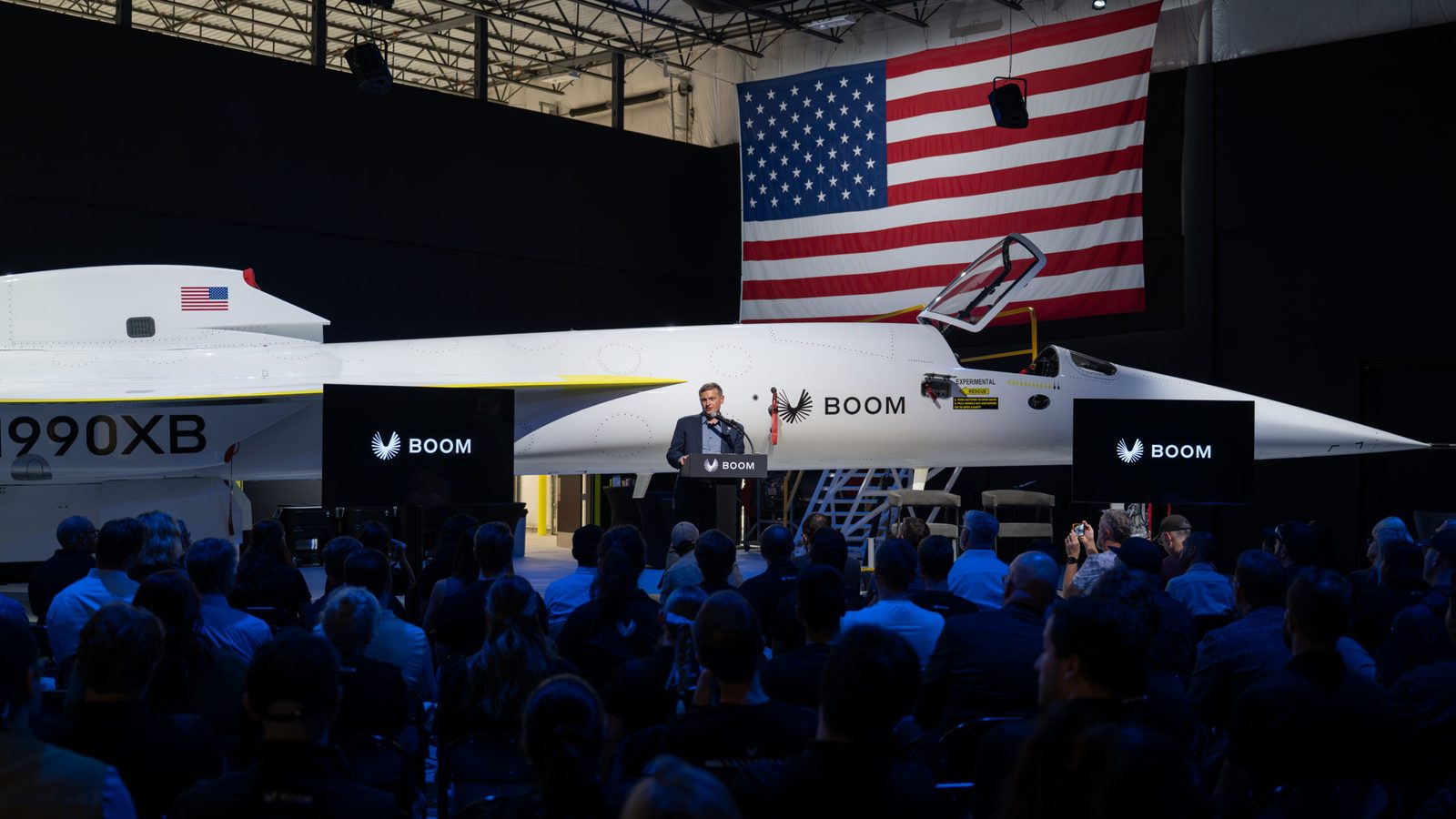
Boom flew its XB-1 demonstrator aircraft in 2024 and 2025 to demonstrate a boomless cruise concept that uses the Mach cutoff phenomenon. That approach involves flying just beyond supersonic speeds at higher altitudes under specific atmospheric conditions, so shockwaves refract upward and minimize ground impact. The plan has been backed by the Trump administration, and in June 2026 the FAA proposed a rule overturning a long-standing ban on commercial supersonic flights over the United States after an executive order from President Donald Trump. Boom previously said it would achieve aircraft certification and carry first paying customers by 2029.
Factory questions
Boom completed an Overture production factory in 2024 at Piedmont Triad International Airport in Greensboro, North Carolina. That facility has mostly sat dormant since then, raising questions for state leaders who provided more than $50 million in taxpayer funding to help build it. Separately, NASA has since October 2025 conducted test flights with the experimental X-59, which has a long nose designed to reduce sonic booms. That is a completely different approach from Boom's Mach cutoff flights.
AI data center turbines
Boom's recent focus has been natural gas turbines for AI data centers as an additional revenue stream. On October 22 it unveiled a factory in Centennial, Colorado, dedicated to producing the Superpower turbine for data centers. US Secretary of Energy Chris Wright and Colorado Governor Jared Polis took part in the event. Boom described the factory as making turbine parts while still undergoing construction, and aims to deliver first gas turbines to AI data center customers in mid 2027, with annual production rising to 25 turbines in 2028 and 50 by 2029.
Scholl acknowledged on September 25 the loss of a $1.25 billion deal under which Crusoe would have purchased 29 Boom gas turbines. Crusoe has been involved in building Texas data centers for Oracle, Google, and Microsoft using various power sources including natural gas and renewables. Scholl said Boom will be delivering about 250 megawatts of Superpowers next year to other sites, but did not specify customers. Boom has described the data center turbine work as synergistic with its Symphony engine for Overture, and completed a Sprint Core prototype intended to eventually power both the Superpower turbine and the Symphony engine. That core is set to undergo testing at the Colorado Air and Space Port, with Boom planning to fire the turbine for the first time before Thanksgiving.
Sources: Ars Technica
SiTech — AI-powered web development
We build fast, modern websites and bring AI into real business workflows. Have a project or a question? We'd love to help.