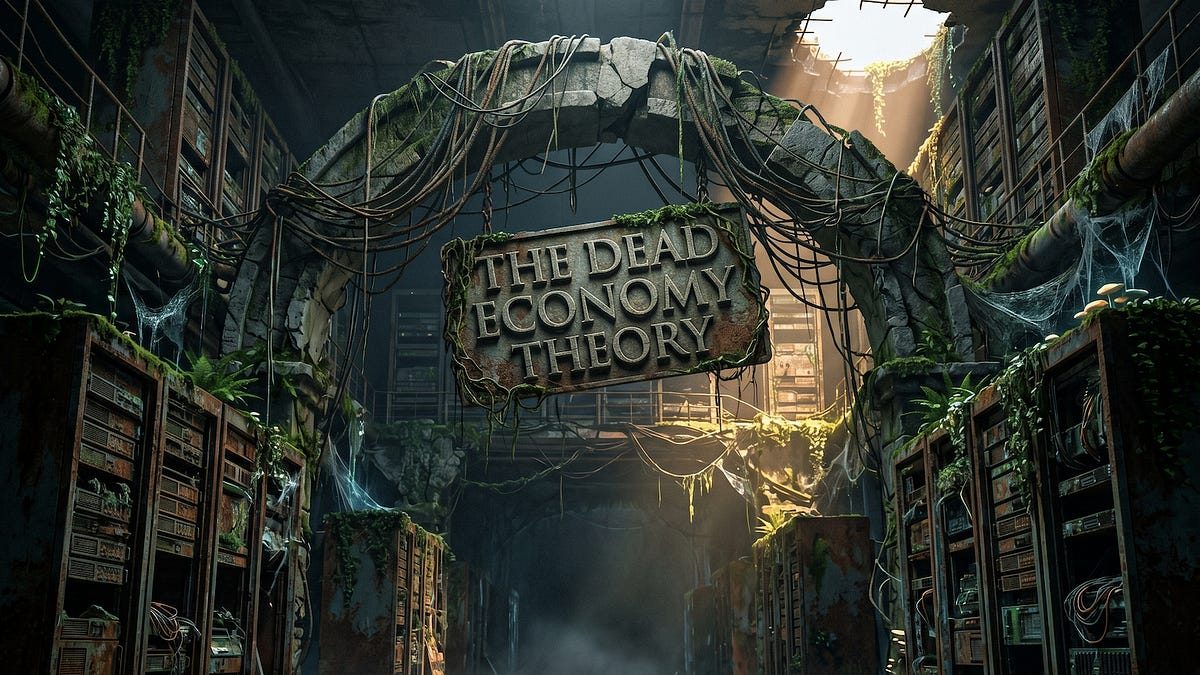
The Dead Economy Theory: What AI’s Trillion-Dollar Bet Actually Requires
The dead internet theory says much of what we read online is made by bots. A new essay extends the idea to the economy: AI valuations only work if human labour is eliminated at civilizational scale.
Most readers know the dead internet theory: much of what we encounter online is produced by machines for other machines. The essay “The Dead Economy Theory” moves that observation from feeds to balance sheets — its argument being that the model underneath the AI boom only works if human labour is eliminated at civilizational scale.
The bet underneath the valuations
Combined investment in large-scale AI infrastructure at OpenAI, Anthropic, Google DeepMind, Meta AI and Microsoft now runs into hundreds of billions of dollars. OpenAI alone has been valued above 800 billion dollars, and Anthropic, which has never posted a profitable year, carries a valuation in the same range. Such numbers require a market big enough to justify them, and the only market that large is the global labour market.
The benchmarks point the same way. OpenAI’s GDPVal measures models across forty-four occupations; Mercor’s AI Productivity Index scores them against four professional roles. An OpenAI evaluation lead told the New York Times that models now achieve “over an 80 percent win rate compared to human professionals” on tasks no model could match months earlier.
The demand spiral
The essay follows the logic in three turns. A company replaces part of its workforce with agents; costs fall, margins expand, investors bid the shares up. The dismissed workers stop spending, so the businesses that served them lose revenue and cut staff in turn. Finally the first company discovers that its customers were, in aggregate, other companies’ workers — growth stalls because efficiency shrinks the market. Cutting first is always the rational individual move, which makes it a prisoner’s dilemma. Bharat Ramamurti, a former deputy director of the National Economic Council, expects the displacement to run in about two years: the essay warns that would look more like 1929 than 2008.
The evidence is unimpressive so far
Daron Acemoglu finds that only 4.6 percent of tasks are currently cost-effective to automate with AI, and puts AI’s productivity impact over the next decade at 0.66 percent, against Goldman Sachs’s 2023 projection of seven percent. More than ninety percent of firms surveyed in 2025 reported no measurable impact on employment or productivity despite a quarter-trillion dollars of investment. Acemoglu calls the phase “so-so automation”: mediocre at replacing workers, cheap enough to deploy anyway, cutting jobs without meaningfully lowering costs.
What could still change
The remedies proposed are unglamorous: public ownership stakes in AI infrastructure, antitrust enforcement with teeth, a real tax regime on automated labour and, in Branko Milanovic’s formulation, wider capital ownership. All of them require democratic institutions willing to take on the richest companies in history — at a moment when AI-related investment accounted for thirty-nine percent of US economic growth in 2025.
The closing image is the point. The dead economy is not one where nothing happens: plenty happens, and GDP may well rise. It is the economy where none of it requires you.
SiTech — AI-powered web development
We build fast, modern websites and bring AI into real business workflows. Have a project or a question? We'd love to help.