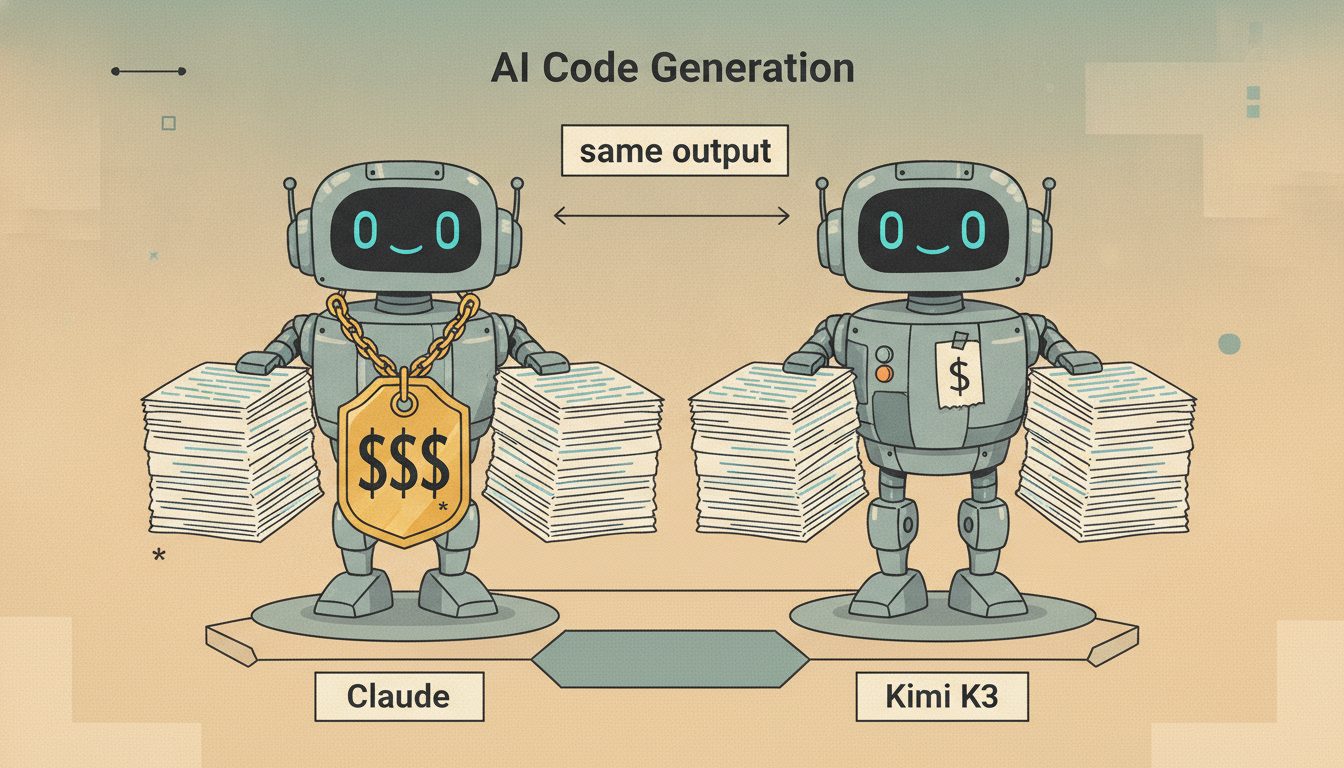
The Kimi K3 Moment: a developer says the gap with Claude has closed
A developer's blog post reports that Moonshot AI's Kimi K3 matches Claude on ordinary coding work at a fraction of the price, and argues that US restrictions on frontier models only hurt American customers.
A developer's blog post argues that the practical gap between the best American and Chinese coding models has closed — and that the price gap has not. Stephen Bochinski writes that after running Moonshot AI's Kimi K3 alongside Claude in his ordinary coding work, he could no longer tell the two apart.
Same work, a very different bill
On the same tasks K3 produced the same quality of output, with near-identical token counts on the way to the answer: the open model was not sloppier and did not grind through more tokens, the author reports. The pricing is another matter. K3's API costs $3 per million input tokens and $15 per million output tokens, against $10 and $50 for Claude's top model. On the subscription side Kimi's paid plans start at $19 a month, and the $39 coding tier is described as far more generous than anything Claude sells near that price, where a normal day of agent work can exhaust the allowance before lunch.
Fine print and policy
The post points to a change in Claude's cheaper tier: access to Fable could not be sustained on the twenty-dollar plan and was switched off, with the plan quietly falling back to Opus. For the author that is proof the plan never really sold the headline model. The wider argument is about US AI policy, which he calls an unmitigated failure: restrictions on domestic frontier models bind American customers, he writes, while a frontier-quality open-weight model from a Chinese lab that Washington cannot regulate is a download away. He cites a Semgrep benchmark in which GLM 5.2, released under an MIT licence, beat Claude on cyber-security tasks — the restricted model declines the work, the open one simply does it. OpenAI, he adds, went through the same regulatory process with GPT-5.6 and still came out able to put its flagship on a twenty-dollar plan.
The auto-industry playbook
The author expects the current administration to regulate AI and open source along the lines of the old playbook for carmakers, where decades of subsidies, bailouts and protective tariffs produced American manufacturers that sell trucks at home and barely register elsewhere in the world. He predicts public-private partnerships propping up domestic models that are used only inside the United States and cannot compete internationally. The result, in his telling, is a future in which America is the one country without access to the best models at the best prices, buying systems tied to the administration that are neither the highest quality nor the cheapest. The post ends with a practical conclusion: he can no longer come up with a reason to keep paying for Claude.
SiTech — AI-powered web development
We build fast, modern websites and bring AI into real business workflows. Have a project or a question? We'd love to help.