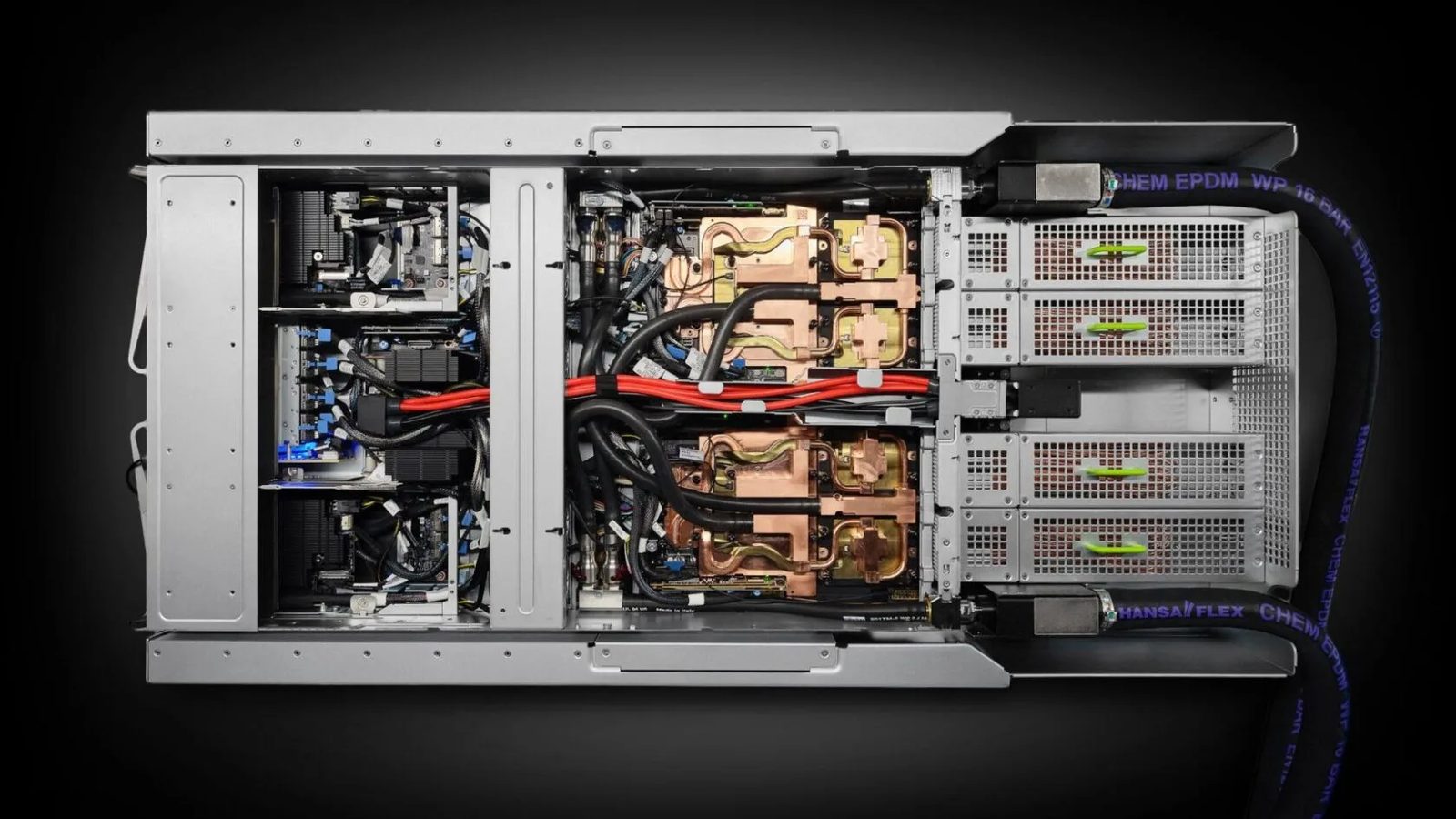
NVIDIA Robots Assemble GB300 Tester Trays Using Classical Pipelines and Specialist AI
NVIDIA's Seattle Robotics Lab and the Isaac engineering team taught robots to assemble GB300 tester trays. Classical pipelines, specialist pose estimation, and 3D-printed gripper fingers delivered over 95% success on busbar assembly.
Robots Take on GB300 Tester Tray Assembly
The NVIDIA Seattle Robotics Lab, working with the NVIDIA Isaac engineering team, has developed robotic systems that assemble GB300 tester trays, the fixtures used to verify GB300 compute modules before shipping. Working with the NVIDIA Operations Team and contract manufacturer Foxconn, the team targeted two tasks: busbar assembly and multi-connector insertion. Manufacturers set a 99.5% success rate and cycle times no more than twice those of skilled workers, 124 seconds for busbar assembly and 72 seconds for all four connectors. The team describes the work as one of the hardest problems the lab has tackled in nine years, a fresh case of Moravec's paradox in which human dexterity remains exceptionally difficult to automate.
Classical Pipeline Wins on Busbar Assembly
For busbar assembly, the team built a modular pipeline rather than an end-to-end learning system. Perception used NVIDIA FoundationPose with multi-view confidence scoring to fix large pose errors. Planning combined fast waypoint generation with Lissajous-curve manipulation primitives, and a high-performance impedance controller with automatic damping design and inertial compensation handled contact. Three arms split the work: one Flexiv Rizon 4S positioned a camera, a second inserted the limit fixture and busbar and removed the clamp, and a Universal Robots UR10e drove 16 screws with an OnRobot screwdriver. The system achieved over 95% success, though the full 160-second cycle time still exceeds the 124-second target, with sequential screwdriving the main bottleneck.
Specialist AI and Mechanical Design for Connectors
Multi-connector insertion required lifting two large and two small cable-mounted connectors and seating them in tight-clearance sockets. Cable grasping with SAM3 segmentation worked almost flawlessly, but generalist pose estimation failed on the small, textureless connectors, and end-to-end imitation learning with ACT or diffusion policies also fell short because the deformable cables could only be handled a limited number of times. The team called this an "inverse bitter lesson," where data scale is physically intractable. They instead built DOPER, a specialist pose-estimation framework trained on synthetic CAD renders and fine-tuned on pseudolabels from 3D neural reconstructions, running at 30 Hz or faster. Custom 3D-printed multi-purpose gripper fingers constrained part motion during contact, making grasp poses repeatable without tactile sensors. Insertion policies were pretrained in NVIDIA Isaac Lab with sim-to-real reinforcement learning and refined with real-world residual training via the SPARR method using force-torque inputs.
Infrastructure and Outlook
The work ran on containerized robotics services and the TALOS orchestration system, which sequences planners, primitives, and controllers in real-time loops above 500 Hz across Franka, Flexiv, Universal Robots, and SO-101 arms. The team says it is rapidly approaching the manufacturer thresholds as of the article's publication, and that the results challenge assumptions about where end-to-end learning beats modular stacks. High-performance control and mechanical design, the team argues, remain underused tools in robot learning.
Sources: Nvidia Dev
SiTech — AI-powered web development
We build fast, modern websites and bring AI into real business workflows. Have a project or a question? We'd love to help.