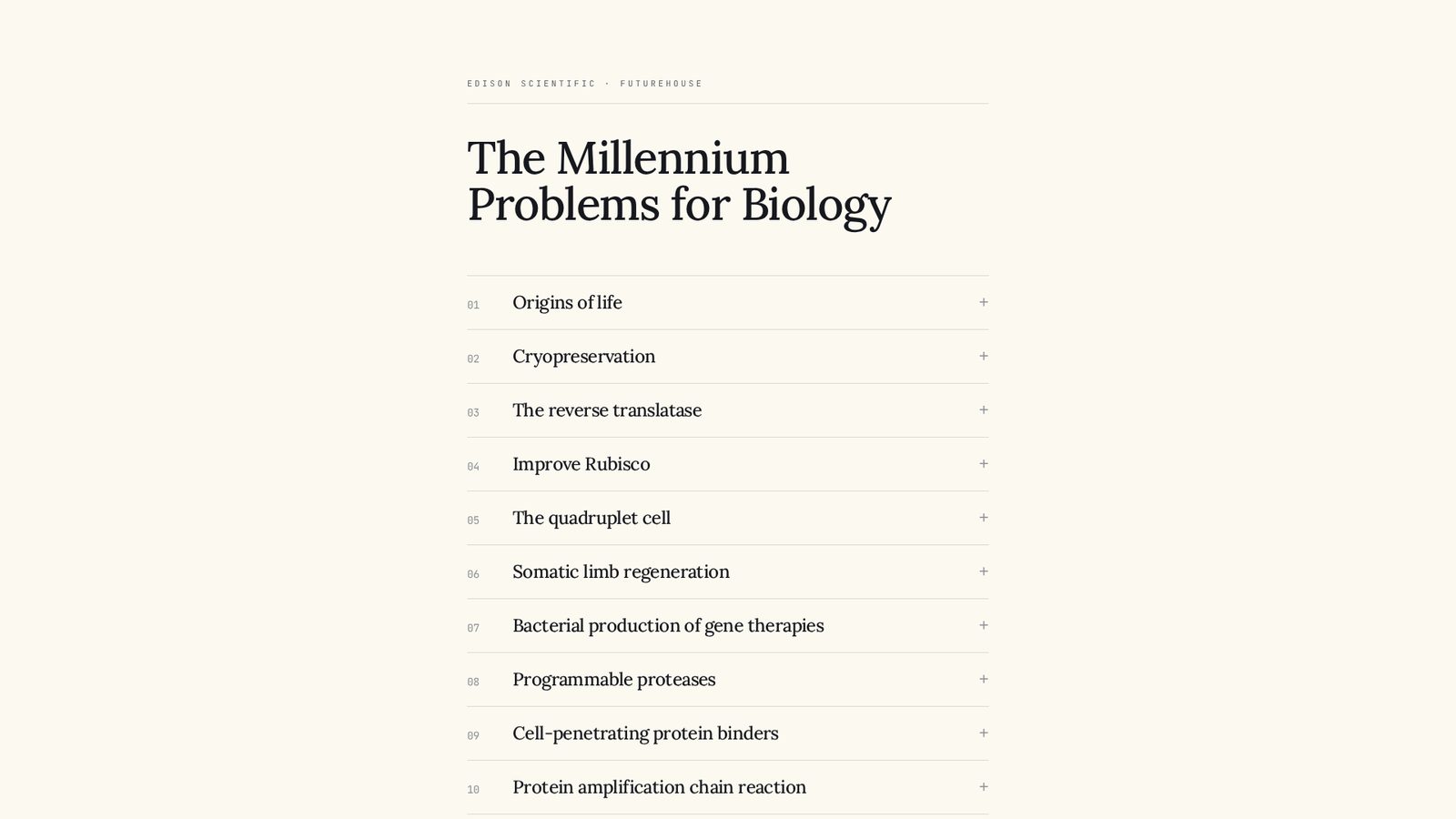
The Millennium Problems for Biology: Twelve Concrete Targets for Researchers
Edison Scientific and FutureHouse have published a working catalogue of twelve open problems in biology, from the origins of life to cryopreserved mice, each with explicit and measurable success criteria.
Edison Scientific and FutureHouse have published a working catalogue of twelve open problems in biology, framed as concrete and testable targets for the field. The list brings together long-standing questions — from the laboratory emergence of life to limb regeneration in adult mammals — and specifies, for each, the measurements that would count as a solution. The page credits Sam Rodriques and Michaela Hinks.
From primordial soup to frozen mice
The first problem asks for the unassisted emergence of self-replicating, RNA- and protein-based cells from a plausible primordial soup with a plausible energy source. A cell may be any compartment with a defined boundary, but it must increase its abundance by at least a factor of 10⁶ — roughly twenty generations — and its division must be able to continue indefinitely. Heritable information stored as nucleic acids or polypeptides is strongly preferred.
The second problem is cryopreservation: reversing the whole-body frozen or vitrified state of live, intact, wild-type adult mice. Animals must stay frozen for at least 24 hours, be recovered with more than 99% viability, and show no permanent organ damage. Somatic genetic engineering is discouraged but permitted, and every experiment requires ethics approval. Later entries include regeneration of amputated limbs in adult wild-type mice, with motor and sensory function indistinguishable from controls.
Molecular tools and rewritten codes
Several problems target the machinery of the cell. A “reverse translatase” should read an untagged polypeptide and synthesize a nucleic acid strand encoding its residue sequence, with at least 90% accuracy across 100 preregistered peptides. A “quadruplet cell” would encode every protein, including its own translation machinery, in four-base codons. Other targets include a Rubisco whose carbon dioxide specificity exceeds that of Galdieria partita and whose turnover matches maize, a full set of 3′→5′ polymerases, and a nitrogenase without homology to any known family.
The catalogue also reaches into medicine: producing infectious AAV and lentivirus in bacteria, designing proteases that cut a blinded site in a folded endogenous protein, and protein binders that enter cells and engage intracellular targets at pharmacological concentrations. Protein amplification and programmable proteases are among the problems that allow partial credit.
Why the framing matters
Each entry states its own success criteria, deadlines and verification rules: designs must be delivered within 24 hours of targets being preregistered, screening and target-specific evolution are barred, and blinded observers judge regeneration results. Several problems accept weaker versions as partial success. The result is less a wish list than a benchmark — a way to ask what biology can actually be made to do.
SiTech — AI-powered web development
We build fast, modern websites and bring AI into real business workflows. Have a project or a question? We'd love to help.