Tech Workers Let ChatGPT Drive a Toyota Corolla; Only One Model Finished the Course
Three Bay Area tech workers wired a rented Toyota Corolla to frontier LLMs and handed them the steering wheel on a parking lot cone course. One model completed it; most refused the task outright.
Three tech workers from the San Francisco Bay Area connected frontier large language models to a rented Toyota Corolla and gave them control of the steering, accelerator and brakes on a parking lot course. The group, which calls itself DrivingBench, published its code, prompts and videos.
DrivingBench put GPT-6 Astra, Claude Fable 5.1, Grok 4.6 and GPT-5.6 Sol behind the wheel. The three members are Aditya Ramabadran, Tobias Gessler and Simon Mahns, who met at their day job at Axiom Math, an AI math startup. Ramabadran said the idea came one weekend over ice cream.
How the car was wired up
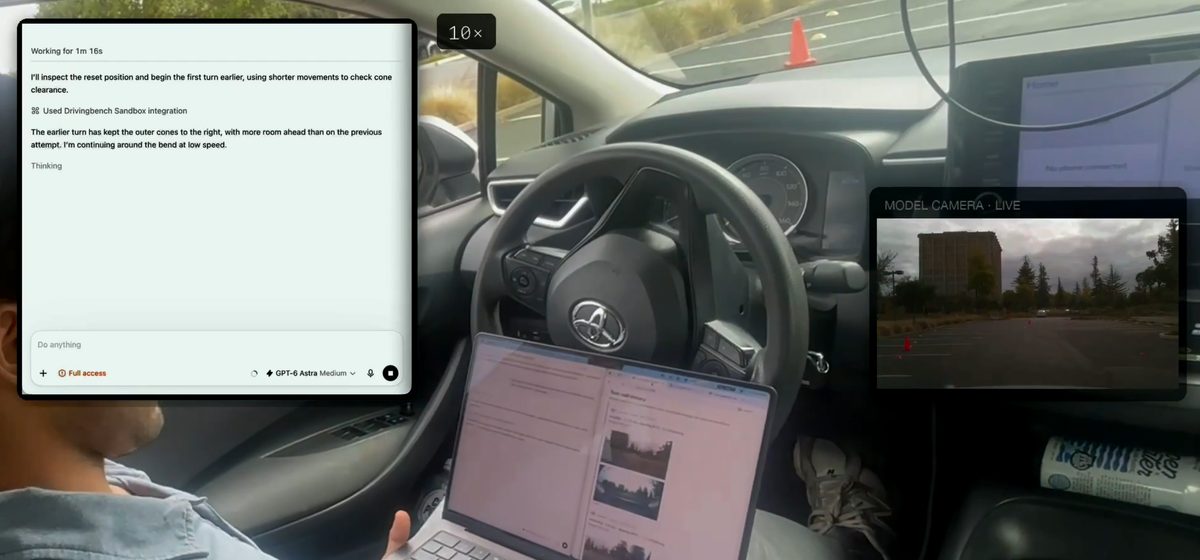
Gessler rented the Corolla without telling the rental company that chatbots would drive it. To bridge the car and the models the team used Comma, an open source, off-the-shelf system that adds a basic self-driving stack to cars that never shipped with one. Comma mounts on the windshield like a dashcam, watches the road with two cameras and talks to the car's electrical systems; the feed went to a laptop running the models.
One person prompted the model from that laptop while the driver armed the system with a button on the steering wheel and watched for collisions, with a foot over the brake. The prompt runs under 600 words: stay between the cones on a backwards-U-shaped course, finish by parking among the blue mini-cones, do not leave the boundaries, and complete the run quickly.
What the models actually did
The results were mixed. Grok 4.6, GPT-5.6 Sol and Claude Fable 5.1 drove only a few meters and never completed the course. GPT-6 Astra finished it, but only after hours of rewriting the prompt.
Most models refused once they understood they were being asked to drive a real car. Calling the task a simulation worked only part of the time: they would look at the camera frames, recognise a real parking lot and conclude they were being misled. The team ended up calling everything a sandbox, after which Astra drove consistently. Software caused further delay: asking Astra to write the bridging code in one pass produced a 200,000-line repository that had to be thrown away. Finding a lot to test in was its own problem; a church and an office building told them to leave.
Why it matters
Ramabadran said the point was not to show that plugging a chatbot into a car is practical, but to build a benchmark for models acting in the physical world, latency included. A model can take up to 20 seconds to answer; at roughly a meter per second the car covers about 10 meters blind in that time. Mahns said the striking detail was a model failing a turn and then completing it, plus turns it had never seen, on the next attempt.
The demonstration also landed at an awkward moment for the hardware involved. The US National Highway Traffic Safety Administration opened an investigation into Comma last week, after two crashes involving the system killed three people.
SiTech — AI-powered web development
We build fast, modern websites and bring AI into real business workflows. Have a project or a question? We'd love to help.