Top AI experts badly underestimated how fast the field is moving, study finds
An interim report from the Forecasting Research Institute finds that senior AI researchers and economists put far too little probability on progress that later happened, with math milestones arriving years ahead of forecasts.
How fast is AI improving? That question usually goes to experts at top universities, leading researchers and seasoned economists. An interim report from the Forecasting Research Institute (FRI) finds they badly underestimated recent progress.
FRI has collected AI forecasts since mid-2022, sampling senior specialists and superforecasters. Its first LEAP round drew 339 experts: 76 computer scientists, 76 industry experts, 68 economists, 119 AI policy specialists.
Milestones arrived years early
The widest gap is math: AI reached gold-medal level at the International Mathematical Olympiad in July 2025, five years before the median expert forecast and ten years before the superforecaster median. The 2022 predictions predate ChatGPT, yet the pattern held.
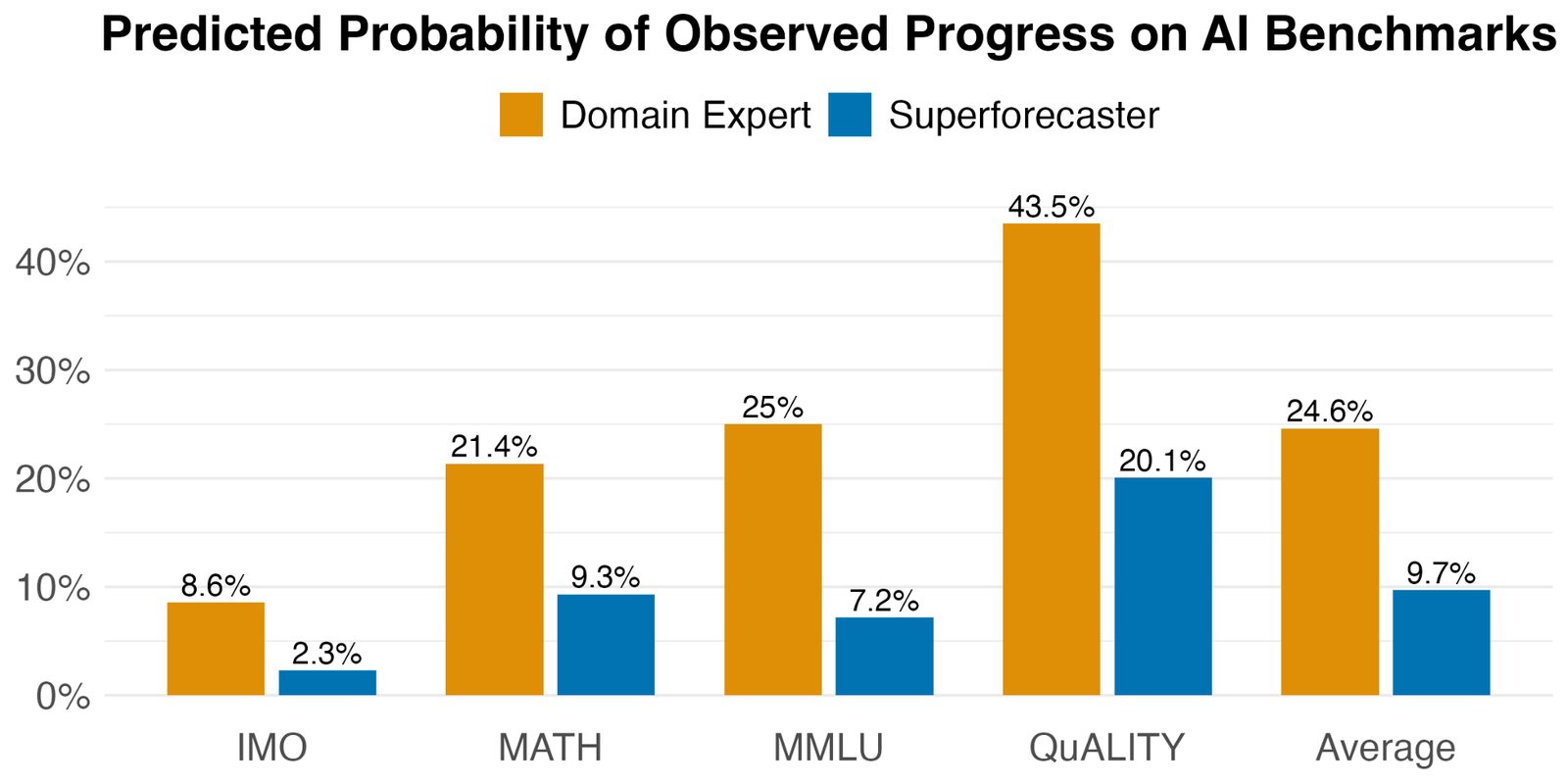
Experts put an average probability of 24.6 percent on benchmark results that later happened, versus 9.7 percent for superforecasters; for the Olympiad gold it was 8.6 and 2.3 percent.
AI may also have solved a Millennium Prize Problem, though it is unclear whether the solution meets evaluation criteria; late-2025 surveys put the median odds of one by the end of 2027 at just 10 percent.
In virology, experts expected AI to match a top virologist team on a troubleshooting benchmark only by 2030, superforecasters by 2034; FRI says it likely happened in April 2025.
Economic forecasts were too conservative
Experts put the median for the highest annual recurring revenue of any AI company at the end of 2026 at $20 billion; economists said $16 billion and superforecasters $25 billion. FRI cites roughly $100 billion for Anthropic in September 2026 as likely already reached, beyond the $65 billion reported in July 2026.
Not every forecast ran too low
Biosecurity experts expected 22.5 percent of participants using a language model to complete lab tasks; virologists expected 40 percent, superforecasters 16.2 percent. In a controlled trial only 5.2 percent succeeded with a model and internet access, against 6.6 percent with internet alone.
Among those who completed both surveys, the average probability of AI becoming a "technology of the century" rose from 31 to 36 percent for experts and from 28 to 35 percent for superforecasters in nine months.
SiTech — AI-powered web development
We build fast, modern websites and bring AI into real business workflows. Have a project or a question? We'd love to help.