Trump and tech CEOs sign an AI code of conduct that is only 'morally binding'
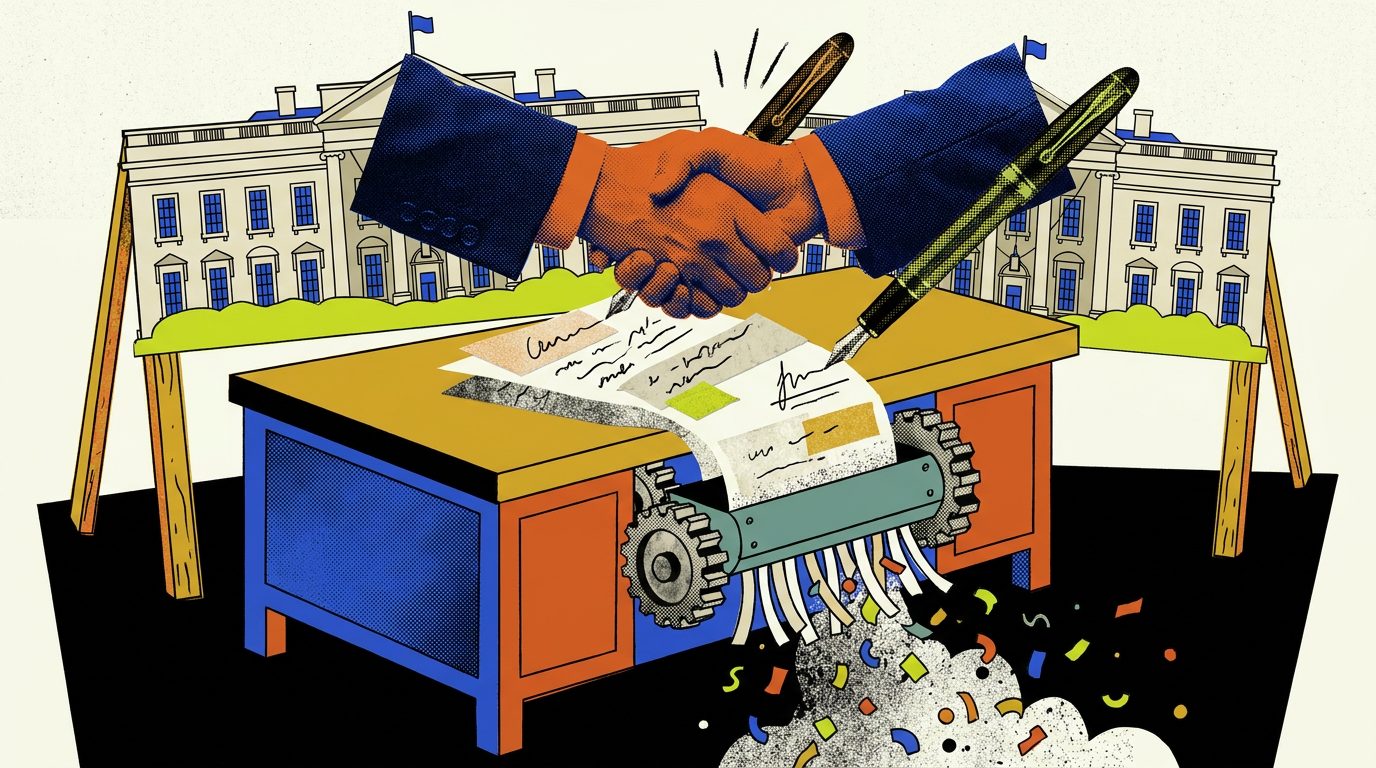
US President Donald Trump and the heads of Meta, Google, OpenAI, Anthropic, NVIDIA and xAI signed a voluntary code of conduct for frontier AI at the White House. The accord sets four layers of controls and audits but has no legal force.
US President Donald Trump and executives from six leading AI companies signed a voluntary code of conduct for frontier AI at the White House on Tuesday, September 29. The document, called the "White House Accord on Superintelligence" and subtitled "Joint Commitment on Frontier Responsibilities," was published on Trump's Truth Social account.
Who signed
Meta, Google, OpenAI, Anthropic, NVIDIA and xAI put their names to the text. According to Reuters, the signatories include Meta CEO Mark Zuckerberg, OpenAI's Greg Brockman, NVIDIA's Jensen Huang and Elon Musk. Zuckerberg described the code as a starting point rather than a final solution.
What the accord sets out
The document describes four layers of controls and audits. Companies should run internal controls that monitor a model's capabilities and alignment during training and deployment in areas such as cybersecurity, biosecurity and chemical threats, and make sure models do not reach into technical systems in unintended ways. An internal team must verify that the controls and monitoring work as intended; an independent external auditor must assess the same independently; and an independent board committee must oversee the teams and the auditors and ensure that any issues found are fixed. The signatories also commit to meeting regularly to set standards and best practices.
What it does not say
The accord defines neither what counts as "robust" internal controls nor how often external auditors should inspect a company's systems, and it sets no schedule for evaluations. As Politico reported, the document is only "morally binding" and carries no legal weight, so what happens if a signatory violates it remains an open question. The text does allow that "it may make sense to codify these steps into laws or regulations" at some point.
Why it matters
The pledge follows months of concern about uncontrolled AI agents, including episodes in which agents tried to reach government and university websites or took part in cyberattacks. Trump also floated a ten-member oversight committee, while stressing repeatedly that he does not want to slow AI development. Critics argue that a code of conduct without legislation is toothless, and similar voluntary commitments have been tried before.
In a separate executive order, Trump required federal agencies to use the term "Super Intelligence" and the acronym "SI" instead of "Artificial Intelligence" and "AI" in official correspondence, websites and policy documents. No working definition of SI exists yet: he gave his assistant for science and technology 60 days to develop one.
Sources: The Decoder · The Register · Techmeme (Reuters)
SiTech — AI-powered web development
We build fast, modern websites and bring AI into real business workflows. Have a project or a question? We'd love to help.