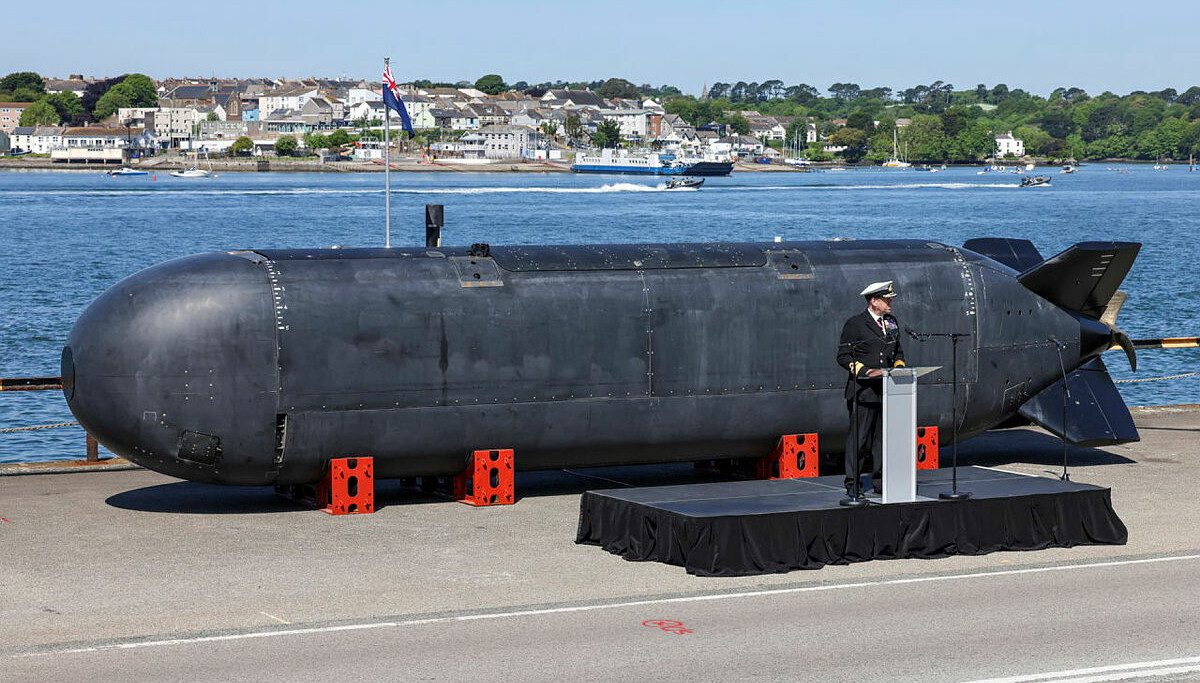
UK's uncrewed experimental submarine test-fires a torpedo
Britain's XV Excalibur, a 12-metre experimental underwater drone, has launched a heavyweight torpedo in an AUKUS trial — the first such firing from an uncrewed submarine by either the UK or the US.
A British uncrewed submarine has test-fired a torpedo for the first time, demonstrating that undersea drones can attack targets as well as carry out reconnaissance and surveillance. The firing took place as part of AUKUS, the trilateral security partnership between Australia, the UK and the United States.
XV Excalibur and Project CETUS
The vehicle involved is the XV Excalibur, a 12-metre (40 ft) experimental uncrewed underwater vehicle (UUV) unveiled last year as the Royal Navy's first large submarine drone, developed under Project CETUS. According to the Prime Minister's Office, the test involved Excalibur launching a heavyweight torpedo "jointly developed by the US and Australia" — wording that implies the Mk 48 torpedo carried by all US Navy submarines.
Downing Street said this was the first time either the US or the UK had launched a torpedo from an underwater drone rather than a crewed submarine.
Autonomous navigation, external targeting
According to The Register, Excalibur navigated autonomously to its launch position and carried out a pre-programmed launch sequence. The vehicle was not responsible for detecting or tracking the target: that data was supplied through external systems.
Defence site Navy Lookout noted that Excalibur has no torpedo tubes and that its payload bay in the midships section of the hull is too small to hold a large torpedo, so the weapon may have been carried on a cradle attached to the underside of the sub. The Register has asked the Ministry of Defence for more details, including whether trials with the British Spearfish torpedo are also planned.
From trials to future UUVs
The vehicle's builder, Plymouth-based MSubs Ltd, announced in July that it had won a new £6.7 million ($8.9 million) contract from the Submarine Delivery Agency for the next phase of trials and evaluations of Excalibur for the Royal Navy. Although Excalibur remains experimental, it is expected to inform requirements for future UUVs that the Royal Navy wants to help patrol the North Atlantic and protect undersea cables and other infrastructure against expected Russian sabotage.
The tests come as UK Prime Minister Andy Burnham is expected to confirm an AI and Autonomy partnership between Britain and the US, aimed at protecting critical national infrastructure from sea lanes to air space. "We are at our strongest when we work with our partners to tackle the most complex shared challenges we face, driven by our values," Burnham said. "That ambition is underlined in our new defence partnership with the United States on AI and autonomy, bringing together the brightest minds to strengthen the protection of critical infrastructure, deter those who threaten our security, and use the enormous potential of AI to our advantage."
SiTech — AI-powered web development
We build fast, modern websites and bring AI into real business workflows. Have a project or a question? We'd love to help.