Unreal Labs unveils Unreal Agent, an async harness with up to 40% cost savings
Unreal Labs has published details of Unreal Agent, a harness that manages tool calls fully asynchronously so models never wait or poll. It matches Codex on Terminal-Bench 4.0 while costing far less per run.
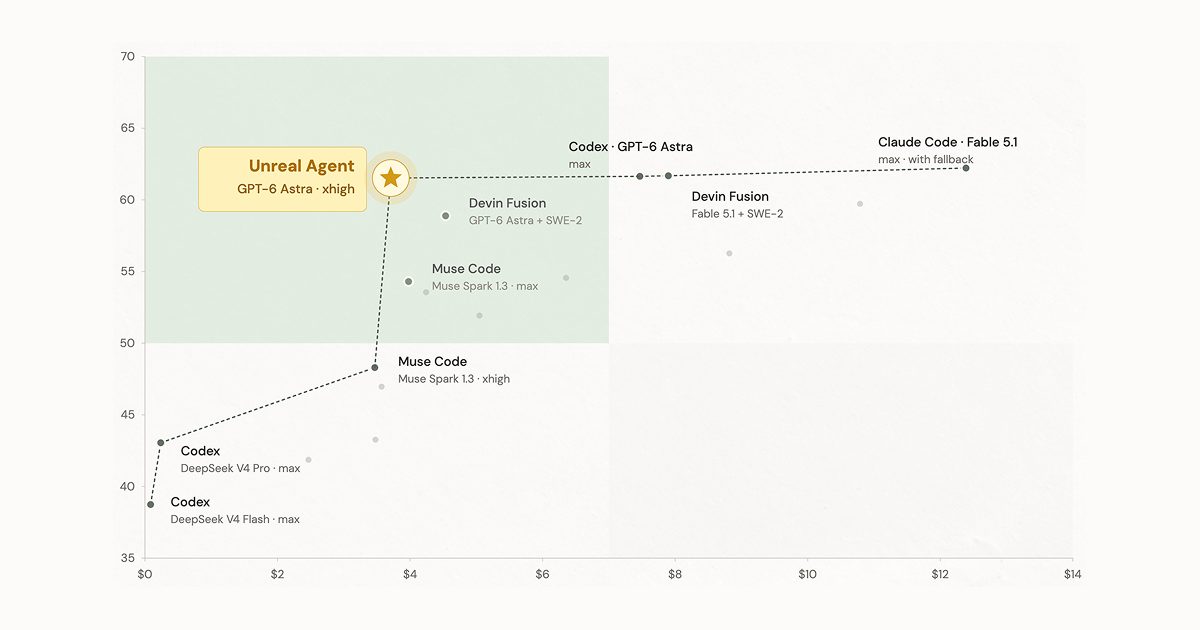
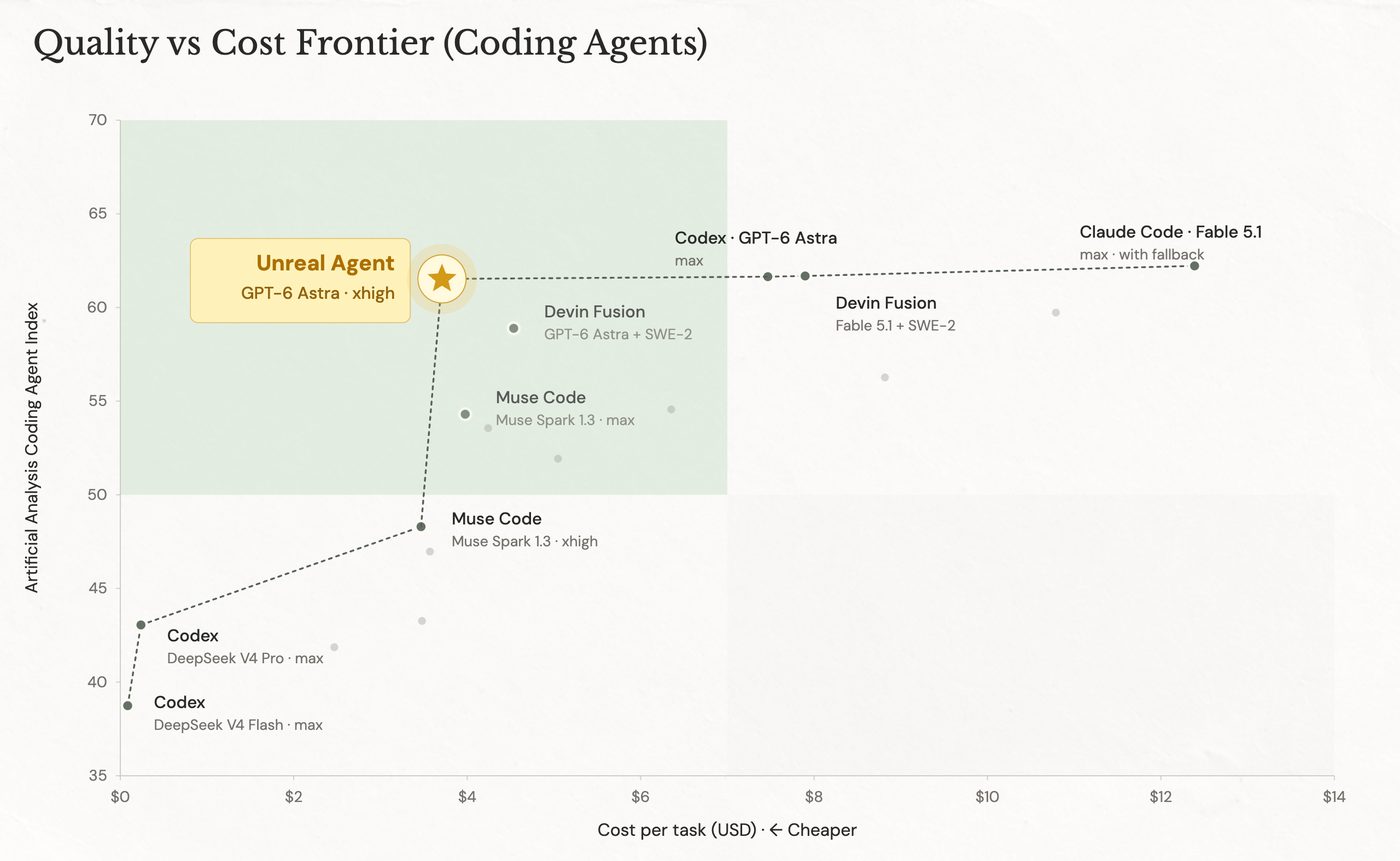
Unreal Labs has published details of Unreal Agent, an agent harness built around one design decision: tool calls are managed entirely asynchronously, so the underlying model never has to wait, poll or send heartbeats for a tool. The company says the current version cuts costs by up to 40% compared with Codex and up to 20% compared with Pi across real workloads and agentic benchmarks.
The harness grew out of a practical problem: agents spend much of their time and tokens managing tool calls rather than doing useful work. The design also lets people steer the agent at any moment without waiting for a running tool call.
An asynchronous tool-calling runtime
Every time Unreal Agent issues a tool call, it immediately writes an event-log record marking the tool as in progress and keeps executing it in the background. Once the tool finishes, the result is appended to the session log and a model call follows. The company notes that the two-item tool result pattern — one running, one final — is currently underspecified in the Responses API documentation.
Benchmarks against Codex and Pi
Tested with GPT-6 Astra at xhigh reasoning effort, Unreal Agent matched the Codex leaderboard baseline on Terminal-Bench 4.0 with a 57.9% pass rate while costing $1,428 against $2,350. On SWE-Atlas Codebase QnA it scored 65.8% for $936, ahead of Codex at 63.3% for $1,303. On DeepSWE 1.1 it reached 72.4% for $1,367, versus Codex at 69.0% for $1,633. On the ALE-CLI set it recorded a 30.0% full pass rate and a 59.7 mean score for $217, against 29.0% and 58.1 for $292 with Codex. Unreal Labs attributes the narrow spread to benchmark variance and notes that the harness is domain-agnostic.
Why not an existing SDK
The post argues there is no golden path for building an agent-first product. CLI-oriented SDKs such as Claude's Agent SDK assume local sessions, subprocesses and resource limits that do not translate cleanly into production, leaving teams to build their own lifecycle management for completion, cancellation and background tasks. Multi-provider support adds compatibility work: switching API modes can break tools or compaction, and SDK upgrades can change message formats. Approvals built on harness hooks need more upkeep than deterministic sandbox constraints such as host allowlists.
Unreal Agent is therefore kept small: simple prompts, token-optimized tool results, no sub-agents or workflows. The SDK ships a Go library, a runner comparable to claude -p, and a Harbor-compatible benchmark runner; the code is on GitHub.
SiTech — AI-powered web development
We build fast, modern websites and bring AI into real business workflows. Have a project or a question? We'd love to help.