Valve introduces Pyrowave video codec in Steam beta for low-latency streaming
Valve's Steam client beta has introduced Pyrowave, an experimental video codec for high-bandwidth, low-latency streaming. It uses the Vulkan API, supports HDR and YUV 4:4:4 and is geared to LAN use with at least Gigabit Ethernet.
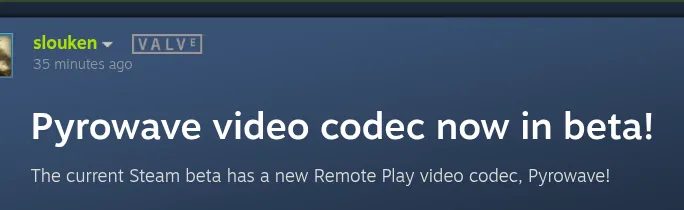
Valve's Steam client beta has introduced Pyrowave, an experimental video codec for high-bandwidth, low-latency video streaming. Rumors over the summer suggested Valve was working on a new Pyrowave video encoding method for Steam on Linux, and the codec is now available in beta form. Phoronix reported the change on 21 September 2026.
Pyrowave was developed by engineer Hans-Kristian Arntzen, who is known for his work on VKD3D-Proton. That project is a Direct3D 12 to Vulkan translation layer that lets Windows games run on Linux.
Vulkan, HDR and YUV 4:4:4
Pyrowave makes use of the Vulkan API and was designed for extremely low latency. The codec supports HDR and YUV 4:4:4, which keeps colour detail intact.
In exchange, it is said to use roughly 5-10 times the bandwidth of other streaming codecs. That is why Pyrowave is geared for LAN usage and requires at least Gigabit Ethernet.
Where to enable it
In the current Steam beta the codec is available on Windows, macOS and Linux, with Linux requiring the experimental SteamRT3 client. It can be enabled through the Steam Remote Play advanced client settings. Further details are in the beta announcement published on SteamCommunity.com.
Why it matters
Most streaming codecs try to fit acceptable quality into limited bandwidth, while Pyrowave spends bandwidth freely to cut latency. In a home network, where both machines sit on the same wired LAN, that is often the better trade-off.
SiTech — AI-powered web development
We build fast, modern websites and bring AI into real business workflows. Have a project or a question? We'd love to help.