Where to Find the Colors Your Screen Can't Show You
Some colors exist in the real world but no camera can capture them and no display can reproduce them — most are cyans. Ryan Moulton explains why the digital world is starved of them and where to find them in nature.
Some colors exist in the real world but cannot be shown on a screen: a camera cannot capture them, no display can reproduce them, no game contains them. Most of them are cyans. In a June 2026 article, Ryan Moulton explains why the digital world is starved of them and where to find them in nature.
Why a screen cannot show every color
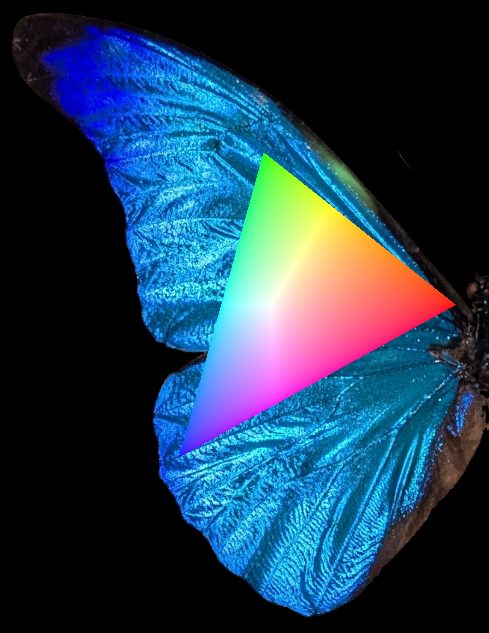
The eye has three types of cone cells, and they do not register wavelength — they only respond with a certain intensity. Any two spectra that make the cones respond identically look the same to us, which is why displays need only three primaries. In 1931 the CIE mapped human color vision onto a diagram and chose three wavelengths as primaries; their triangle covers only part of it. A large lobe of green, cyan and blue lies outside: the most saturated cyans would need "negative red", which does not exist.
Color television used phosphors rather than laboratory monochromators, so its primaries could not reach the edge of the diagram. That limit became sRGB, which still covers standard monitors, most of the internet and mass-market photography; the wider Display-P3 is now standard on nearly all smartphones and Macs.
Natural filters: leaves and water
Leaves absorb much blue and red light, but their transmittance is far more selective than their reflectance. Light that crosses several leaves is purified towards a peak near 550 nm, so a green leaf lit through another leaf is already outside the gamut — greener than green. Water behaves similarly: it absorbs reds aggressively, greens slowly, blues barely. Sand under shallow water shifts into unrepresentable cyans and then blues, and the full intensity appears only when you dive, past the scattering.
Birds and structural color
Mammals see color poorly; only primates re-evolved red-green vision. Birds descend from dinosaurs, with cones evenly spaced across the spectrum and an extra cone for ultraviolet, so their color space cannot be drawn on a flat diagram. Yellows and reds come from dietary carotenoids, while blues and greens are structural, built from melanin layers half a wavelength apart deep inside the feather. A peacock makes half a dozen colors from the same dark brown pigment, and ground to powder its feather is simply brown. Around 500 bird species have colors outside sRGB, about 100 outside Display-P3.
Living light and man-made color
In the deep ocean, bioluminescent dinoflagellates glow cyan; in warm hypersaline lagoons such as Vieques in Puerto Rico, a kayak paddle leaves a cyan trail. New Zealand glow worms paint cave ceilings the same color, and scorpions fluoresce teal under ultraviolet. Man-made light can be purer still: modern traffic lights are LEDs, and their "green" is really an intense turquoise. Lasers duplicate photons until one wavelength wins, which is why the most artificial color of all is a green laser beam.
SiTech — AI-powered web development
We build fast, modern websites and bring AI into real business workflows. Have a project or a question? We'd love to help.