Whiteboard: an open-source canvas where developers and coding agents design together
Whiteboard, an open-source desktop app from the dev.fast team, puts a developer and a coding agent on one canvas. The project is MIT-licensed and its semantic diff viewer is written in Rust.
Whiteboard, an open-source desktop app built by the team at dev.fast, has joined the Y Combinator winter batch (W26). The pitch is narrow: one shared canvas where a developer and a coding agent design software together instead of trading diffs in a terminal.
The project went public on GitHub on 18 August 2026. As of 25 September it has 641 stars, 27 forks and 438 commits, with 11 open issues. It is released under the MIT licence and runs against local checkouts, so the code never has to leave the developer's machine.
An agent that draws its reasoning
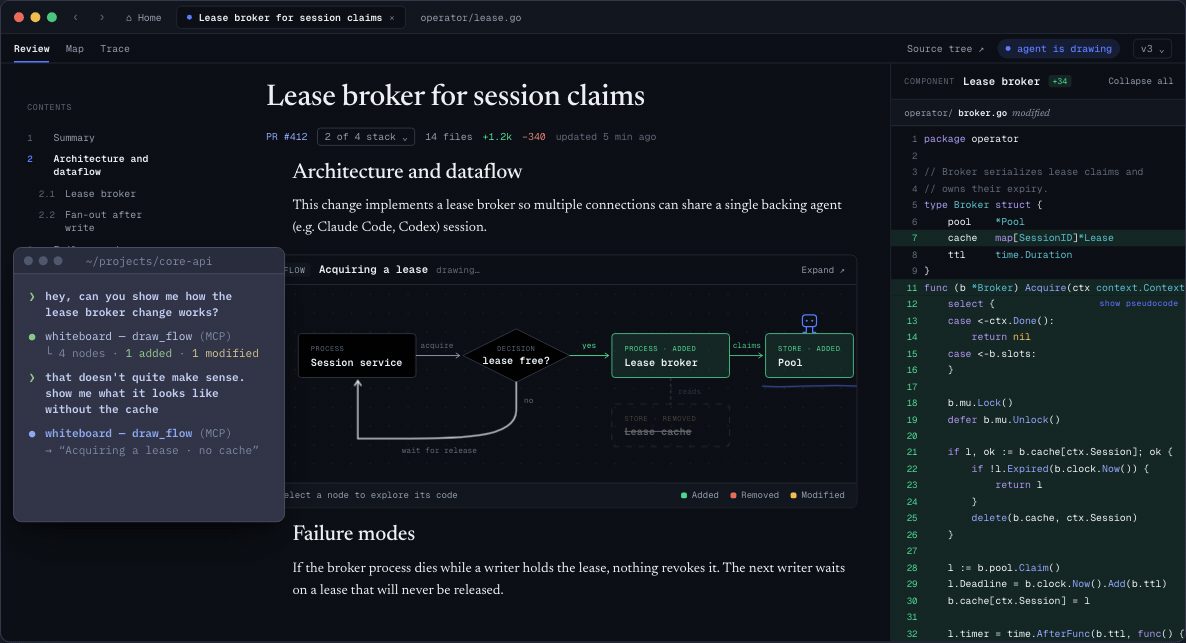
Whiteboard plugs into tools developers already run, among them Claude Code and Codex. The agent receives an SDK that lets it draw on the in-app canvas: flow diagrams, sequence diagrams and entity-relationship diagrams that describe its work next to the code it changed. A one-minute demo video walks through the loop.
The workflow is short: download the app, connect an agent from the welcome screen, then ask it to review the current branch against an up-to-date main and open the result on the board. According to the documentation, Whiteboard works best with models such as GPT-6 Sol and Claude Opus 5.5.
A semantic diff viewer written in Rust
The most technical part of the project is its diff viewer, written in Rust and aware of the abstract syntax tree rather than only of individual lines. Large added functions are summarized as pseudocode, while changes to unit tests and documentation are collapsed or hidden by default. A WASM-based plugin system lets teams change the rules.
Clicking an element of a diagram jumps to the underlying code in the same window. The editor is based on a fork of Code OSS, so VS Code keybindings and language-server support work out of the box. The README notes that roughly 45% of today's stock VS Code codebase is Copilot, which is why the authors vendor the editor rather than patch it.
Decision log and limitations
Auditing autonomous agent work after the fact is hard, so Whiteboard gives agents tools to query and link their own traces on the canvas. A team can then see the requirements it set, how they were implemented and which decisions the agent took on its own.
Not everything is finished. Files cannot be edited inside Whiteboard yet, reviewing several repositories at once is poorly supported, and shared reviews do not receive updates made after the link is sent. Anonymous telemetry excludes code, diffs, prompts and model output, and can be switched off. A hosted product for teams is planned, but the README promises the project will always remain self-hostable.
SiTech — AI-powered web development
We build fast, modern websites and bring AI into real business workflows. Have a project or a question? We'd love to help.