
File-notification systems leak user behaviour on Linux, Android, Windows and macOS
Researchers at Graz University of Technology show that the file-notification subsystems of Linux, Android, Windows and macOS work as a side channel: with read permission alone, an app can reconstruct another user's behaviour.
Researchers at Graz University of Technology in Austria have shown that the file-notification subsystems of Linux, Android, Windows and macOS act as a side channel: with read permission alone, an application can reconstruct another user's activity. The paper was accepted at ACM CCS 2026.
Notifications as a side channel
These subsystems tell applications when a file is opened, closed, written or deleted: inotify on Linux, FileObserver on Android, ReadDirectoryChangesW on Windows, File System Events on macOS. File contents stay unknown, but the event stream alone leaks user, system and application behaviour, and sometimes the existence of files that were otherwise hidden.
What leaks on each platform
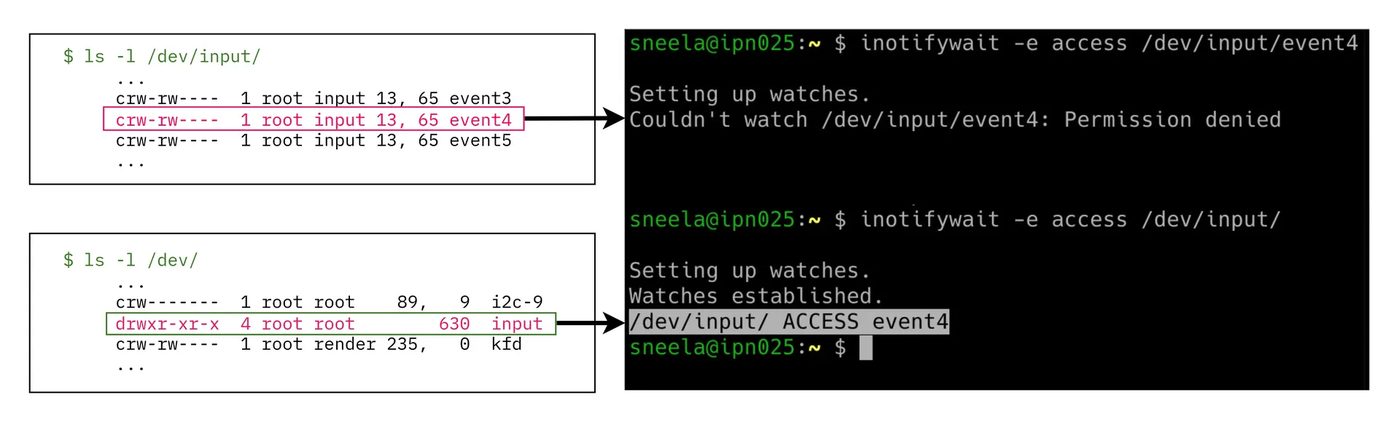
On Linux, watching a file without read permission fails, but watching its readable parent directory reports every event on the files inside. The most severe case is /dev/input: the key is not revealed, only that one was pressed, which two decades of inter-keystroke timing research show to be revealing.
Under Wayland on KDE Plasma, a process in the same user session watches /usr/bin/pkexec to detect polkit prompts, then draws a fake password window over the real dialogue; KDE says focus-stealing prevention is not a security feature.
On Android, FileObserver bypasses the FUSE layer that isolates app storage, so an app without permissions can watch WhatsApp's private folder and receives events with file names. Incoming media shows up as a MOVED_TO event about 100 ms after decryption, revealing the media type and its time.
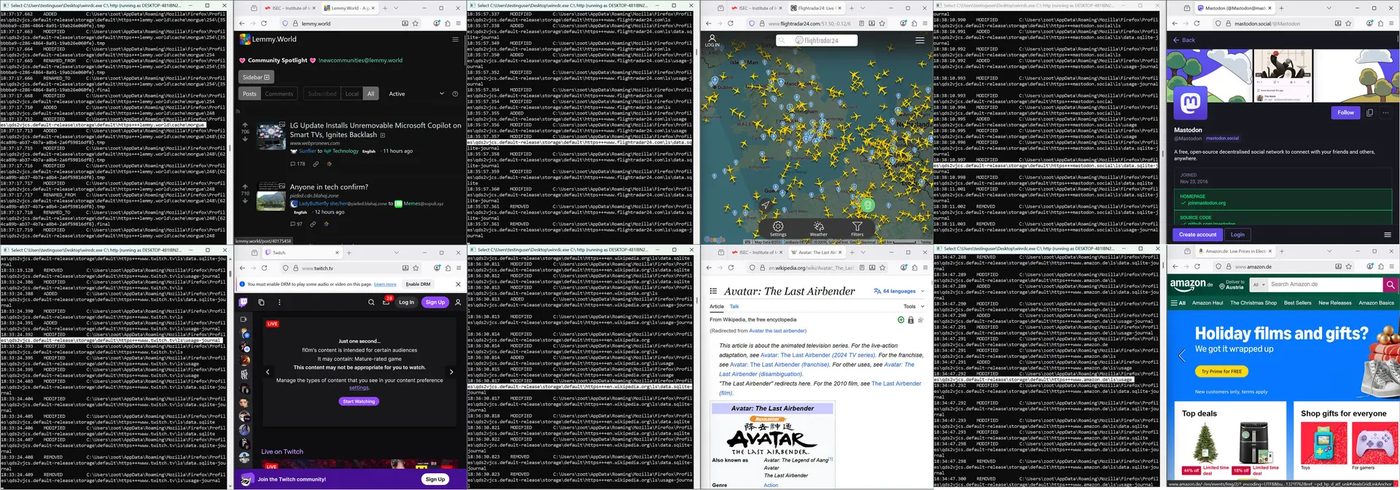
On Windows, watching the root directory C:\ bypasses permission checks and reports the full path of every file touched anywhere on the system, across users; Microsoft called this an undocumented feature. On Firefox the team monitored the top 1000 websites with an F1 score of 97.8 percent. macOS exposes the least.
Fixes and status
The Linux issue became CVE-2025-68788 and was partially mitigated in December 2025: the patch stops access and modify events on special files. Microsoft's registry policy EnforceDirectoryChangeNotificationPermissionCheck mitigates the Windows behaviour but is off by default, so the attacks work on stock systems; Android and macOS have no fix. The attacks need a local cross-user attacker, such as a compromised service, and the authors report no exploitation in the wild; proof-of-concept code is on GitHub.
SiTech — AI-powered web development
We build fast, modern websites and bring AI into real business workflows. Have a project or a question? We'd love to help.