Amazon Uncovers AI Agent Campaign Targeting LiteLLM and Dify for API Keys
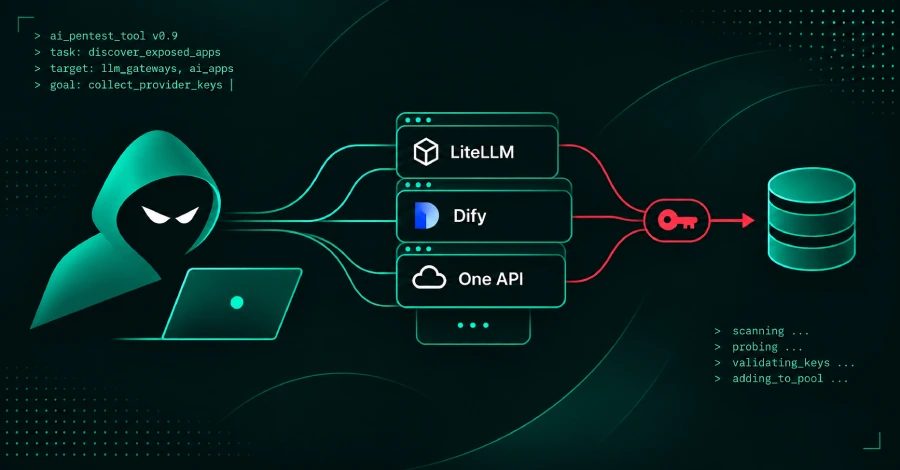
Amazon's threat intelligence team recorded AI agents that appear to run on the open-source penetration testing tool ARTEX hunting exposed AI applications such as LiteLLM and Dify, stealing provider keys and pooling them for reuse. It assesses with moderate confidence that separate China-linked groups were behind the campaign.
Amazon's threat intelligence team has uncovered a campaign in which AI agents systematically scanned internet-exposed AI applications to steal provider API keys. The agents, believed to run on the open-source penetration testing tool ARTEX, targeted platforms including LiteLLM, Dify, One API, Langflow, and RAGFlow, extracting stored credentials and adding them to a shared pool for reuse.
Campaign Details
The agents operated from October 3 through late last week, sending requests to decoy servers in Amazon's MadPot network that posed as popular LLM services. Captured records show the agents followed a playbook of known entry points, exploiting default administrator credentials, unfinished installations, authentication bypasses, and server-side request forgery vulnerabilities. The team assessed with moderate confidence that the operators were separate China-linked groups, citing Simplified Chinese prompts and China time zone settings.
When the agents found cloud credentials, they prioritized managed services hosting AI models and secret stores, focusing on premium AI models over general cloud access. They also used internet scanning services, certificate transparency logs, GitHub repositories, package registries, container images, and paste sites to locate leaked keys. Microsoft recently reported similar agentic AI tools being used for GitHub secret hunting, and the FBI issued a FLASH alert noting ARTEX use since at least August across multiple sectors worldwide.
Vulnerabilities Exploited
The playbook includes several known flaws: Langflow CVE-2025-3248, a missing authentication issue allowing remote code execution in versions before 1.3.0, which CISA added to its Known Exploited Vulnerabilities catalog in May 2025; RAGFlow CVE-2026-28797, a server-side template injection requiring a registered account with self-registration enabled by default, with a sandbox fix released in version 0.25.0; and an authentication bypass via the isCliRequest header in One API family systems, for which no affected versions or fix were named. Other entries cover secrets left in client-side JavaScript, source maps, debug routes, and environment files.
Defender Recommendations
Amazon's team recommends treating AI apps, model gateways, and inference endpoints like other production systems. Defenders should change default credentials such as LiteLLM's master key, avoid leaving new installations unfinished, scan configuration files and CI/CD pipelines for embedded secrets, rotate exposed credentials quickly, set expiry dates and IP restrictions on Cloudflare API tokens, and monitor for Cloudflare Worker scripts named artex-* and related patterns. The team also advises checking logs for indicator IP addresses published with the decoy findings and for addresses linked to ARTEX by Cisco Talos researchers.
Sources: The Hacker News
SiTech — AI-powered web development
We build fast, modern websites and bring AI into real business workflows. Have a project or a question? We'd love to help.